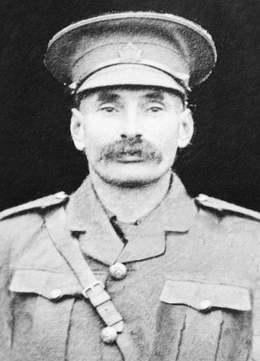
Captain Frederick William Campbell VC was born in Ormandie Township, just outside Mount Forest, Ontario on 15 June 1869. Only son of Ephraim B. and Esther A. Hunt Campbell, of Mount Forest; husband of Margaret Annie Campbell, of Mount Forest, Ontario. He served in the Boer War with the 2nd (Special Service) Battalion, The Royal Canadian Regiment, and awarded South African Medal with four bars of distinction.
At the beginning of the Great War he was a Captain in the 30th Wellington Rifles (Militia) located in Mount Forest and commissioned as Lieutenant, serving with the 1st Battalion, C.E.F.

Captain James Britton Corley, 50th Battalion, wounded twice during the Great War. He survived and returned to Canada in January 1919.
France
When the call came, Lieutenant Campbell wasted no time enlisting on 23 September 1914. Then, Lieutenant Campbell embarked for France on 9 February 1915, arriving at St. Nazaire on 12 February. By train, his unit traveled to Strazelle, Belgium and marched to billets in Merris. Finally, on the 18th, the unit is in Armentieres for training, and back to Merris on the 24th.
The unit first enters the trenches at Fleurbaix on the last day of February 1915. Casualties begin on their second day in action. Many of the casualties in the 1st Battalion of this time found in Y-Farm Military Cemetery, Bois-Grenier where the first actions of the Canadian contingent took place.
The Battle of Kitchener’s Wood
The 1st Battalion inspected by the G.O.C. for the first time at Oudeeele on 9 April 1915, with most of early April spent in training, the unit entrenches again at the Yser Canal, in order to attack Pilkem Village on 23 April 1915. On the same day, Campbell to be Temporary Captain.
The unit remains entrenched however, and attacks at St. Julien on 25 April 1915 (the first day of the Second Battle of Ypres – The Battle of Kitchener’s Wood). Then, the unit withdraws after four days of constant action and moves to billets in Vlamertinghe in the morning of 29 April.

The Canadian Corps withdrawn and re-enters the theatre at Festubert on 22 May 1915, with the 1st Battalion entrenched in the afternoon. Then, relived by the 2nd Battalion on night of 28/29 May and move to Bethune. Resting in billets, provided with a couple of exceptional days for bathing on 2 – 3 June, and later proceed to trenches near Givenchy.
The 1st Battalion exchange their Ross Rifles for Lee-Enfields on 13 June, and prepare for action on the 15th.

Givenchy
Captain Frederick William Campbell the machine gun officer with his Battalion when the attack made on Givenchy, 15 June 1915. Entering the battle, the 1st Battalion armed with eight Colt machine-gun crews. Six of the crews put out of action. Advancing with two crews, in short time, only one machine-gun crew operational, Campbell’s depleted crew. Proceeding through the German trench, soon, only Campbell and Private Howard Vincent are the only members of the crew uninjured.

Second German Line
At 6 p.m., the forward Company reaches the second German line. The position is untenable owing to their exposed flanks. Before they withdraw, Captain Frederick William Campbell orders Private Howard Vincent 6861 to accompany him along with 1,000 rounds.

Third German Line
Then, they head to the third German line, where Captain Frederick William Campbell sets up his machine-gun on the back of Private Vincent. Vincent a strong lumberjack before the Great War.

Their heroic action covers the withdrawal of the 1st Battalion. The initial German counter-attack repulsed by this one machine gun. The second German counter-attack gains a foothold in the very trench of Campbell and Vincent. They are forced to withdraw.

Wounded
While doing this, Captain Frederick William Campbell wounded by machine gun bullets which practically severed his leg (compound fracture of his femur). Vincent immediately applies a tourniquet, and unable to continue, Campbell orders Vincent to bring the machine-gun back to the battalion at the second line.
Strapping the remaining unspent rounds to his back, Vincent then straps the red-hot machine-gun to his back. He begins to crawl back to the second line. Then, after his departure, Campbell begins dragging himself back to the second line.

Stretcher-Bearer Party
Vincent arrives at the second line, passing the word Captain Frederick William Campbell has been seriously wounded. Then, a stretcher-bearer detachment sent forward for Campbell, and found not far from the third line. Company-Sergeant-Major Arthur Evan Owens 6873 one of the two stretcher-bearers. Miraculously, all three men return, and Campbell admitted to the forward Regimental Aid Station.

Frederick given first aid by Capt. Gordon, the regimental Chaplain, also of Mount Forest. Capt. Gordon assisted by Private William George Seim, 2nd Battalion, another man from Mount Forest (Seim would rise to the rank of Sergeant).

Boulogne
Captain Frederick William Campbell admitted No.1 Canadian Field Ambulance, 15 June 1916, to No. 4 C.C.S. Entrained 16 June 1915 for Boulogne.

Four days after the battle, Captain Frederick William Campbell died of wounds, at No. 2 Stationary Hospital, Boulogne, 19 June 1915. His promotion to Captain posthumous, as well, his Victoria Cross medal.
Boulogne Eastern Cemetery

Victoria Cross Citation
“For most conspicuous bravery on 15th June, 1915, during the action at Givenchy. Lieutenant Campbell took two machine-guns over the parapet, arrived at the German first line with one gun, and maintained his position there, under very heavy rifle, machine-gun, and bomb fire, notwithstanding the fact that almost the whole of his detachment had then been killed or wounded. When our supply of bombs had become exhausted, this Officer advanced his gun still further to an exposed position, and, by firing about 1,000 rounds, succeeded in holding back the enemy’s counter-attack. This very gallant Officer was subsequently wounded, and has since died.”

(London Gazette, No. 29272, 23 August 1915)
Mrs. Margaret Annie Campbell
Mrs. Margaret Annie Campbell, while awaiting the Victoria Cross, stated, His son will wear it now. My husband has served his country in this war and Africa. He has given his life. We are bereft. We have lost a husband and father who was as truly noble in his everyday life as he was when fighting for his country. I think (her voice faltered) I think that now our boy has earned the right to wear that cross when it does come. Campbell’s mother died subsequently, therefore two Memorial Crosses went to the widow, 13 November 1920.
Origin of VC to the Lord Ashcroft collection: Purchased privately, 2017. Other than the Canadian War Museum, CEFRG condones only the purchasing of medals by Michael Anthony Ashcroft, Baron Ashcroft, KCMG, PC.

Current location of VC: Displayed on rotation at The Lord Ashcroft Gallery: Extraordinary Heroes exhibition, Imperial War Museum
Private Howard Vincent
Private Howard Vincent awarded the DCM for his role in the attack. Vincent bore the machine-gun which Frederick fired on his very back, as their tripod carrier wounded. Private Vincent discharged in 1916, and returned to Toronto in January 1917. His wife had died while he was in France. Severe sciatica leaving him partially disabled. Vincent remarried, and, with his family, attended the unveiling of the Mount Forest Cenotaph in 1928. He died 17 May 1939.
Private William George Seim
Private William George Seim returned to Canada in 28 June 1919 on H.M.T. MAURETANIA.
VCs
Lieutenant-Colonel William Hew Clark-Kennedy VC in the Great War
Captain Bellenden Seymour Hutcheson VC, MC, in the Great War
Please subscribe to CEFRG to be notified by email when there are new posts. Subscription is free, and your email kept confidential.