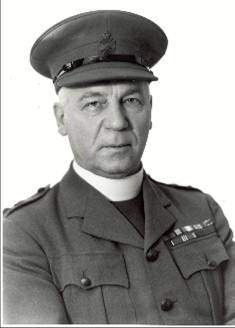
The Right Reverend George Anderson Wells, CMG, DD was the second Bishop of Cariboo. Wells was a fisherman, sealer, labourer, and a trooper in the South African War before continuing his education at various American institutions. During the Great War, appointed Senior Chaplain to the Canadian Corps on 27 December 1917.
Early Life
Born at Clarke’s Beach, Newfoundland on 18 November 1877. Son of William John Wells and Cicely Mary Spooner. Firstly, Wells served with British forces in South Africa from 1901 to 1902. Then he came to Manitoba in 1903 and was educated at Winnipeg’s St. John’s College, receiving a BA degree. He later received an MA degree from the University of Chicago.
He was ordained an Anglican deacon in 1910. In September 1910, he married Charlotte McDonnell of Montreal. Then he was ordained a priest in 1911. While living in Manitoba, he was a member of the AF & AM (Prince of Wales Lodge, Minnedosa).
Enlistment
George Anderson Wells stood 6′ tall, 175 pounds with good physical development. Enlisted in August 1914, and joined the 6th Battalion, Fort Garrys as Chaplain, 24 September 1914.

Examined on SS LAPLAND, 11 October 1914. Then, in England, he worked at the Second Canadian Stationary Hospital and was Senior Chaplain of Shorncliffe, 5th Division, Witley.
To France
Chaplain Wells went to France with the Second Canadian Division. Commanding Officer, No. 2 Canadian Stationary Hospital, Le Touquet from 24 January 1915. Then, granted leave to England from 11 September 1915 to 9 October 1915. However, transferred to England, 8 November 1915.

To be Honorary Major George Anderson Wells, 1 March 1916, London Gazette No. 30065. In addition, Major George Anderson Wells appointed Senior Chaplain, Shorncliffe on the same day. Then, detailed for duty with 53rd Reserve Battalion from 15 June 1916 to 22 June 1916.
Major George A Wells W.O. List
Brought to the notice of the Secretary of War for valuable services rendered in connection with the War, W.O. List, 24 February 1917. Then, Major George Anderson Wells appointed Chaplain to the 5th Canadian Division, Witley Camp, 28 May 1917.
Operation
Major George Anderson Wells operated on at Moore Barracks Hospital, 6 July for hemorrhoids. Discharged 11 July 1917, still suffering from the effects of the operation. However, a short leave of absence to recuperate required.
Major George Anderson Wells S.o.S. on proceeding overseas, 31 October 1917. Disembarked SS ARAGUAYA Boulogne, 14 December 1917. Then, posted to 2nd Canadian Division HQ as Senior Chaplain.

Major George A Wells CBG
To be a Companion of The Order of St. Michael and St. George, London Gazette, No. 30450, 1 January 1918.
Admitted No. 4 Canadian Field Ambulance, Dermatitis left leg, 4 February 1918. Then on sick leave, 4 – 8 February 1918, UK. And finally admitted No.8 Michelham Convalescent Hospital, Menton, 15 February 1918.
Mentioned in Despatches
Mentioned in Despatches, London Gazette No. 30612, 12 February 1918. Then, rejoined the 2nd Canadian Division, 8 March 1918. Finally, granted 14 days leave, 6 September 1918, returning 5 November 1918.

Major George Anderson Wells attached to the 2nd Canadian Division during the March to the Rhine in December of 1918.
Mentioned in Despatches
Major George Anderson Wells Mentioned in Despatches, London Gazette No. 31009, 31 December 1918.

Following his participation in the Allied Occupation of Germany, Wells granted 14 days leave to the UK on 10 January 1919. He returned from leave on 28 February 1919. Wells remained with the 2nd Canadian Division in France until 16 April 1919, when he proceed to England for the last time. Then, Wells in charge of demobilization of chaplains at Witley Camp, England until September 1919. Then, to be Honorary Lieutenant-Colonel George Anderson Wells, London Gazette No. 31353, 5 April 1919.
Mentioned in Despatches
Mentioned in Despatches, London Gazette No. 31448, 11 July 1919.
Discharge
Returning to Canada after his military discharge, he served successively as Rector at Minnedosa, St. Luke’s (Victoria). Then, at Saint Margaret’s (Winnipeg); Warden of St. John’s College. Later, Examining Chaplain to the Archbishop of Rupert’s Land (Winnipeg). In addition, Lecturer in religious education and Biblical Greek at St. John’s College. Finally, in 1934, he became Bishop of the Cariboo diocese.
Second World War
Major George Anderson Wells served once again in the Second World War. From his home in Victoria, through high-ranking Militia contacts, Wells offered to serve in any capacity that was needed. In September 1939, on his way to Ottawa, with his Great War files in hand, in order to re-establish the Chaplain Service. Finally, arriving at HQ, the Bishop of the Diocese of Cariboo, the most decorated chaplain in the British Commonwealth. In addition, promoted Honorary Brigadier George Anderson Wells.
Later Life
Assistant Bishop to the Bishop of Toronto from 1946 to 1951. He died at Toronto, Ontario on 10 April 1964.

More
Bishop Michael Francis Fallon in the Great War
Honorary Captain Charles Valentine Lester in the Great War
Honorary Captain William Henry Davis MC in the Great War
Please subscribe to CEFRG to be notified by email when there are new posts. Subscription is free, and your email kept confidential.