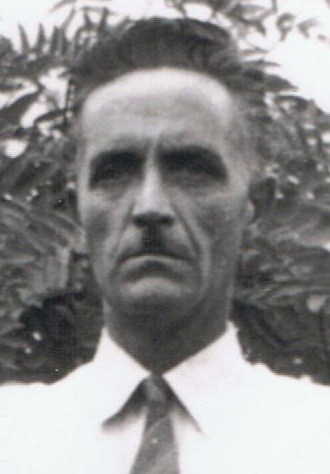
Private Everett Clarence Melvin Marshall 748698 of the 5th Canadian Mounted Rifles. Born on September 24, 1896, in Inverness, Quebec, his father, Herbert, was 27 and his mother, May, was 20. He was a farmer.
Service
Private Everett Clarence Marshall 748698 enlisted with ‘B’ Co., 117th Eastern Townships Overseas Battalion, CEF. At Inverness on 22 February 1916. At the time, he stood 5′ 9″ tall, 140 pounds, with dark complexion, grey eyes and black hair. Everett and his unidentified friend in this photo taken at a local studio while training.

To England
Everett sailed from Halifax, 14 September 1916 per SS EMPRESS OF BRITAIN. However, the original men of the 5th C.M.R. had boarded SS HESPERIAN from Quebec on 18 July 1915.

Private Marshall transferred to 5th CMR at Seaford Camp, on 1 December 1916.

Private Marshall spending only a week at Seaford Camp before he T.o.S. in the field, near Étrun, 8 December 1916. Étrun a commune in the Pas-de-Calais department, just north-west of Arras, in the Hauts-de-France region of France.
Lance-Corporal Gordon John McNamara
During Everett’s first experience in the trenches, on 11 December 1916, Lance-Corporal Gordon John McNamara 415151 killed instantly by shrapnel. Death a great loss to Battalion. McNamara recommended for VC for bravery at THE BLUFF for which he eventually received the DCM.
A splendid soldier, son of Thomas and Annie McNamara, of Evanston, Nova Scotia; husband of Ethel McNamara, of Hespeler, Ontario.

Buried at Louez Military Cemetery, Plot I, Row H, Grave 12 at 11 am on 12 December, Father Labonte officiating. Louez Military Cemetery is 4 kilometres north-west of Arras and 1 kilometer north of the main road from Arras to St Pol.
Battle of Vimy Ridge
Battalion in billets at Woodman Camp near Villers-au-Bois on 12 April 1917 following Battle of Vimy Ridge. Private Marshall admitted to No.1 Convalescent Hospital, Boulogne, Bronchitis, 13 April 1917, and later discharged 26 April 1917. Finally, to No.10 Convalescent Depot, Écault, and Everett discharged on 24 May 1917.
Private Marshall arrived at the 3rd Entrenching Battalion, on 12 June 1917. After a summer in working parties with the 3rd Entrenching Battalion, finally, Everett sent to Canadian Corps Reinforcement Camp, 23 September 1917, preparing to head back to the trenches.
Battle of Passchendaele
Private Marshall rejoined the 5th C.M.R., on 10 November 1917. Arriving at his unit on the day they are congratulated for having reached their objectives (Valour and Vapour Trenches) during the Battle of Passchendaele. Fortunately, for Everett, he had missed the big show. Then, granted 14 days leave to UK, 25 December 1917, returning from leave 12 January 1918.

Major George Pearkes, 5th Canadian Mounted Rifles, photographed wearing the Military Cross service ribbon. Has not yet received the ribbon for the Victoria Cross, awarded due to his personal bravery, and masterly command decisions capturing and holding enemy strongpoints during the Battle of Passchendaele. Finally, notice, Pearkes wearing 4 wound stripes on his sleeve.
Lt. William Rider-Rider captured MIKAN No. 3403382 of Captain H.H. Pineo’s grave on the second anniversary of his funeral.

Battle of Amiens


Demobilization
Private Marshall caught up with his unit at Wattrelos, Pas-de-Calais. Then, on 18 January 1919, Sir Arthur Currie gave a very brief procedure for demobilization to the 8th Brigade. Bad news for Everett, the 3rd and 4th Canadian Divisions returning home first (the 5th CMR in the 8th Brigade of the 3rd Division).

Currie’s hurried visit no doubt scheduled by his longer visits to Brigades of the 1st and 2nd Canadian Divisions. Later, it would be the men of the first divisions returning home responsible for thirteen demobilization riots in England.

The 5th CMR left Wattrelos on 7 February 1919, headed for England. Then, Le Havre reached on the 11th, and Bramshott Camp entered on 15 February 1919. Colours presented at Bramshott in March 1919 by Sir George Perley on behalf of people of the Eastern Townships.
Finally, Private Marshall S.o.S. to Canada, from Liverpool, 8 March 1919. Then, demobilized at Dispersal Station ‘F’, Military District No.4, Montreal on 19 March 1919. In addition, the Colours of the 5th C.M.R. deposited in St.Peter’s Church, Sherbrooke on 6 April 1919.
Later Life
Everett married Emma ‘Bertha’ Henderson on June 23, 1920, in Thetford Mines, Quebec. They had five children in 11 years. He worked for some time at the Don Jail, in Toronto, Ontario.

At Soldier’s Memorial Hospital, in Orillia, Ontario, Everett Clarence Melvin Marshall died on October 14, 1973. He was 77 years of age.

This CEFRG post was suggested by the maternal granddaughter of Everett Marshall, Elsie Johnson.
More
Captain William Henry Davis MC in the Great War

Signaller Guy Wray Garrett in the Great War

Contac CEFRG


Please subscribe to CEFRG to be notified by email when there are new posts. Subscription is free, and your email kept confidential.