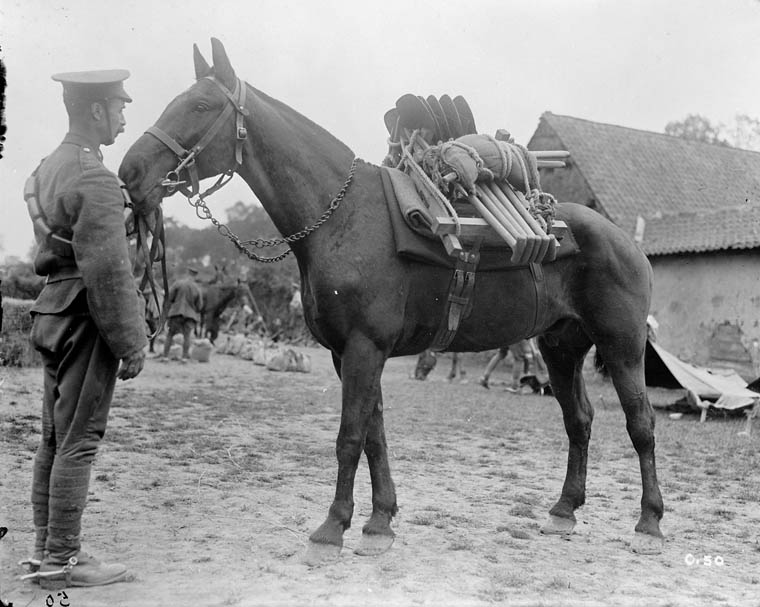
Fort Garry Horse
Private Ambrose Hancock son of Emily Hancock of Spreyton, Devon, England. Born 8th January 1891. He had a brother William, and sister Ada.
Private Ambrose Hancock’s Service
Enlisted 17th January 1916 in Winnipeg, Manitoba with the 34th Fort Garry Horse, 3rd Royal Dragoons. He was a farmer, and stood 5’7″ tall, 140 pounds. Before enlisting, Private Ambrose Hancock had two years prior service with 9th County London Territorials.

The Regiment entrained at Shorncliffe aboard five trains and proceeded to South Hampton, 24 February 1916. Arrived in le Havre on 25 February and proceeded to St. Elimont on 28 February. However, Squadron training commenced and continued for months.
In April, Private Ambrose Hancock inoculated for Typhoid in England. Meanwhile, the Regiment moved to Daours in July 1916, and Ambrose completes his will on 24 July, leaving everything to his sister, Miss Ida Hancock of 16 South John Street, Adelphi Strand, London. Private Ambrose Hancock left for his unit on 14 August 1916, joining them in Neslette. Exercises continued in Soues during October.

Death of Private Ambrose Hancock
Killed-in-Action by shellfire, 2 January 1917. At about five o’clock in the morning of January 2nd, 1917, whilst in a dugout near Friaucourt, Hancock instantly killed by an enemy shell. However, the HQ of the Fort Garry Horse was in Friaucourt, far from the front lines. Private Ambrose Hancock actually killed in the vicinity of Combles, on the Somme.

The village of Combles entered in the early morning of the 26th August, 1916, by units of the 56th (London) Division and of the French Army; and it remained in Allied occupation until the 24th March, 1918, when captured after a stubborn stand by the South African Brigade at Marrieres Wood. At last, retaken on the 29th August, 1918, by the 18th Division.

Combles Communal Cemetery Extension
The large village of Combles is 16 kilometres east of Albert and 13 kilometres south of Bapaume. The Communal Cemetery is on the right just before the village, and the extension is at the back, or north-east, of the Communal Cemetery.
The village later adopted, with Flers, by the County Borough of Portsmouth. Firstly, the cemetery begun in October, 1916 by French troops, but the 94 French graves made in 1916 removed to another cemetery. Then, the first British burials took place in December, 1916. From March, 1917, to the end of May, 1918, the Extension not used. In June, July and August, 194 German soldiers buried in Plot I, but these graves, also removed; and in August and September further burials made by the 18th Division. Finally, Plots II, V, VI and VII and most of Plot IV added after the Armistice by the concentration of 944 graves from the battlefields in the neighbourhood and from smaller cemeteries.

Over 1,500 Great War casualties commemorated in this site. However, of these, over half unidentified and special memorials erected to nine soldiers from the United Kingdom and one from South Africa, known or believed buried among them. In addition, other special memorials record the names of three soldiers from the United Kingdom, buried in Maurepas and Longtree Dump Military Cemeteries, whose graves destroyed by shell fire. Finally, the Extension covers an area of 5,356 square meters, enclosed by brick walls on the North-East and South-West.
Please subscribe to CEFRG to be notified by email when there are new posts. Subscription is free, and your email kept confidential.