CEFRG.ca

Category: Soldiers

Between 1914 and 1919, over 650,000 Canadians served at home and overseas during the Great War. On the Western Front in Belgium and France, Canadian soldiers of the Great War distinguished themselves in numerous battles, including Second Battle of Ypres, Battle of Vimy Ridge, and Second Battle of Passchendaele. In Canada’s Last Hundred Days of the Great War, Canadian soldiers at the sharp end of the spear breaking through the enemy’s formidable trench defences, the Hindenburg Line. Their efforts have inspired these soldier stories.

Collections

Many collections used to bring the soldier stories to life. First, and foremost, the Personnel Records of the soldiers serving in the Canadian Expeditionary Force (CEF). This collection, like the others to follow, digitized and made available by Library and Archives Canada (LAC). Secondly, the War Diaries of the CEF often provide vital information about a soldier’s life not contained in their service file. Finally, Circumstances of Death (CoD), War Graves Registers (GRRF), and Veterans Death Cards provide further information on The Fallen. These three collections in conjunction with records of the Commonwealth War Graves Commission (CWGC) vital to cases of identification and recovery of The Missing.

Courts Martial Records (FGCM)

Additional collections used to present the soldier stories include Courts Martial Records. Courts martial had the authority to try a wide range of military offences that resembled civilian crimes like fraud, theft or perjury. Others, like desertion and cowardice – purely military crimes. Records of individual courts martial consist of an average of 20 to 25 documents, mainly standardized forms. These document the trial and the charges under the Army Act.

MIKAN photo collection

Finally, the most powerful way of bringing soldier stories of the Great War to life, the images of the MIKAN collection digitized by LAC.  Often complementing these photos – images held by the Imperial War Museum (IWM), some of which also contain images captured by the Official Canadian War Photographers (CWRO) during the Great War. Both LAC and IWM have film collections which further bring the reality of the soldier stories of the Great War to life.

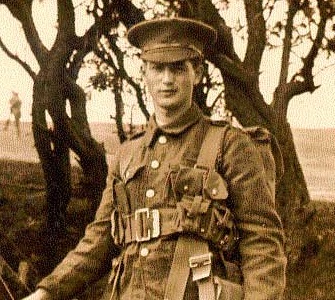
  • Lance Corporal Edward Alphonse Ayre in the Great War

    Lance Corporal Edward Alphonse Ayre in the Great War

    Lance Corporal Edward ‘Ted’ Alphonse Ayre 1009 Royal Newfoundland Regiment enlisted on 29 January 1915 at St. John’s, Newfoundland. His mother, Mrs. Selina Ayre of Channell, Newfoundland had nine children, six living (losing three sons during the war). Ted, a Seaman, standing 5′ 4″ tall, 130 pounds.

    Channel-Port aux Basques
    Channel-Port aux Basques
    Lance Corporal Edward Alphonse Ayre
    Lance Corporal Ayre

    Enlistment

    Lance Corporal Edward Alphonse Ayre left Newfoundland aboard T.S. Stephaus 20 March 1915. Transferred to T.S. ORDUNA 22 March 1915, landing 30 March 1915 at Edinbourg Castle.

    Hawick
    High Street, Hawick post card

    Disembarked Alexandria, Egypt, 1 September 1915. Embarked for Gallipoli, 13 September 1915.

    Lance Corporal Edward Alphonse Ayre
    Lance Corporal E A Ayre
    RMS MEGANTIC
    RMS MEGANTIC postcard

    Embarked Port of Suez, 4 March 1916. Disembarked at Marseilles 22 March 1916.

    The Girl He Left Behind

    Attached to the Virtual memorial listing are a series of images, some of them are postcards that Edward sent to the love of his life, Maud McNiven.

    Maud McNivens
    Maud McNiven

    There is a photo of Maud and one of Edward with his best friend, Maud’s brother. Tragically both boys would be killed in action on 1 July 1916.

    Lance Corporal Edward Alphonse Ayre
    Picture of Edward (right) and his friend, Private William McNiven (left)

    Thank you to Fred Pafford of Wesleyville, Newfoundland for sharing these images.

    Maud McNivens
    Post Card
    Lance Corporal Edward Alphonse Ayre
    Loving Hearts

    The soldier records show that Edward (Ted) survived the Gallipoli campaign ( Sept ’15 – Feb ’16) and landed in France in March 1916.

    THE GIRL HE LEFT BEHIND
    SS PORTIGINARE
    Lance Corporal Edward Alphonse Ayre
    Lance Corporal Edward Alphonse Ayre

    Lance Corporal Edward Alphonse Ayre’s Last Will and Testament

    Lance Corporal Edward Alphonse Ayre Last Will and Testament
    Last Will and Testament

    The Battle of the Somme

    At dawn on 1 July 1916 the Newfoundland Regiment waited in St John’s Road Trench for the leading assault battalions to take the forward German lines, after which they were to continue beyond Beaumont Hamel onto the Beaucourt ridge. An hour after zero hour ordered to move forward in conjunction with the 1st Essex and occupy the enemy’s first trench. Communication trenches blocked with wounded, the battalion deployed directly from this trench, moving across ground out of the direct sight of most of the German defenders. However, the Essex Regiment on their right under observation from Thiepval and obliged to use the communication trenches, so they were unable to get into position until about an hour later.

    1 July 1916. CEFRG

    The Newfoundland Regiment on their own. As they advanced, silhouetted over the ridgeline, making them a clear target for the German machine gunners and riflemen. Proceeding through gaps cut in the British wire, these gaps identified by the Germans and targeted accordingly. At this stage the battalion the only troops moving on this part of the battlefield and thus the principal target of the German artillery and infantry. The Danger Tree marked the furthest point of their advance.

    Lance Corporal Ayre’s badly mutilated body found and buried east of Y Ravine at 57d.Q.10.d in No Man’s Land on 23 April 1917.

    Lance Corporal Edward Alphonse Ayre, 12 August 2019. CEFRG
    Lance Corporal Edward Alphonse Ayre, 12 August 2019. CEFRG

    Y Ravine Cemetery

    Using the D919 from Arras to Amiens you will drive through the villages of Bucquoy, Puisieux then Serre Les Puisieux (approximately 20 kilometres south of Arras). On leaving Serre Les Puisieux, 3 kilometres further along the D919, turn left following the signs for Auchonvillers. At the crossroads in the village centre following the signs for Newfoundland Park, Beaumont Hamel. The Y Ravine Cemetery is located within the Park.

    Y Ravine Cemetery at dawn and dusk. CEFRG

    More

    Please subscribe to CEFRG to be notified by email when there are new posts. Subscription is free, and your email kept confidential.