Major Edward Lewin Knight born 23 April 1882 in Collingwood, Ontario. Married to Margaret Allan Knight. Edward had been Superintendent of Bridge and Highway construction in Simcoe County.

Enlistment
Prior to the Great War, Major Edward Lewin Knight had previous military service with 35th Regiment, Simcoe Foresters, 2nd Canadian Mounted Rifles and, 9th Mississauga Horse. At this time, he stood 6′ tall, with dark complexion, grey eyes and dark hair a month shy of his 34th birthday.

Eaton Motor Machine Gun Battery
Initially organized in January 1915 under the command of Major William James Morrison. At this time, Sir John Eaton subscribed $100,000 for the purchase of quick-firing machine guns mounted on armoured trucks – this paid for fifteen and the government supplied twenty-five. Mobilized at Toronto, recruited mainly in Toronto, also appealed to motor mechanics, drivers and athletes. Left Montreal 4 June 1915 aboard SS METAGAMA, and later arrived in England on 13 June 1915.

Later, Boyle’s Yukon Motor Machine Gun Battery attached 26 July 1915 with a strength of 24 officers, 264 other ranks. Finally, arrived in France 25 February 1916 with the 3rd Canadian Division. Brigaded with 1st Canadian Motor Machine Gun Brigade and later Borden’s Motor Machine Gun Battery on 12 July 1916. Additionally, absorbed by 2nd Canadian Motor Machine Gun Brigade 8 June 1918. Finally, Colours presented by Parkdale (Toronto) Chapter, IODE, and each man presented with a small Union Jack.
War Diary
Major Edward Lewin Knight began writing the unit war diary in February 1916 in Foklestone, later departing Southampton on 24 February 1916. Then, in billets at Godewaersvelde (France close to the Belgian border) on 29 February 1916. In addition, Knight, one of the least prolific writers of war diaries, often going a week without an entry. Finally, by June 1916, Major Knight slightly more active, but returned to his old ways mid-month (one last entry 30 June 1916).

On 18 April 1916, the battery has two guns in WARRINGTON AVENUE, also four guns at YEOMANRY POST. In addition, usual routine of guns in reserve on 30 April 1916. The first casualty, Private Stanley Walter Platt, shrapnel wound in the leg, 12 May 1916, then followed by Private George Stanley Ball shrapnel wound in arm and shoulder on 30 May 1916. The following day, guns are in Divisional Reserve.

Receiving instruction on Vickers Gun at Poperinghe during July 1916, and more training in August 1916.

Private Raymond Clifford Burton 431142 died 13 June 1916 and later buried at Maple Copse Cemetery. Son of Frank Burton Annie Maude Brown (formerly Burton), of British Columbia. Later the same day, Private John Stammers 648 died and buried at Poelcapelle British Cemetery.
Battle of Flers-Courcelette
On 26 September 1916, Major Knight killed-in-action, at this time, the battery covering attacks on Zollern, Hessian and Regina trenches, near Courcelette.

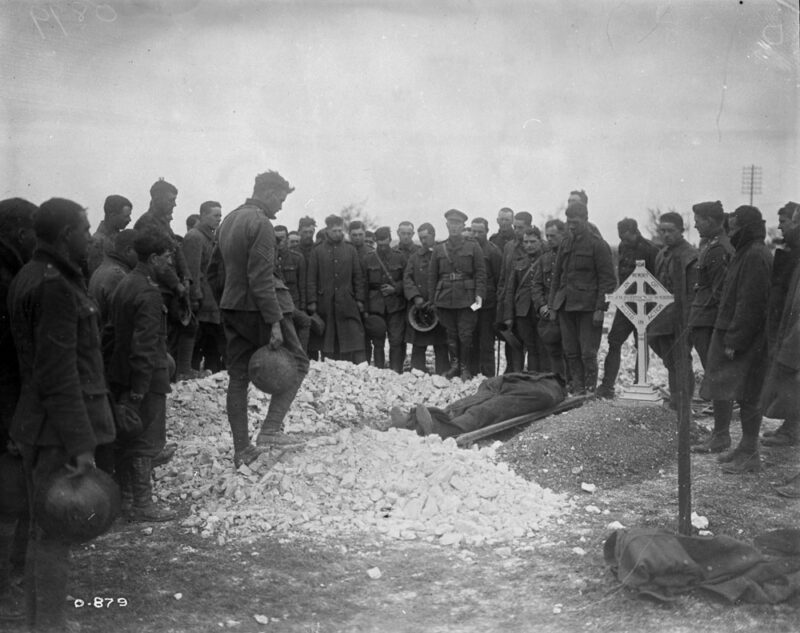
Major Knight and two officers with whom he was conversing killed instantaneously by an enemy high explosive shell, at 3:40 pm on 26 September 1916, while sitting outside the Headquarters dugout, situated about 500 yards North West of Pozieres, near the Cemetery. Furthermore, images from his funeral reveal Major Knight had been decapitated.

Bapaume Post Military Cemetery
Preparing the cross for Major Knight.
Funeral of Major Edward Lewin Knight, Eaton Motor Machine Gun Battery, 28 September 1916.

Officiating chaplain Captain A. P. Shatford at Bapaume Post Military Cemetery.


The existing grave that of Pioneer Joseph William Robinson 430519 of the 3rd Battalion, Canadian Pioneers, died on 22 September 1916.

Funeral of Major Edward Lewin Knight
The grave of Major Knight in Bapaume Post Military Cemetery early in 2017.

More
- Home of CEFRG
- Blog
- CEFRG on FaceBook
- CEFRG on YouTube
- Soldiers and Nursing Sisters
- Units (Brigades, Battalions, Companies)
- War Diary of the 18th Battalion (Blog)
- 116th Battalion CEF – The Great War
- Les Soldats du Québec Morts en Service
- Montreal Aviation Museum
- Battles of the Great War
- Cases
- Cemeteries
- Memorials
- On This Day
- About CEFRG