Private John Dorrian 291602 and brother Jim O’Neill Dorrian 291603 sons of William Dorrian and Lizzie O’Neill, Ballywater County Down, Ireland (married on 11 May 1880 in Newtownards Parish Church of Ireland Church (St Mark’s)).
The Dorrian Family
William Dorrian (aged 21) from Glastry, Ballyhalbert was a son of George Dorrian, a farmer. Lizzie O’Neill (aged 21) from Comber Street, Newtownards was a daughter of James O’Neill, a labourer. The Dorrian family lived in Main Street Ballywalter.

William Dorrian worked as an agricultural labourer and he and Lizzie had at least eleven children: Mary Ann (born 18 December 1881 in Ballywalter, died of bronchitis 21 March 1884 aged 2), George (born 30 May 1884 in Ballywalter, died of tuberculosis in Ballyobegan 12 March 1905 aged 20), Agnes McCance (born 7 October 1886 in Ballywalter), James O’Neill (born 30 January 1889 in Ballywalter), Mary Ann (Minnie, born 20 June 1891 in Glastry) John (born 6 February 1894), William (born 22 August 1896 in Ballyobegan), Lizzie (born 17 September 1899 in Ballyobegan), Samuel (born 26 August 1901 in Springvale; died of influenza 18 July 1918 aged 16), Essie (born 12 October 1903 in Springvale; died 10 November 1940 aged 37), George (born 27 November 1905 in Ballyobegan). All the children baptised in Ballywalter Presbyterian Church.
Enlistment
John Dorrian 291602 enlisted with the 222nd Battalion on 10 February 1916 in Winnipeg. Two days previously, his brother Jim (not James) Dorrian 291603 also enlisted with the 222nd Battalion. Jim born 19 January 1892 in County Down, Ireland. Married to Elizabeth Dorrian, with two children, and a Teamster like John. Jim stood 5′ 7″ tall with medium complexion, blue eyes and brown hair. Jim resided at Suite 12, Waller Block, Norwood, Winnipeg, Manitoba. John born 6 February 1895, also in County Down, he was single, living in Waller Block, Norwood. John stood 5′ 6″ tall with medium complexion, gray eyes and brown hair.
44th Battalion
Organized in February 1915 under the command of Lieutenant-Colonel Edward Robert Wayland. Mobilized at Winnipeg. Recruited in Winnipeg. Then, a draft of 5 officers and 249 other ranks sent to England on 4 September 1915. Once again, a draft of 10 officers and 500 other ranks from 44th and 45th Battalions sent to England on 1 June 1915. Finally, embarked from Halifax 23 October 1915 aboard SS LAPLAND. The 44th Battalion disembarked England 30 October 1915, with a strength of 36 officers, and 1076 other ranks.

France
The Dorrian Brothers disembarked in France 10 August 1916 with the 4th Canadian Division, 10th Canadian Infantry Brigade. Their unit, reinforced by 18th Canadian Reserve Battalion, and returned to England 23 April 1919. Finally, disembarked in Canada 4 June 1919 and demobilized 6 June 1919. In addition, published “Gin Pills” from November 1915 to May 1916 at Bramshott Camp Brass and pipe bands.

Private Jim Dorrian fought on the Western Front and on 10 April 1916 wounded in the chest. Transported to hospital in England where he remained until September 1916.
1917
Battalion sports are played on the afternoon of 9 July 1917, and the Dorrian Brothers assemble with their unit along the route of H.M. the King on 11 July. Then, on 3 August 1917, the 44th Battalion relieves the 47th Battalion at Chateau de la Haie.

Green Crassier
The Dorrian brothers participate in the attack at 03h00 on 23 August 1917. On this day, their company obtained the objective at Green Crassier in only 30 minutes, casualties negligible, owing much to the cover of darkness. Then, moving onto Alpaca Trench, the 44th Battalion’s luck runs out, running into determined resistance, and worse, daylight; their casualties are heavy, as the battalion is very much out-numbered.
Then, they are relieved after two days of action, and fall back to Zouave Valley near Chateau de la Haie, moving there on 30 August.
Battle of Hill 70
Battle of Hill 70, 15 – 20 August 1917 (video). 2nd Canadian Infantry Brigade troops receiving hot tea at a Soup and Tea Kitchen within 1/4 mile of front line on night before attack on Hill 70, 14 August 1917. Canadian leads in a Boche whose nerves have been shattered during our advance on Hill 70, 15 August 1917. In addition, wounded Canadians who took part in capture of Hill 70 leaving Casualty Clearing Station for Blighty. Then, General Sir Arthur Currie watching his men who took Hill 70, marching to rest camp after being relieved, Hersin-Coupigny. Canadian Mobile Veterinary Section caring for Horses wounded at Hill 70. The Mayor, Aldermen and prominent business men of Souchez return after two years to dig for their money buried by the French before evacuating.
Suicide Valley
Back in the trenches for five days at Suicide Valley on 2 September 1917. A few men per day are wounded, but no one killed. The Dorrian Brothers have their first taste of gas during their next tour of the trenches on 10 September 1917, with the former commanding officer, Lt-Col Reginald Davies DSO, admitted to Field Ambulance. Moving to Avion later in the month, shelling becomes a constant irritant.
Columbia Camp, Souchez
In early February 1918, the battalion at Columbia Camp located (36c.S.13.b.90.95), close to Residence Jehan de Marigny on Rue Carnot, Souchez today. Move to Cite de Rollencourt on 10 February 1918, providing working parties at night. The battalion situatued at Cite de Riaumont (36c.M.30.a.35.90), just east of Boie de Riaumont. Considerable enemny aeroplane activity. Lieutenant Hugh Scott Davie, Private John Dorrian, Private Robbins 291984 killed by a light trench mortar in the morning of 17 February 1918.

Military Medal
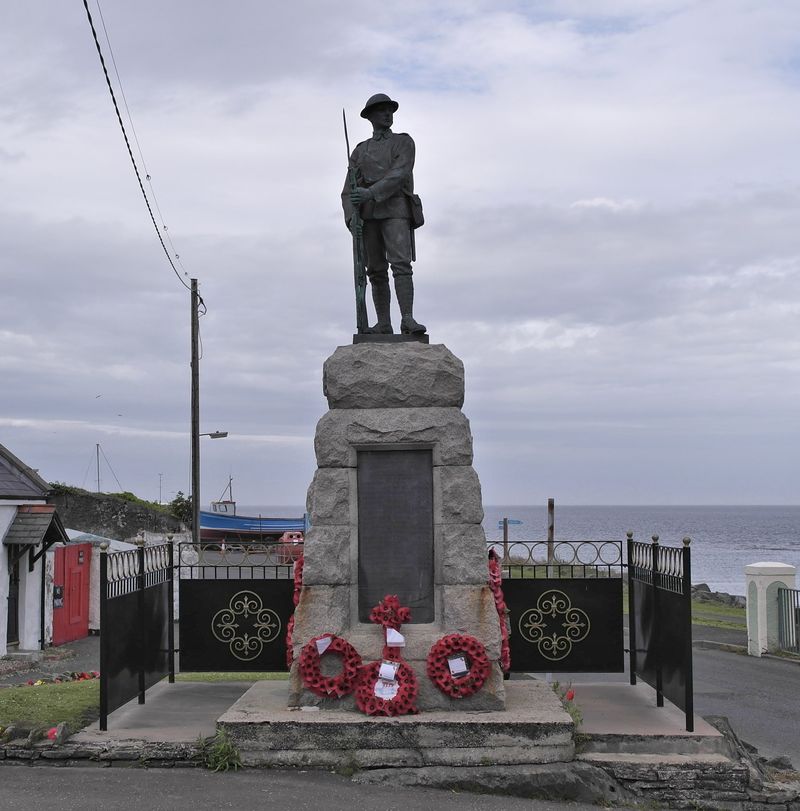
For operations at Fouquescourt on 12 August 1918, Private Jim Dorrian awarded the Military Medal, 9 September 1918 (London Gazette No. 31173, 7 February 1919.). Later, Private Jim Dorrian commemorated on Ballywalter and District War Memorial, on the family grave headstone in Whitechurch Cemetery Ballywalter (where the date of death is inscribed as 1 July 1916) and in Ballywalter Presbyterian Church.
More
Please subscribe to CEFRG to be notified by email when there are new posts. Subscription is free, and your email kept confidential.