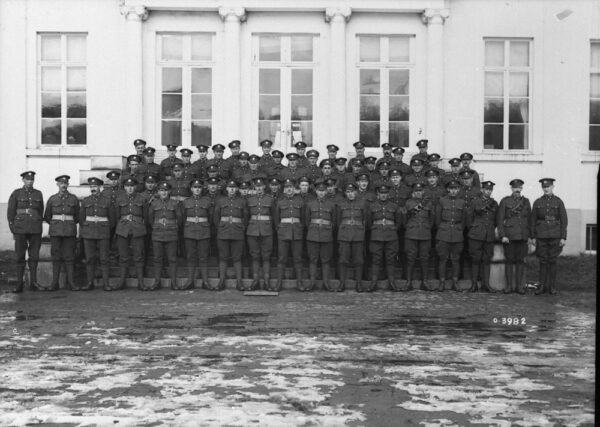
Corporal Thomas Calvert 13 born 30 November 1881 in Lancaster, England. Son of Mrs. Annie Parkinson, 35 Bradshaw Street, Primrose, Lancaster, England.

Attestation
Private Thomas Calvert attested 23 April 1915 in Winnipeg, Manitoba. At this time, a Steam Engineer with 3 years prior service in the South African Constabulary – Thomas Thomas stood 5′ 7″ tall, with fair complexion, blue eyes, and auburn hair. In addition, a ballet girl tattoo mark on right arm, and Thomas assigned $20 of his monthly pay to his mother, Mrs Annie Parkinson.
HQ Staff
Private Thomas Calvert transferred to 2nd Divisional HQ Staff, Shorncliffe, 1 September 1915. Later, employed as Batman and Groom, GOC Staff, 8 November 1915. Finally, to Canadian Training Centre, 9 January 1916, and taken on strength (T.o.S) Headquarters CTD on 12 August 1916.

Pvt Calvert operated on 13 March 1917, cartilage of right knee, then later discharged at Bramshott, 11 May 1917.

Then, Private Thomas Calvert struck off strength (S.o.S.) on transfer to 15th Reserve Battalion, Bramshott, 17 May 1917.
15th Canadian Reserve Battalion (Saskatchewan)
Organized at East Sandling on 4 January 1917 under the command of Lieutenant Colonel Anson Dulmage. Firstly, formed by absorbing 32nd and 188th Battalion. Secondly, absorbed 214th and 232nd Battalion on 29 April 1917, 243rd Battalion on 9 June 1917 and 249th Battalion on March 1918. Thirdly, absorbed 19th Canadian Reserve Battalion. on 15 October 1917, and reinforced 5th and 28th Battalions and on 15 October 1917, 46th Battalion and 1st Canadian Mounted Rifles. Finally, moved to Bramshott on 23 February 1917 and to Ripon on 21 January 1919, and disbanded in England on 14 June 1919.

Private Calvert granted Good Conduct Badge, Bramshott, 16 July 1917.
Last Will and Testament
I devise and bequeath all my real estate unto Miss Mary Hamilton, 70 Goodwood Road, Southsea, Nr. Portsmouth, to the above, I also leave one large colored Photo of myself, now in my Mother’s Keeping, also one Gold nugget, attached to my watch chain, also in my Mother’s Keeping. Absolutely, and my personal estate I bequeath to my Mother, Mrs. Annie Parkinson, 35 Bradshaw Street, Primrose, Lancaster.
Last Will and Testament, 22 August 1917

Having made my will. I deem it advisable to offer a few facts, not generally known to my friends or relations.
I married a second time thinking my first wife was dead, however such was not the case. Married a second time on 7 March 1916 my first when then alive. She later divorced me, in July 1916, therefore I find myself free, although having married twice and both women are living according to the law of England. I am free should anyone claim to be my wife and try to prove same I leave one shilling.
In case of my death, should me relations with Miss M. Hamilton be friendly, she must receive said effects mentioned. But should we have broken our friendly relations, than all my effects and Real Estate goes to my Mother.
Miss M. Hamilton has been one of my very best friends, both in times of sickness and health.
Very sincerely, Thomas Calvert.
P.S. Goodwood Rd Southsea is only a temporary address.
Thomas Calvert
1st Battalion, D Company, Canadian Engineers
S.o.S. on transfer to C.E.T.D., Seaford, 25 February 1918. Transferred to 1st Battalion, Canadian Engineers, 2 March 1918.
1st Battalion, Canadian Engineers organized in France in May 1918 under the command of Lieutenant-Colonel Hugh C. Walkem. Firstly, nucleus formed from 1st Field Company and from a portion of the 107th Pioneer Battalion. Secondly, remainder of personnel from Canadian Engineers Reinforcement Depot, 1st Canadian Engineer Brigade. Finally, demobilized in Winnipeg in May 1919, and disbanded by General Order 192 of 1 November 1920. Pipe band (formerly band of 107th Pioneers). See also 1st Field Company, Canadian Engineers and 107th Battalion.
Private Calvert S.o.S. to No. 2 Tunneling Company, 16 May 1918.
No. 2 Tunnelling Company, Canadian Engineers
Organized in September 1915 under the command of Major R. W. Coulthard. Mobilized at Calgary. Firstly, recruited in mining centres in Alberta and British Columbia. Then, left Halifax 22 January 1916 aboard MISSANABIE and arrived in England 30 January 1916. Finally, arrived in France 10 March 1916 with the 2nd Canadian Division, and ceased to exist 6 July 1918: personnel to 1st, 2nd, 3rd, 10th, 11th, and 12th Battalions, Canadian Engineers. Disbanded by General Order 192 of 1 November 1920.

Private Thomas Calvert T.o.S. 1st Battalion, C.E., 24 July 1918. Private Calvert appointed Acting Corporal, 16 September 1918.
Wounded
While filling craters on roads in Thulin, wounded, GSW head, 9 November 1918. At this time, A/Bbdr Richard Francis Walshe in Thulin with the 61st Field Battery. While in hospital, Acting Corporal Calvert promoted Corporal, 18 November 1918.

Corporal Thomas Calvert died of wounds (bronchial pneumonia and GSW head), 23 November 1918, No. 56 General Hospital, Etaples. Buried in Plot L, Row F, Grave 22 at Etaples Military Cemetery, 24 November 1918.

Etaples Military Cemetery
Etaples is a town about 27 kilometres south of Boulogne. The Etaples Military Cemetery is to the north of the town, on the west side of the road to Boulogne. During the Great War, the area around the small fishing port of Etaples the scene of immense concentrations of Commonwealth reinforcement camps and hospitals. Remote from attack, except from aircraft, and accessible by railway from both the northern or the southern battlefields. At its peak, 100,000 troops housed there with Commonwealth army training and reinforcement camps and an extensive complex of hospitals.
Military Medal
Corporal Thomas Calvert posthumously awarded the Military Medal, London Gazette No. 31173, 11 February 1919.

More
Please subscribe to CEFRG to be notified by email when there are new posts. Subscription is free, and your email kept confidential.