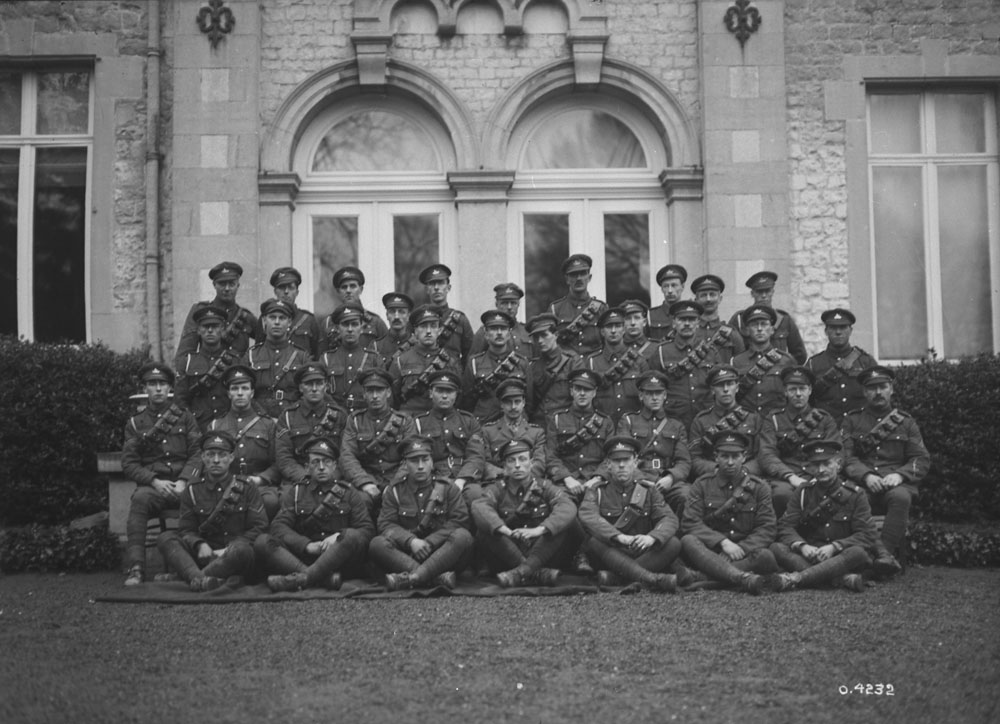
Royal Canadian Dragoons
Private Clarence Douglas Blackwell 826 of the Royal Canadian Dragoons son of William and Priscilla Blackwell of 75 Craddock Street, Wolverhampton, Staffordshire, England. Private Blackwell wounded in June of 1916 and killed-in-action two months later on 15 August 1916.

Enlistment of Private Clarence Douglas Blackwell
Private Clarence Douglas Blackwell enlisted 6 August 1814 with the Queen’s Own Rifles at Valcartier, Quebec. At this time, Clarence stood 5′ 7″ tall with fair complexion, grey eyes and auburn hair, aged 21 years, 8 months, scar right groin. A Driver by trade, Blackwell sent $12 of his monthly pay home to his family.

Private Clarence Douglas Blackwell with ‘C’ Squadron, Royal Canadian Dragoons as of 18 September 1914.
Royal Canadian Dragoons
The Royal Canadian Dragoons the most senior cavalry regiment in Canada, formed on 21 December, 1883. At this time, the regiment currently serves as a regular force armoured unit in the 4th Canadian Division’s 2 Canadian Mechanized Brigade Group based at CFB Petawawa, ON. The Royal Canadian Dragoons originated in Quebec City, Quebec on 21 December 1883, when the ‘Cavalry School Corps’ authorized to be formed, redesignated the ‘Canadian Dragoons’ on 14 May 1892.

Royal Canadian Dragoons mobilized at Valcartier on 14 August 1914 under the command of Lieutenant-Colonel C. M. Nelles. Left Quebec on 26 September 1914 aboard LAURENTIC and LACONIA, and later arrived in England on 17 October 1914. In addition, formed part of Canadian Cavalry Brigade on its formation on 2 February 1915 with a strength of 34 officers, 541 other ranks.
Battle Honours
Festubert, 1915, Somme, 1916, ’18, Bazentin, Pozières, Flers-Courcelette, Cambrai, 1917, ’18, St Quentin, Amiens, Hindendburg Line, St Quentin Canal, Beaurevoir, and finally, Pursuit to Mons, France and Flanders, 1915-18.
Canadian Cavalry Brigade
Organized on Salisbury Plain on 2 February 1915 under the command of Colonel J. E. B. Seely. Firstly, composed of Royal Canadian Horse Artillery, Royal Canadian Dragoon, Lord Strathcona’s Horse (Royal Canadians) and 2nd King Edward’s Horse. Later, concentrated at Mansfield Park, Mansfield, Sussex, and arrived in France (less the Royal Canadian Horse Artillery) on 6 May 1915 as a dismounted unit: known as Seely’s Detachment. Became Canadian Cavalry Brigade on 22 July 1915.
Secondly, restored to horses on formation of Canadian Corps in September 1915, and Seely’s Force formed on 3 October 1915, composed of Canadian Cavalry Brigade and 1st CMR Brigade. Later, Seely’s Force disbanded on 9 October 1915, and re-formed on 22 November 1915, composed of Canadian Cavalry Brigade, 1st and 2nd Canadian Mounted Rifles Brigades, ceased to exist on 10 December 1915. Furthermore, Canadian Cavalry Brigade transferred to 1st Indian Cavalry Division on 26 January 1916, and Fort Garry Horse replaced 2nd King Edward’s Horse in Canadian Cavalry Brigade on 25 February 1916. Finally, returned to England on 16 April 1919, and arrived in Canada on 29 May 1919.
John Edward Bernard Seely

John Edward Bernard Seely, 1st Baron Mottistone was Secretary of State for War for the two years prior to the Great War, before being forced to resign as a result of the The Curragh incident of 20 March 1914, generally known as the Curragh mutiny. As General Jack Seely, he led one of the last great cavalry charges in history at the Battle of Moreuil Wood on his war horse Warrior in March 1918. Seely was a great friend of Sir Winston Churchill and the only former cabinet minister to go to the front in 1914 and still be there four years later.

Private Clarence Douglas Blackwell’s unit sailed 3 October 1914.

Lance Corporal Clarence Douglas Blackwell
Private Clarence Douglas Blackwell promoted Lance Corporal 23 October 1914.
Lance Corporal Clarence Douglas Blackwell later reverts to ranks at own request, 4 December 1914 – a common request in order to proceed overseas.

Private Clarence Douglas Blackwell forfeits two days pay, AWOL, 23 January 1915 and granted 14 Days C.B., 11 February 1915. Clarence completes his Will on 16 March 1915, leaving everything to his mother Mrs Priscilla Blackwell of 75 Craddock Street, Wolverhampton Staffs, England.
![R.C.D. Guard at Cavalry Brigade H.Q. [Royal Canadian Dragoons]. 3 March 1919. MIKAN No. 3405863 Private Roy Edward Henley](https://i0.wp.com/cefrg.ca/wp-content/uploads/2020/09/3405863-a004140-v8.jpg?ssl=1)
France
Private Clarence Douglas Blackwell and the Royal Canadian Dragoons docked in Boulougne-sur-Mer, France on 4 May 1915.
On 5 May 1915 they disembarked in France, where it fought in an infantry role as part of ‘Seely’s Detachment’, 1st Canadian Division.

On 24 January 1916, the RCD resumed its cavalry role as part of the 1st Canadian Cavalry Brigade with whom it continued to fight in France and Flanders until the end of the war.

Queen’s Road Dugouts on 4 June 1916 and moved to Lepreol the following day when a shell kills Private William Reader 958, a woman and two children, Private Blackwell also wounded, and returned to duty with unit on 5 July 1915. Reader later buried at Brown’s Road Military Cemetery, Festubert.
Private Clarence Douglas Blackwell granted leave of absence to England, 19 to 27 January 1916. Returned from leave, 31 January 1916.
Battle of the Somme
Death of Private Clarence Douglas Blackwell
Private Clarence Douglas Blackwell killed-in-action 15 August 1916.

Dantzig Alley British Cemetery
The village of Mametz was carried by the 7th Division on 1 July 1916, the first day of the Battle of the Somme, after very hard fighting at Dantzig Alley (a German trench) and other points. Dantzig Alley British Cemetery begun later in the same month and was used by field ambulances and fighting units until the following November.
The ground was lost during the great German advance in March 1918 but regained in August, and a few graves were added to the cemetery in August and September 1918. At the Armistice, the cemetery consisted of 183 graves, now in Plot I, but it was then very greatly increased by graves (almost all of 1916) brought in from the battlefields north and east of Mametz.