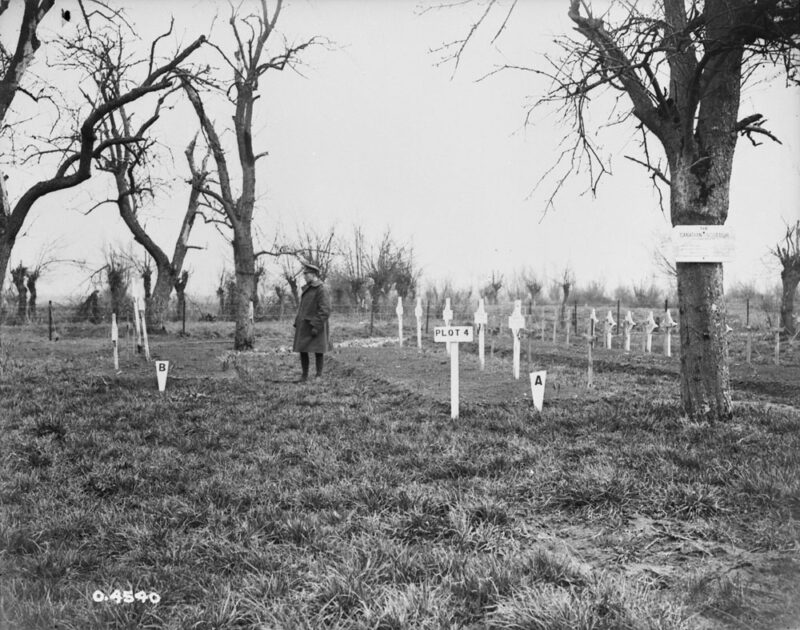
Scottish Regiment
Private Robert Edward Bradshaw born in Plaistow, London, England on 6 January 1888. A salesman by trade, with 5 years previous service in the 3rd King’s Royal Rifles, 1905-1910. Bradshaw one of Canada’s 20,000 Missing in the Great War, yet evidence reveals he lies in Nine Elms Military Cemetery, Thélus, Pas-de-Calais.

Private Robert Edward Bradshaw 43945 attested 28 September 1914 in Rimouski, Quebec. Bradshaw stood 5′ 9″ tall, with fair complexion, blue eyes, and fair hair. Scar left side and back of neck. Assigned $15 of monthly pay to wife Gertrude Bradshaw residing at 107 Erin Street (later 94 Durham St), St John, NB.
England
Private Robert Edward Bradshaw to be Bombardier from 7 October 1914, on board SS MEGANTIC.

Bombardier Robert Edward Bradshaw to be Corporal, 30 January 1915. Later, Corporal Robert Edward Bradshaw reverts to Driver from Corporal, on 3 March 1915.
Driver Robert Edward Bradshaw absent from tattoo while under open arrest, 28 Days Field Punishment No 1, forfeits 3 days pay, 4 September 1915.

Later admitted to No.9 Stationary Hospital, Le Havre, 26 September 1915, and discharged to No.1 Camp, 20 October 1915, and to Canadian Base Depot, 28 October.
Driver Robert Edward Bradshaw ToS 1st Divisional Ammunition Column 28 October 1915, and later forfeits 50 cents per day from 1 October 1915 to 12 October 1915 (VDG).
1st Divisional Ammunition Column
Organized in August 1914 under the command of Lieutenant-Colonel J. J. Penhale. Mobilized at Valcartier, and later left Quebec on 30 September 1914 aboard MEGANTIC and MONTEZUMA. Then, arrived in England 14 October 1914 with a strength of 30 officers, 561 other ranks. Later arrived in France 12 February 1915 with the 1st Canadian Divisional Artillery, and returned to England 21 March 1919.

Driver Robert Edward Bradshaw transferred to 16th Battalion, 1 January 1916, and later given seven days C.B. (confined to barracks) for when on active service, AWOL for 2 hours.

16th Battalion
The 16th Battalion (Canadian Scottish Regiment) organized in Valcartier Camp in September 1914, composed of recruits from Victoria, Vancouver, Winnipeg and Hamilton. Commanded by Lieutenant-Colonel R.G.E. Leckie. Embarked Quebec 30 September 1914 aboard SS ANDANIA, and later disembarked in England 14 October 1914, with a strength of 47 officers, 1111 other ranks.

Private Robert Edward Bradshaw T.o.S. in the field, 15 January 1916, Kortepyp Huts (near Ballieul), and later Private Robert Edward Bradshaw granted 7 Days Leave, 14 February 1916.
Absent without leave, 29 February 1916. Cancelled, 31 March 1916. Admitted to hospital in England while on leave, 31 March 1916.

Then, Private Robert Edward Bradshaw awarded 8 days Field Punishment No.2 and forfeits 8 days pay, for AWOL, East Sandling, 14 March 1916.
Private Bradshaw attached to Brigade M.G. Base for duty, 25 March 1916.

Private Robert Edward Bradshaw later admitted to No.1 Canadian Field Ambulance, 10 October 1916 (GSW right leg/knee), and discharged to duty 12 October 1916.
Battle of Vimy Ridge
Private Robert Edward Bradshaw killed-in-action on the morning of 9 April 1917 during the first day of the Battle of Vimy Ridge.
Family history recounts stretcher bearers found a live puppy in the pocket of Private Bradshaw’s overcoat when he was removed from No Man’s Land. They also found the following poem, which Private Bradshaw’s great grandson Jason Bradshaw has submitted.
The Front Line by Robert Edward Bradshaw
In front, a ragged shell-torn waste, barbed wire and noisome weeds;
The grave of many a gallant man who died for his country’s needs;
The bar between two mighty foes, alert, watchful and still,
Like savage beasts as they pause and wait, ‘ere they spring to rend and kill.The rattle of the machine guns spraying death along the line;
The boom of a distant field gun, then a shrill increasing whine.
A crash – an acrid blinding smoke, a shower of stones and dirt –
Then casually someone asks, “Is anybody hurt?”A dazzling streak of light shoots up and bursts, a pretty sight,
Transforming No Mans Land into a fairy land of light;
‘Tis hard to think a thing so fair is but a means of death,
Yet as each “star-shell” shoots aloft we crouch and hold our breath.And then a low-voiced call comes down for “stretcher bearers here.”
Men hurry by and soon a moan falls on the listening ear,
“Somebody hit,” you merely think and no one stops at all,
Because out here one soon gets used to seeing comrades fall.Inside the dug-out, damp and foul, a candle’s flickering light
Shows sleeping forms oblivious of the ever ceaseless fight;
Their pillow just a haversack, their bed is only mud:
Maybe a cast-off overcoat, damp with a comrade’s blood.Day after day, night after night, the same grim wearing strife:
Men come and go – some stay; those who for right gave up their life:
For yes, we know the right is ours, our cause is just and true,
And so we care not what we hear or what we have to do.No matter what our task may be, what sacrifice we make
Private Robert E. Bradshaw
For Honour, our Religion and our Liberty’s at stake.
Our comrades too, both dead and maimed, also demand that we
Fight on until the very end, to Death or Victory.
Vimy Centennial
Jason Bradshaw (grandson of Private Robert Edward Bradshaw) should have been a keynote speaker on 9 April 2017 at the 100th Anniversary of the Battle of Vimy Ridge. Instead, due to the atrocious and disrespectful planning of Veteran’s Affairs Canada (e.g., singing and dancing on the Hill), his recitation heard before a paltry crowd on Vimy Hill, 10 April 2017.
Nine Elms Military Cemetery
We have several reasons to believe Private Robert Edward Bradshaw lies in Nine Elms Military Cemetery, most compelling of which is his Circumstances of Death Card.

The reverse side of the CoD card mentions a burial location to far back near the jump-off point of the 16th Battalion. The burial teams had no instructions to bring back bodies The usual practice to gather and bury the men close to where they fell.

This infamous trench map coordinate, 51b.A.10.c.9.7, the erroneous location sometimes known as Grave C.A. 40. The actual location of this mass burial site, over a kilometer to the east, just west of Rue d’Arras, south-west of Thelus, matching the CWGC description of C.A. 40.
274 metres West of the main road, by the light railway track. Here were buried 44 Canadian soldiers of the 16th Battalion who fell on the 9th April 1917.
CWGC
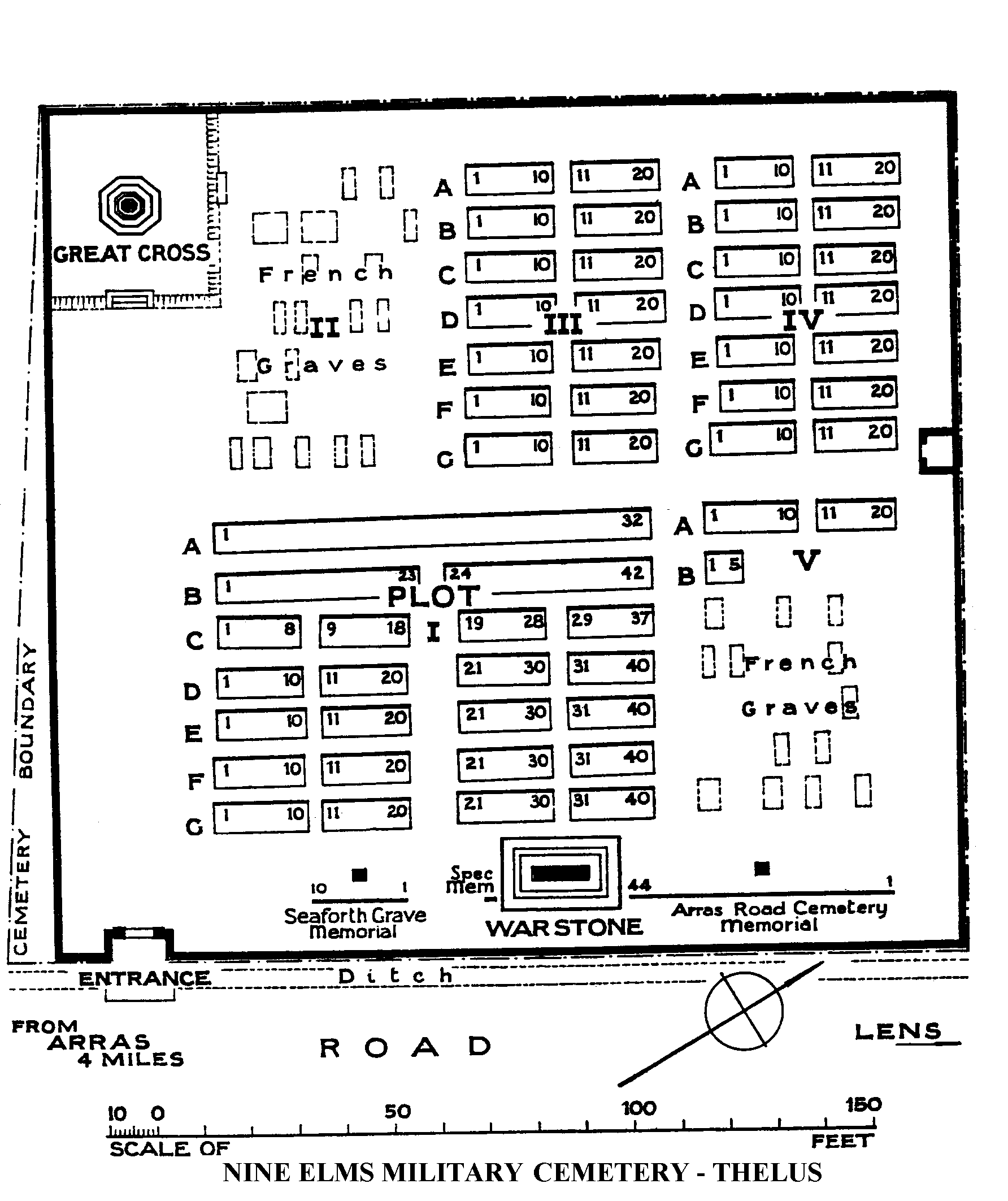
40 men of the Scottish Regiment, exhumed from the location in early 1919, were buried as Unknowns in Nine Elms Military Cemetery (the remaining four found in Zivy Crater Cemetery). For reasons not clearly understood, the Kipling Memorial (Memorial Cross No. 9) containing the names of these 40 men, including a Victoria Cross recipient (Private William Johnstone Milne VC), cancelled.

Last Will and Testament of Private Robert Edward Bradshaw
Please forward all personal belongings to Mrs H Thompson, 102 Grove Park Terrace, Chiswick, London. In the vent of my death, I give the whole of my property and effects to my wife – Gertrude (Weston) Bradshaw, now residing at 102 Grove Park Terrace, Chiswick, London.
Corporal Robert E. Bradshaw, 1st Canadian Division Ammunition Column, 1 March 1915.

Widow Gertrude (Weston) Bradshaw, now residing 131 Lansdowne Ave, Toronto, ON received the ’15 Star, the British War Medal, and Victory Medal. Gertrude remarried, 12 May 1919.
More
Please subscribe to CEFRG to be notified by email when there are new posts. Subscription is free, and your email kept confidential.