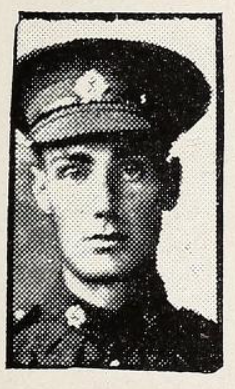
Private Robert Dundas 113197 son of Crawford Dundas, of Garrison, Co. Fermanagh, Ireland, born in Inniskilly, Ireland on 2 August 1894. A Presbyterian and shipper by trade.
Robert Dundas attested 31 July 1915 in Barriefield, Ontario with ‘C’ Squadron, 8th C.M.R. At this time, Robert stood 6 feet tall, 170 pounds, with dark complexion, blue eyes and brown hair.
8th Canadian Mounted Rifles
Organized in November 1914 under the command of Lieutenant-Colonel John Routh Munro, and later mobilized at Ottawa, “A” Squadron recruited in Ottawa, “B” Squadron at Peterborough and “C” Squadron at Toronto. Left Montreal 9 October 1915 aboard MISSANABIE, and later arrived in England 18 October 1915, with a strength of 31 officers, 601 other ranks.
Then, a draft to various Canadian Mounted Rifles units: remainder absorbed by Canadian Cavalry Depot at Shorncliffe on 5 February 1916. In addition, perpetuated by The Princess Louise Dragoon Guards which, in 1936, amalgamated with the 4th Hussars forming the 4th Princess Louise Dragoon Guards.

Pvt Robert Dundas arrived in England onboard SS MISSANABIE, 19 October 1915, and later On Leave, 5/9 November 1915.
Dundas AWOL, 28/29 December 1915 and later forfeits two days pay.
Robert Dundas transferred for Overseas Service with 8th Infantry Brigade, 28 January 1916, and later ToS in the field, 21 February 1916, 4th C.M.R.
4th Canadian Mounted Rifles
Organized in November 1914 under the command of Lieutenant-Colonel William Craven Vaux Chadwick, and later mobilized at Toronto, and recruited from Governor General Body Guards, 2nd Dragoons, 9th Mississauga Horse and 25th Brant Dragoons. Left Quebec 18 July 1915 aboard HESPERIAN, and later arrived in England 27 July 1915, with a strength of 31 officers, 602 other ranks. Finally, arrived in France 22 September 1915, with the 2nd Brigade, Canadian Mounted Rifles.

Furthermore, designation changed from regiment to battalion on formation of 8th Canadian Infantry Brigade, 1 January 1916. Returned to Canada, 17 March 1919, and later demobilized 19 March 1919. Finally, perpetuated by The Mississauga Horse which, in 1936, amalgamated with The Governor General’s Body Guard forming The Governor General’s Horse Guards.

Death of Private Robert Dundas
Trooper Robert Dundas wounded during the Battle of Mount Sorrel, 6 June 1916, and later died at Wurtt Feldlazarett 11 on 8 June 1916 (GSW Lung) – from a German list dated 4 August 1916.

Dundas at first believed to have died at Wahn (near Cologne), but correctly identified as the German field hospital in Menen.

Menen Communal Cemetery
Menen (formerly Menin) in German hands for much of the Great War until taken by the 34th Division on 15 October 1918, the communal cemetery largely used and extended by the Germans. Most of the Commonwealth graves removed to Harlebeke New British Cemetery, but a few remain, those buried in Plot III died as prisoners in 1916-17, and in Plot IV, after the capture of the town. Menen Communal Cemetery contains 14 Commonwealth burials of the Great War, two of which unidentified. There is also one burial of the Second World War dating from the withdrawal to Dunkirk in May 1940 ahead of the German advance.

MENEN(MENIN)COMMUNAL CEMETERY located 18 Km east of Ieper town centre on the N8, a continuous road from Ieper to Menen(Menin), via the village of Geluveld. From Ieper town centre the N8 Meenseweg located via Torhoutstraat and then right onto Basculestraat. Then, Basculestraat ends at a main crossroads, directly over which begins the Meenseweg. Finally, on reaching the town of Menen the cemetery located immediately after the left hand turning onto the Zandputstraat. The Commission plot located centrally in the cemetery.
More
Please subscribe to CEFRG to be notified by email when there are new posts. Subscription is free, and your email kept confidential.