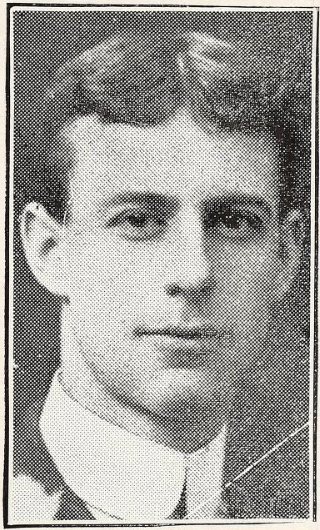
Lieutenant James Chester Hughes born 30 March 1888. Nephew of Brigadier-General William St. Pierre Hughes and General Sir Sam Hughes. Brigadier-General Garnet Hughes the son of the Minister of Militia (Sam Hughes).

Chester Hughes a Civil Engineer by trade. Only son of father Dr James L Hughes and mother Adelaide M Hughes of 47 Dundonald Street, Toronto, ON. Two years previous service in F.C.C.E.
Education of James Chester Hughes
Hughes educated at the Parkdale Collegiate Institute and the University of Toronto in 1909 with a B.Sc. (Mech. Eng.) degree. A member of the University Training Corps. Upon graduation, he took up construction work and superintended the building of several bridges in Scarboro township. Then, he joined the Canadian Pacific Railway engineering department and located the line from Bellevilla to Newtonville. Following this work, he went to New Brunswick, where he took charge of important railway construction.

Attestation
In September of 1914, Hughes came back to Toronto to enlist as a Private with the 6th Field Company, Divisional Engineers. At this time, he stood 5′ 11″ tall with medium complexion, blue eyes and brown hair. A few months later, this corps sent to Ottawa, and when Hughes returned to Toronto for a few days at Christmas, he wore the stripes of a Sergeant.

Returning to military camp, his uncle Colonel William Hughes offered him a commission, but he refused, wishing to remain an engineer. However, before the engineers went to England in April 1915, Hughes given a commission in the company, and promoted to Lieutenant on 1 January 1915.
Belgium
Disembarking at Le Havre, France in September 1915, Lieutenant James Chester Hughes immediately employed in charge of construction of strong points for machine guns, near Locre, Belgium, and bivouacked near Locre Chateau.

From 22 September to 30 September 1915, 6th Field Company commenced drainage of the following trenches: Via Gellia, Regent Street, Piccadilly, Pall Mall, Vigo Street and Kingsway, later improving the parapets of these trenches.

A mine explosion in S1-S2 trenches on 8 October at 5:42 pm causes the loss of 21 men in the 28th Battalion. Lt Edwin Albert Baker and Lieutenant James Chester Hughes with 25 sappers and 75 infantry repaired the damage to the trenches. Lt Baker shot through the eyes at 11 pm on 9 October 1915.

Death of Lieutenant James Chester Hughes
Lieutenant James Chester Hughes (son of Dr. J L Hughes, Toronto, and nephew of Sir Sam Hughes) and Russell (Sapper Russell A Campbell 502) started from their dugout at about 4:45 pm to get a working party at a nearby village, which at this time was being shelled. The guard on the road stopped them to give warning. I expect, and while they were halted a shell came over, killing both instantly. The guard is also in very serious condition.
Letter home by Sapper Charles A Poynton 613 of the 6th Field Company

Locre Churchyard
I came in from the trenches, as did Bert, for the double funeral, which took place from the camp at 10:40 am today. The men of No. 4 Section acted as pall-bearers. The funeral was the most impressive I have ever attended. All the men in the camp marched behind the waggons, the infantry band leading, playing of course, The Dead March.” We marched to a little village, the name of which I presume will be sent to Mr. Campbell. Here they were laid to rest. The Chaplain, Major John Beatty, read the service, the band played “The Last Post,” and then, as there is no firing party here, each man saluted and the band played us back to camp.
Letter home by Sapper Charles A Poynton 633 of the 6th Field Company

LOCRE CHURCHYARD located 11.5 Km south west of Ieper town centre on the Dikkebusseweg (N375). From Ieper town centre the Dikkebusseweg reached via Elverdingsestraat, straight over a roundabout onto J. Capronstraat (for 30 metres), then left along M. Fochlaan. Immediately after the train station, the first right hand turning the Dikkebusseweg. On passing through the village of Dikkebus the road continues for 6 Km to the village of Loker. The church and churchyard located at the side of the road in the village of Locre (Loker) itself.

History of Locre Churchyard
Locre (now Loker) in Allied hands during the greater part of the war, and field ambulances stationed in the Convent of St. Antoine. The village changed hands several times between 25 and 30 April 1918, when recaptured by the French. The hospice, or convent, the scene of severe fighting on 20 May, but not retaken until first week in July. Loker Churchyard used by field ambulances and fighting units from December 1914 to June 1917, and it contains two Commonwealth plots. One grave brought in after the Armistice from LOCRE FRENCH CEMETERY No.4. The churchyard contains 215 Commonwealth burials of the Great War.

Subscribe
Please subscribe to CEFRG to be notified by email when there are new posts. Subscription is free, and your email kept confidential.