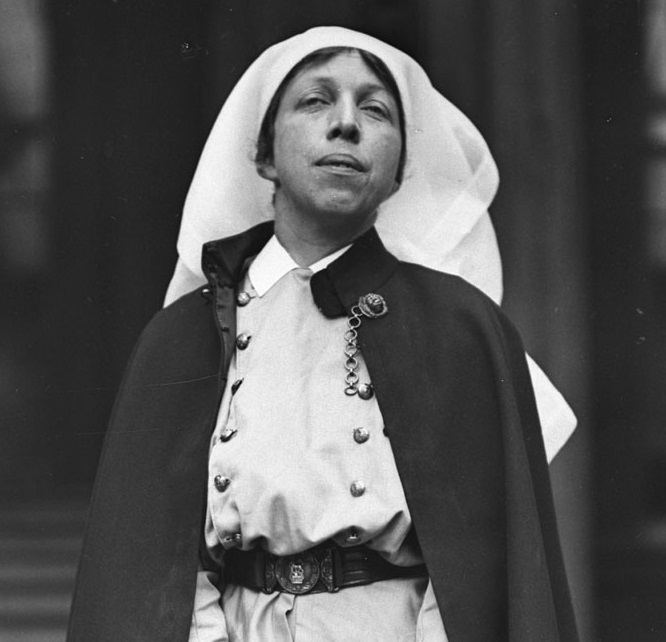
Mary Bell Hubbs a graduate nurse from the Township of Hillier, father Louis Philip Hubbs, mother Prudence Hubbs of Hillier, Ontario, Mary born 31 May 1880 in Hillier.

Attestation of Mary Bell Hubbs
Nursing Sister Mary Bell Hubbs attested 21 January 1915 in Ottawa, Ontario. Medical examination 24 February 1915 in London, England, approving officer MacDonald. Mary stood 5′ 9″ tall, 182 pounds, brunette complexion, with gray-blue eyes and dark brown hair.
In addition to the nurses with the contingents — and with the McGill and Toronto University Units — the Canadian Red Cross Society, at the request of the Chairman of the Nursing Department of the British Red Cross Society’, is sending twenty nurses at once.
Conditions of service
The conditions of service are that the nurse shall be fully qualified, holding a three years’ certificate of a recognized training school of at least one hundred beds, and must be well recommended by the lady superintendent of the hospital. She must also have a health certificate and satisfactory references.
It is necessary that she shall be inoculated against enteric, and if she has not been vaccinated for seven years she should be vaccinated.

Term of service is for one year from the date of enlistment, and the nurse will proceed to England where she will be assigned to duty. The salaries of the nurses will be at the British Government rate of £1 per week and necessary clothing and cost of transportation.
The following nurses arrived lately from Canada, as supernumerary of the first contingent:
April 3, 1915
Misses A. II. McNicol, S. A. Louise, C. M. MacLoan, E. T. Hegan, M. A. Cxinimings. M. B. Hubbs. L. F. Boyd. E. Pierce. C. M. Motherwell. E. M. Armstrong, E. Boultbee, O. Boulter. B. Laveragan. M. Rosse. K. Shaw, and Mrs. A. M. Spalding.
Misses M. J. Dickinson. G. Billyard, G. E. Stalker, C. J. Douglas, C. E. IMallory, M. H. McGill, M. Howe. L. Lj-nch. S. Ferguson, I. Willis, A. M. Mills, F. .Armsrong, C. E. Cameron, A. Cameron-Smith. K. G. Clark. H. Dougharty, C. Drew, M. M. Ellis. C. Malby, A. McKay, C. G. Nixon, C. C. Raymond. J. Kobley. E. Sullivan, and J. Wishart. Many have gone to France, to relieve the nurses who have been working among the wounded for months.
Mary begins her service with No.2 General Hospital, CAMC.
No.2 General Hospital, CAMC
Organized at Valcartier in September 1914 under the command of Lieutenant-Colonel J. W. Bridges.
Left Quebec 30 September 1914 aboard FRANCONIA and VIRGINIAN. Arrived in England 15 October 1914.
Strength: 25 officers, 136 other ranks. Arrived in France 14 March 1915. Le Tréport, March 1915 – 2 March 1919.
Disbanded by General Order 211 of 15 November 1920.
The British journal of nursing
From: The British journal of nursing, SATURDAY, JANUARY 2, 1915.
” The faults of the Red Cross Societies seem the same all over Europe. The little that Society does here is a series of stupidities in so far as nursing is concerned. Here is a true tale. The matron of a children’s sanatorium in the country had to send the children back to Amsterdam in the early days of August, and offered the sanatorium to the R.C.S., as it is an ideal place for convalescents. It replied that the Society could not accept the offer, ” because they, did not want the soldiers to eat tuberculosis”!
– A nurse from Holland
Nursing Sister Mary Bell Hubbs granted 10 days leave from Le Treport, 19 February 1916.

Mary granted 14 days leave, 17 January 1917.
Nursing Sister Mary Bell Hubbs posted to CAMC Depot Shorncliffe, 9 June 1917. Posted to Moore Barracks Hospital, from No.2 Canadian General Hospital, Shorncliffe, 12 June 1917.
Nursing Sister Mary Bell Hubbs On Command HMHS ARAGUAYA, 17 September 1917.

To CAMC Shorncliffe, General Convalescent Stationary Hospital, 7 November 1917.
Nursing Sister Mary Bell Hubbs granted 4 Blue Service Chevrons, 3 March 1918.

Nervous debility
Admitted No.3 General Hospital, Le Treport on 7 June 1918. Transferred to Kitchener Military Hospital, Brighton, 17 June 1918. Former case sheet reports pain under left breast, worse on pressure. Not plural type, and a small crepitant rales, left side. On admission some dull pain at times under lefty breast, otherwise negative. Previous history negative. Admitted to the Canadian Red Cross Hospital, Buxton on 9 July 1918, nervous debility, and released in the London Area on 21 August 1918.
Mary finished her service with No.1 General Hospital, and Military District No.2, with 43 months total service.
Awarded Royal Red Cross, 2nd Class, 21 June 1918, London Gazette No. 30756.
Royal Red Cross Class 2 (ARRC)
The Royal Red Cross Class 2 (ARRC) instituted on 10 November 1915. ARRC recipients cannot receive a bar, but may be elevated to RRC. On the obverse there is a bareheaded effigy of the reigning monarch in the middle. On the reverse, the Royal Cypher of the reigning monarch is in the centre, surmounted by a crown, with the words FAITH (top), HOPE (left), CHARITY (right), and 1883 on the bottom of the cross.

Nursing Sister Mary Bell Hubbs discharged in Toronto, 17 March 1919.
Death of Mary Bell Hubbs
Mary lived in Wellington in her waning years, and died of heart disease 5 October 1947. Buried in the family plot at Christ Church Cemetery, Hillier, Ontario. Next of kin Mr Robert Hubbs, her brother.
