Lance Corporal John Gemmell born in Lavoy, Alberta on 22 November 1894. Mother Agnes Gennell of Brownhill Farm, Glengarnock, Ayrshire, Scotland. A Farmer by trade.

Attestation of John Gemmell
Private John Gemmell 811615 attested 4 January 1916 in Edmonton, Alberta with the 138th Battalion, CEF.
At this time, John Gemmell stood 5′ 8″ tall, 180 pounds, with fresh complexion, grey eyes and brown hair.

138th Battalion
Organized in November 1915 under the command of Lieutenant-Colonel Robert Belcher, and later mobilized at Edmonton, and recruited in Edmonton, drafts of 200 to 137th Battalion, 120 to 128th Battalion and 250 to 175th Battalion. Embarked from Halifax 24 August 1916 aboard SS OLYMPIC and later disembarked England 29 August 1916 with a strength of 32 officers, 870 other ranks.

Personnel transferred to 128th Battalion on 8 December 1916. Finally, disbanded 4 August 1917 by Privy Council Order 1895 of 17 July 1917. In addition, Colours presented by Mr And Mrs A F Ewing of Edmonton on 1 July 1916, perpetuated by The Edmonton Fusiliers.
Pte John Gemmell later arrived in England aboard SS OLYMPIC on 30 August 1916.
Then, in anticipation of proceeding overseas, John writes his Will and bequeaths all to his mother on 31 July 1916.
Private John Gemmell transferred to the 47th Battalion on 14 November 1916 and later proceeds overseas for service.
47th Battalion
Organized in February 1915 under the command of Lieutenant-Colonel William Norman Winsby and later mobilized at New Westminster, and recruited in New Westminster, Vancouver and Victoria. Drafts of 5 officers, 250 other ranks, 4 officers, 244 other ranks and later 5 officers, 249 other ranks sent to England on 17 June, 24 June and 1 October 1915.

The 47th Battalion embarked from Montreal 13 November 1915 aboard SS MISSANABIE, and later disembarked England 22 November 1915 with a strength of 36 officers, 1115 other ranks. Disembarked in France 10 August 1916 with the 4th Canadian Division, 10th Canadian Infantry Brigade, and later reinforced by 24th Canadian Reserve Battalion. Finally, returned to England 28 April 1919, and disembarked in Canada 4 June 1919, demobilized 6 June 1919, perpetuated by The Westminster Regiment.

Pte John Gemmell to 4th Divisional Lewis Machine Gun School, 17 December 1916, later returning to his unit on 30 December 1916.


Lance Corporal John Gemmell Wounded
The 47th Battalion counter-attacked following a German barrage in the early morning of 22 August 1917. The fighting was of a house-to-house character throughout, and later in hand-to-hand fighting, John wounded. Private John Gemmell admitted to No.11 General Hospital, Camieres, GSW right cheek, severe, on 22 August 1917, later discharged on 12 September 1917. John granted 10 days leave to UK on 29 September 1917. Finally, Pte John Gemmell appointed Lance Corporal on 9 October 1917.
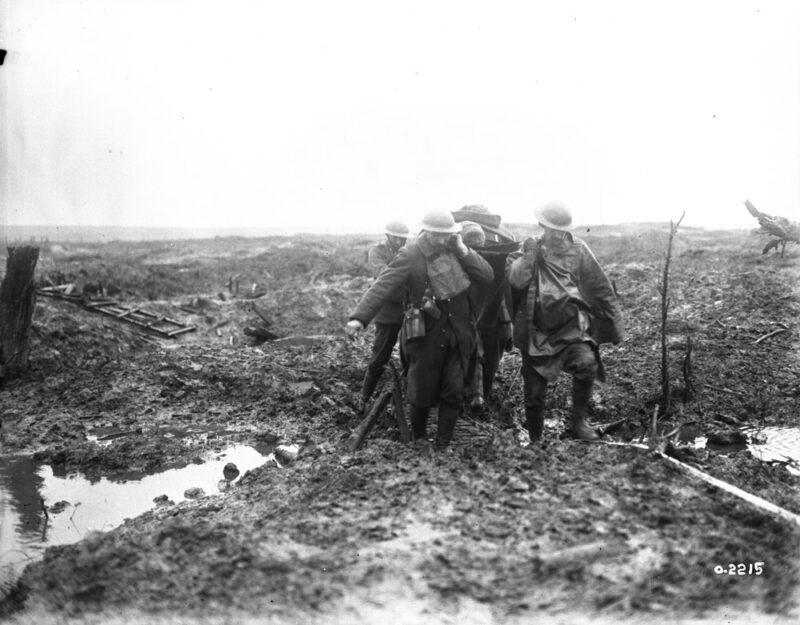
Battle of Passchendaele
Lance Corporal John Gemmell killed in action 28 October 1917.
Lance Corporal John Gemmell later awarded the Military Medal for Bravery in the field, London Gazette, No.30387, 19 November 1917.
Lance Corporal John Gemmell later buried at Passchendaele New British Cemetery.
Passchendaele New British Cemetery
The village of Passchendaele (now Passendale) and surrounding area associated with every phase of the Great War. In the middle of October 1914, Passchendaele briefly under Allied occupation but by 20 October in German hands, where it remained for the next three years. On 6 November 1917, after the severest fighting in most unfavourable weather, the 5th Canadian Infantry Brigade took, and passed, the village, this fight was part of the Second Battle of Passchendaele, the last of the Battles of Ypres, 1917. In the middle of April 1918, in the Battles of the Lys, the Allied line withdrawn far back on the road to Ypres, but on 29 September, in the course of the Allied offensive in Flanders, Belgian forces recaptured the village.
The New British Cemetery made after the Armistice when graves brought in from the battlefields of Passchendaele and Langemarck, almost all of the burials from the autumn of 1917. The cemetery now contains 2,101 burials and commemorations of the Great War, 1,597 of the graves are unidentified, but there are special memorials to seven casualties believed to be buried among them.