CEFRG.ca

Category: Soldiers

Between 1914 and 1919, over 650,000 Canadians served at home and overseas during the Great War. On the Western Front in Belgium and France, Canadian soldiers of the Great War distinguished themselves in numerous battles, including Second Battle of Ypres, Battle of Vimy Ridge, and Second Battle of Passchendaele. In Canada’s Last Hundred Days of the Great War, Canadian soldiers at the sharp end of the spear breaking through the enemy’s formidable trench defences, the Hindenburg Line. Their efforts have inspired these soldier stories.

Collections

Many collections used to bring the soldier stories to life. First, and foremost, the Personnel Records of the soldiers serving in the Canadian Expeditionary Force (CEF). This collection, like the others to follow, digitized and made available by Library and Archives Canada (LAC). Secondly, the War Diaries of the CEF often provide vital information about a soldier’s life not contained in their service file. Finally, Circumstances of Death (CoD), War Graves Registers (GRRF), and Veterans Death Cards provide further information on The Fallen. These three collections in conjunction with records of the Commonwealth War Graves Commission (CWGC) vital to cases of identification and recovery of The Missing.

Courts Martial Records (FGCM)

Additional collections used to present the soldier stories include Courts Martial Records. Courts martial had the authority to try a wide range of military offences that resembled civilian crimes like fraud, theft or perjury. Others, like desertion and cowardice – purely military crimes. Records of individual courts martial consist of an average of 20 to 25 documents, mainly standardized forms. These document the trial and the charges under the Army Act.

MIKAN photo collection

Finally, the most powerful way of bringing soldier stories of the Great War to life, the images of the MIKAN collection digitized by LAC.  Often complementing these photos – images held by the Imperial War Museum (IWM), some of which also contain images captured by the Official Canadian War Photographers (CWRO) during the Great War. Both LAC and IWM have film collections which further bring the reality of the soldier stories of the Great War to life.

  • Second Lieutenant Robert Charles Bark in the Great War

    Second Lieutenant Robert Charles Bark in the Great War

    Second Lieutenant Robert Charles Bark of No.103 Squadron RFC, died of his injuries on 28 March 1918, sustained from a flying accident. Robert’s father Mr Robert J Bark resided at 588 Palmerston Ave, Toronto, Ontario. Robert, though trained in Canada, likely attested with the British Expeditionary Force in England, as his service record is missing .

    No. 103 Squadron

    103 Squadron formed at Beaulieu, Hampshire, England on the 1st September 1917 as a day bomber unit. A week later on the 8th, the squadron moved to Old Sarum airfield, Salisbury, Wiltshire, England. Squadron then started intensive training, working up to operational readiness. DH.9 two-seater bombers arrived at the squadron on 19 March 1918.

    Second Lieutenant Robert Charles Bark
    Second Lieutenant Robert Charles Bark

    2/Lt Bark’s fatal accident occurred on 25 March 1918 at Old Sarum airfield. After taking off, at approximately 200ft the engine in his machine, DH.9 C6107 failed. Straight in front of him, high trees and houses so it looks like he tried turning back to the airfield, a manoeuvre pilots told not to do on taking off with engine trouble. The inevitable engine stall occurred, and the machine crashed to the ground, and caught fire. 2Lt Bark injured, whilst his passenger, Corporal Leslie Norman Witley, 98th Squadron, probably training as an observer, killed outright. Witley buried at Hunstanton (St Mary) Churchyard. Witley only 23 years of age.

    Second Lieutenant Robert Charles Bark
    Second Lieutenant Robert Charles Bark

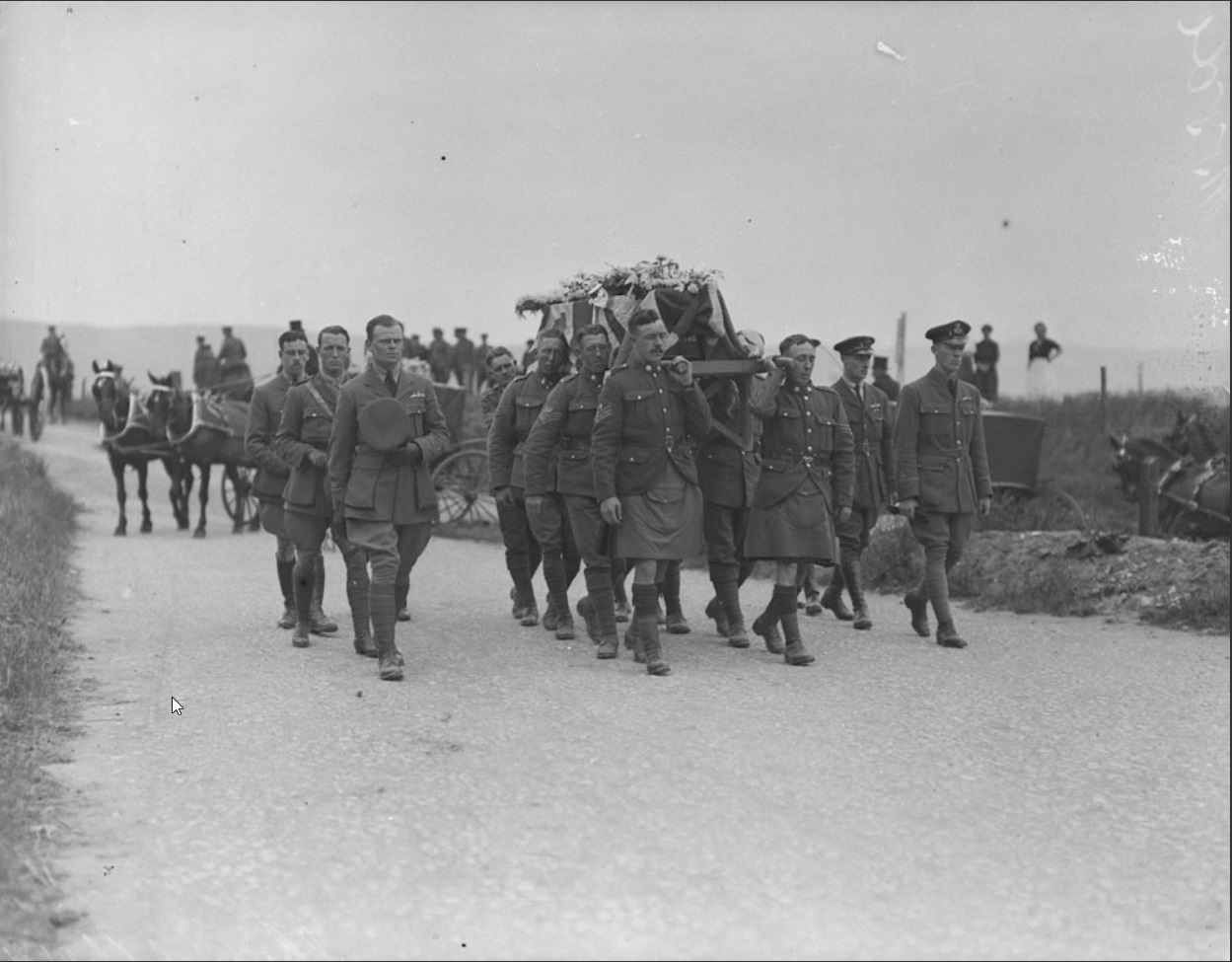
    Funeral of Second Lieutenant Robert Charles Bark

    The funeral procession began at the residence of Robert’s uncle in Manor Park, London.

    Outside the residence of Robert’s Uncle, Mr R V James. MIKAN No. 3394921
    MIKAN No. 3394928
    MIKAN No. 3394920
    MIKAN No. 3394924
    MIKAN No. 3394965
    MIKAN No. 3394966
    MIKAN No. 3394923
    MIKAN No. 3394964
    Robert Charles Bark
    Funeral of 2nd Lt. Robert Charles Bark, Royal Air Force. A Canadian who was accidentally killed. Lt. Bark died 28/03/1918. City of London Cemetery & Crematorium, Manor Park, London.
    Lieutenant Walter Austen Bark facing opposite his uncle Mr R V James. MIKAN No. 3394925
    MIKAN No. 3394927

    Lieutenant Walter Austen Bark

    Brother Lieutenant Walter Austen Bark 510131 served with the CASC. Walter attested 27 September 1915 in Niagara, Ontario. He stood 5′ 9″ tall with dark complexion, blue eyes, and black hair. Served with No. 10 Unit of Supply, Canadian Army Service Corps, the Canadian Base Depot, Shorncliffe and Seaford area, and On Command with the Canadian Salvage Corps until demobilization in July 1919. Rose in the ranks from Private, until granted his Commission on 1 March 1917.

    Special Thanks

    Nigel Cartwright has to be the most knowledgeable man I know on the airmen of the Great War. CEFRG would not have found the true identity of “R.C. Bark” without Nigel.

    ← Back

    Thank you for your response. ✨