CEFRG.ca

Category: Soldiers

Between 1914 and 1919, over 650,000 Canadians served at home and overseas during the Great War. On the Western Front in Belgium and France, Canadian soldiers of the Great War distinguished themselves in numerous battles, including Second Battle of Ypres, Battle of Vimy Ridge, and Second Battle of Passchendaele. In Canada’s Last Hundred Days of the Great War, Canadian soldiers at the sharp end of the spear breaking through the enemy’s formidable trench defences, the Hindenburg Line. Their efforts have inspired these soldier stories.

Collections

Many collections used to bring the soldier stories to life. First, and foremost, the Personnel Records of the soldiers serving in the Canadian Expeditionary Force (CEF). This collection, like the others to follow, digitized and made available by Library and Archives Canada (LAC). Secondly, the War Diaries of the CEF often provide vital information about a soldier’s life not contained in their service file. Finally, Circumstances of Death (CoD), War Graves Registers (GRRF), and Veterans Death Cards provide further information on The Fallen. These three collections in conjunction with records of the Commonwealth War Graves Commission (CWGC) vital to cases of identification and recovery of The Missing.

Courts Martial Records (FGCM)

Additional collections used to present the soldier stories include Courts Martial Records. Courts martial had the authority to try a wide range of military offences that resembled civilian crimes like fraud, theft or perjury. Others, like desertion and cowardice – purely military crimes. Records of individual courts martial consist of an average of 20 to 25 documents, mainly standardized forms. These document the trial and the charges under the Army Act.

MIKAN photo collection

Finally, the most powerful way of bringing soldier stories of the Great War to life, the images of the MIKAN collection digitized by LAC.  Often complementing these photos – images held by the Imperial War Museum (IWM), some of which also contain images captured by the Official Canadian War Photographers (CWRO) during the Great War. Both LAC and IWM have film collections which further bring the reality of the soldier stories of the Great War to life.

  • Private Vincent Zwingel in the Great War

    Private Vincent Zwingel in the Great War

    Private Vincent Zwingel born 1 May 1880 in Suwałki, Russia. Suwałki located about 30 kilometres from the southwestern Lithuanian border and gives its name to the Polish protected area, known as Suwałki Landscape Park.

    Private Vincent Zwingel
    Light railway with Forestry Corps team. MIKAN No. 3522853

    Vincent a labourer and resided at 50 Stephen Street, Montreal (later 535 St Antoine Street, Montreal), his wife Mrs Tena (Antanina) Zwingel of same address. They had four children, Annie (11), Mary (10), Vincent (4), and Anellie (2 months). 

    Enlistment

    Private Vincent Zwingel 847622 enlisted 13 March 1916 with the 150th Battalion, at this time, he stood 5’10” tall with fair complexion, blue eyes and fair hair – a Roman Catholic. Vincent, not understanding a word said by the enlistment officer, signed his attestation paper with an ‘X’, and later begins to send $20 a month home to his wife from his pay.

    150th Battalion

    Organized in November 1915 under the command of Lieutenant-Colonel Hercule Barré, and authorization published in General Order 151 of 22 December 1915. Mobilized at Montreal, and later recruited in the Montreal district. Draft of 99 to 69th Battalion later in March 1916.

    Lieutenant-Colonel Hercule Barré
    Lieutenant-Colonel Hercule Barré né à Montréal, Hercule Barré (1879-1944) est diplômé du Collège Mont-Saint-Louis et de l’Université Laval de Montréal (aujourd’hui l’Université de Montréal) où il y a obtenu un diplôme en pharmacie. À l’entrée en guerre du Canada, il est agent de publicité au quotidien montréalais La Patrie. Au cours de la Première Guerre mondiale, Barré sera fait chevalier de la Légion d’Honneur par la France. Il mourra en 1944.

    England

    150th Battalion embarked from Halifax 27 September 1916 aboard LAPLAND, and later disembarked in England 6 October 1916 with a strength of 24 officers, 515 other ranks. Draft of 75 to 22nd Battalion in November 1916, in addition, drafts of 50 to 22nd Battalion and 47 to 127th Battalion in December 1916.

    Private Vincent Zwingel
    In the trenches. 22nd Infantry battalion (French Canadian). July, 1916. MIKAN No. 3520957

    150th Battalion with the 14th Infantry Brigade, 5th Division later from 13 February 1917 to 9 February 1918. Drafts of 100 each to 14th, 22nd, 24th, 87th Battalions and to 5th Canadian Mounted Rifles later in February 1918. Finally, absorbed by 10th Canadian Reserve Battalion in February 1918.

    MIKAN No. 3219829
    Major George Pearkes, 5th Canadian Mounted Rifles, photographed wearing the Military Cross service ribbon, but has not yet received the ribbon for the Victoria Cross, earlier awarded due to his personal bravery, and masterly command decisions capturing and holding enemy strongpoints during the Battle of Passchendaele. He is wearing 4 wound stripes on his sleeve. MIKAN No. 3219829

    Private Zwingel admitted to Highland View, Amherst, with Pneumonia, 1 April 1916, later discharged to duty 9 May 1916.

    Private Vincent Zwingel
    Horatio Bottomley visiting Hospitals and cemeteries in France. September, 1917. MIKAN No. 3395851

    Vincent embarked for Liverpool from Halifax, 27 September 1916, later disembarking Liverpool 6 October 1916.

    S.S. LAPLAND Private Vincent Zwingel
    S.S. LAPLAND

    Private Vincent Zwingel transferred to 22nd Battalion, 29 November 1916, and joined his unit in the field, later on 4 December 1916.

    22nd Battalion

    In October 1914 under the command of Colonel Frederick Mondelet Gaudet Authorization published in General Order 36 of 15 March 1915. Mobilized at St-Jean, Québec, and later recruited throughout the province of Québec. Embarked from Halifax 20 May 1915 aboard SAXONIA, and later disembarked England 29 May 1915 with a strength of 36 officers, 1097 other ranks.

    Joseph Henri Chaballe commanded 'D' Company.
    22nd Battalion resting in a shell hole on their way to the front line, 15. September 1917. Battle of Flers-Courcelette. MIKAN No. 3522029

    Disembarked in France 15 September 1915 with the 2nd Canadian Division, 5th Canadian Infantry Brigade, and later reinforced by 10th Canadian Reserve Battalion. Returned to England 8 April 1919, disembarked in Canada 16 May 1919, demobilized 18 May 1919, and finally disbanded by General Order 149 of 15 September 1920. Colours deposited in Notre-Dame Cathedral, Montreal in 1919, and later handed over to Royal 22e Régiment in 1921, perpetuated by Royal 22e Régiment.

    Vincent struck-off-strength 22nd Battalion following the Battle of Vimy Ridge, to 2nd Labour Battalion, 17 April 1917.

    2nd Canadian Labour Battalion

    Organized at Seaford in January 1917 under the command of Lieutenant-Colonel Albert Coleman Garner, and arrived later in France 10 February 1917, and worked mainly on broad gauge railways. Later redesignated as 12th Battalion Canadian Railway Troops on 21 November 1917.

    Private Vincent Zwingel
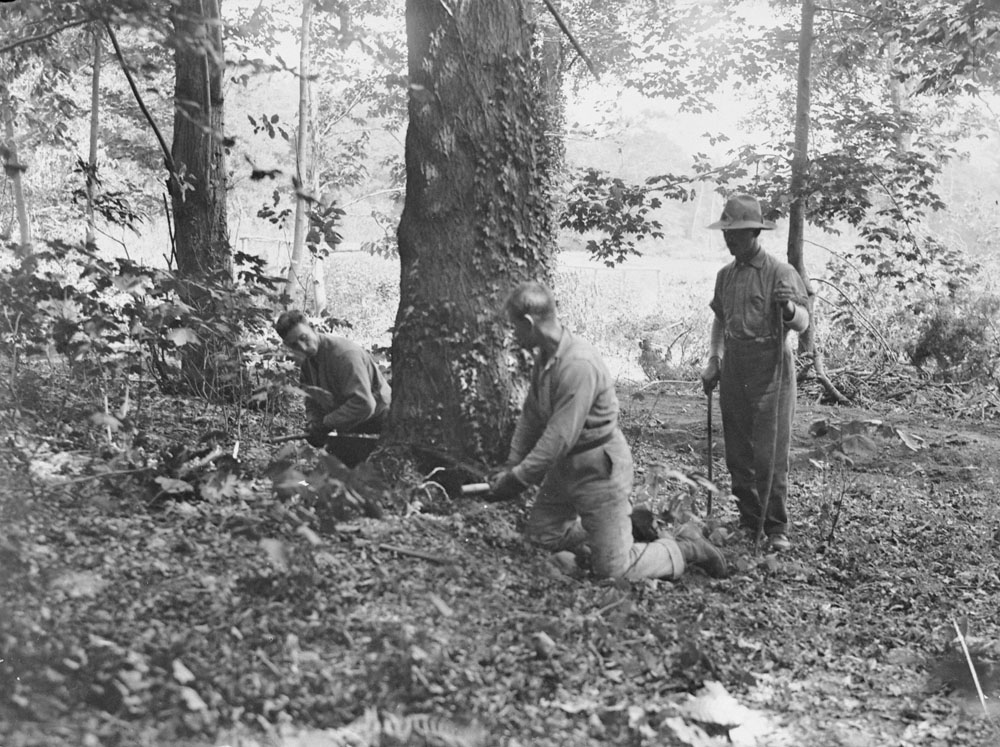
    Bush scene, Canadian Forestry Corps, Gerardmer [France] February, 1919. MIKAN No. 3522521

    Private Vincent Zwingel granted leave from 8 December 1917 to 22 December 1917, later rejoining his unit from leave on 27 December 1917.

    Pte Zwingel left for No.12 District, Canadian Forestry Corps, later on 8 May 1918.

    MIKAN No. 3522520
    Colonel White & Lieut.-Colonel J.B Donnelly, Canadian Forestry Corps H.Q., Paris Plage. February, 1919. MIKAN No. 3522520

    Private Vincent Zwingel granted 14 days leave, 9 November 1918, later rejoining his unit on 30 November 1918.

    Return to England

    Then, on 23 April 1919, Pte Zwingel sent to Base Depot, Sunningdale.

    Private Vincent Zwingel
    (Spectators) Princess Christian at Sunningdale watching a baseball match. Canadian Forestry Depot vs. Canadian Hospital at Taplow. MIKAN No. 3387332

    To Kinmel Park for return later to Canada 10 May 1919.

    Return to Canada

    Private Vincent Zwingel embarked Liverpool, 20 May 1919, later disembarked in Halifax, 28 May 1919.

    14th Battalion R.M.R. entering Phillips Square, Montreal, April 20, 1919

    Finally, S.o.S. in Montreal 19 June 1919, and Vincent went home to 535 St Antoine Street, Montreal, to his wife and four children.