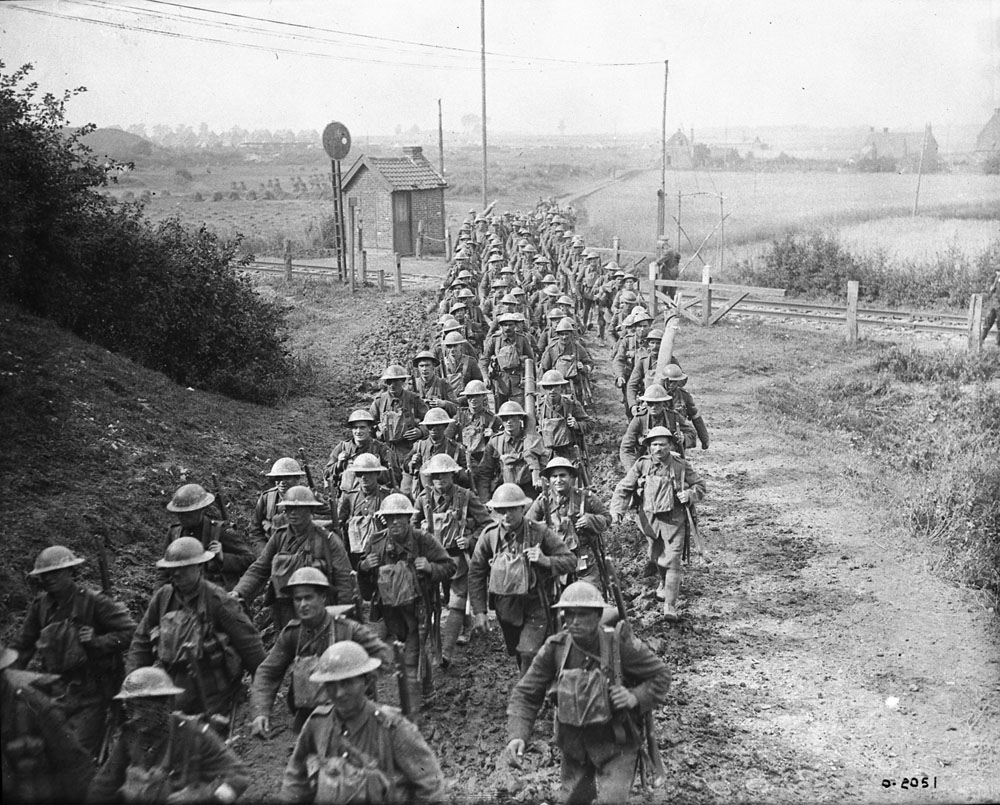
Private Maxwell Arthur Melville 426140 son of Edward William and Mary Ann Melville of Saskatoon, born at Cape Town, South Africa on 21 August 1882. Max decorated for fighting in the 2nd Boer War as a scout with Dumont’s Horse for the British Army – the Boers burned down the family farm so they immigrated to Canada.
Maxwell attested with the 46th Battalion on 29 August 1915 at Shorncliffe (a rare case of attesting in England for the CEF). Two years previous service with Bethune M.I. and Rearington Guards. At this time, he was 32 years of age, standing 5′ 7″ tall with dark complexion, brown eyes and dark hair.
46th Battalion
Organized in February 1915 under the command of Lieutenant-Colonel Hubert Snell, and later mobilized at Moose Jaw, and recruited in Moose Jaw, Regina, Weyburn, Estevan and Arcola. Draft of 5 officers and 250 other ranks sent to England on 5 July 1915, later a smaller draft sent to England on 4 September 1915. Finally, embarked from Halifax 23 October 1915 aboard SS LAPLAND.

Later disembarked in England 30 October 1915 with a strength of 36 officers, 1115 other ranks. Disembarked in France 10 August 1916, with the 4th Canadian Division, 10th Canadian Infantry Brigade, and later reinforced by 19th Canadian Reserve Battalion. Perpetuated by The King’s Own Rifles which was redesignated 20th Saskatchewan Armoured Regiment in 1946, later in 1954, The Saskatchewan Dragoons.

Then on 19 July 1915, Private Maxwell Arthur Melville attached to the 32nd Reserve Battalion, Shorncliffe.
32nd Battalion
Organized as 32nd Battalion Arrived in England 7 March 1915, and later became a reserve Battalion at Shorncliffe on 2 May 1915. In addition, absorbed 152nd Battalion on 21 October and 195th Battalion on 11 November 1916. Finally, absorbed by 15th Canadian Reserve Battalion on 4 January 1917.
Private Maxwell Arthur Melville later transferred to 8th Battalion, France, 6 September 1915.
8th Battalion
Organized in Valcartier Camp September 1914 and initially composed of recruits from Winnipeg and from the 96th Lake Superior Regt. of the Active Militia. Commanded by Lieutenant-Colonel Louis J Lipsett, and later embarked Quebec City 1 October 1914 aboard SS FRANCONIA.

Disembarked England 14 October 1914 with a strength of 47 officers, 1106 other ranks, and later disembarked in France 13 February 1915, with the 1st Canadian Division, 2nd Canadian Infantry Brigade. Later reinforced by 18th Canadian Reserve Battalion. Later perpetuated by The Royal Winnipeg Rifles.

Buried by a shell
Private Maxwell Arthur Melville admitted Graylingwell War Hospital, Chichester, 24 June 1916, contusion back, in addition – shell shock. Maxwell buried by a shell earlier on 14 June 1916, not losing consciousness with contusions to his back.

Admitted Canadian Divisional Convalescent Hospital, Woodcote, 7 July 1916, and later discharged 14 August 1916.
Sick
Reported from base, sick, 7 March 1917, and later admitted to No.138 Canadian Field Ambulance with Scabies.

Private Maxwell Arthur Melville then admitted to No.41 Divisional Rest Station, 10 March 1917.
Admitted to Northumberland Casualty Clearing Station, 11 March 1917, and later discharged to duty, 14 March 1917.

Max completes his will on 7 April 1917, bequeathing all to his mother.
Trench Fever
Then on 16 July 1917, Private Maxwell Arthur Melville admitted to No.8 Stationary Hospital, Camiers, Trench Fever.
Private Maxwell Arthur Melville later transferred to No.2 Canadian Tunneling Company, 28 July 1917.

Admitted to West Birmingham War Hospital, 6 August 1917, and later admitted to Canadian Convalescent Hospital, Epsom, 28 August 1917, and later discharged to duty, 19 September 1917.
Private Maxwell Arthur Melville re-drafted to 8th Battalion, 26 April 1918. In addition, granted Good Conduct Badge, 16 May 1918, in the field.
Battle of Amiens
Maxwell Arthur Melville killed in action, 9 August 1918.


Vrely Communal Cemetery Extension
Vrely a village 32 kilometres East of Amiens, immediately South of Rosieres-en-Santerre. The Communal Cemetery Extension adjoins the rear of the Communal Cemetery, which is west of the village on the road to Caix.
Vrély initially captured by the 2nd Canadian Division on 9 August 1918. The communal cemetery extension then made by the Canadian Corps Burial Officer after the capture of the village. Private Joseph Malouin of The Van Doos also buried at Vrely Communal Cemetery Extension.