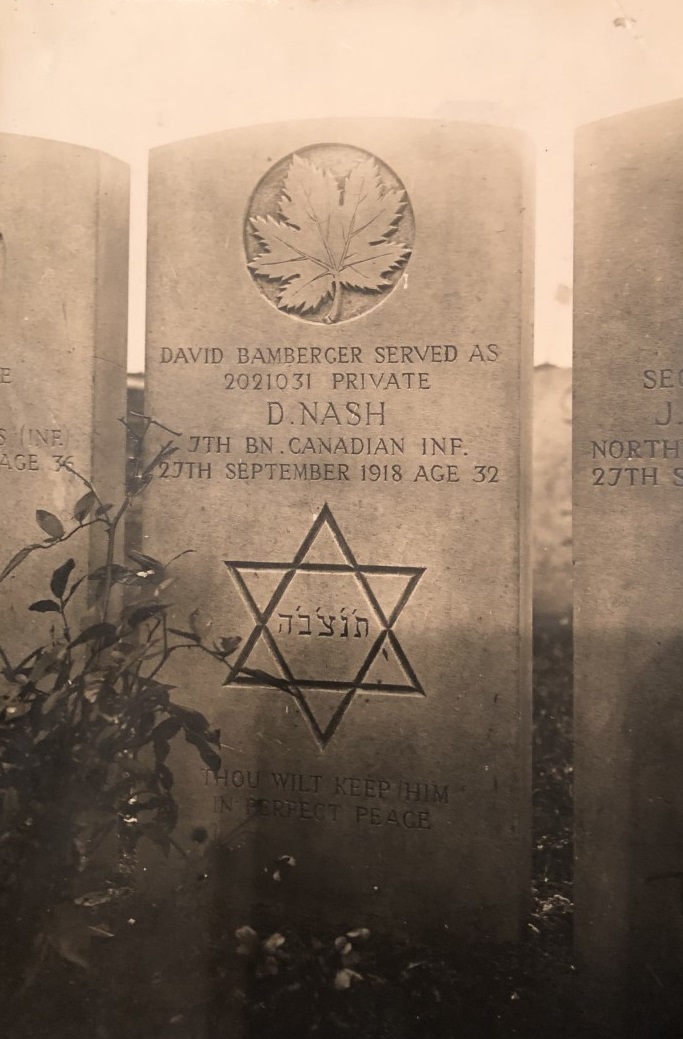
Served as David Nash
Though Wilt Keep Him In Perfect Peace
Private David Bamberger (served as David Nash) son of Jacob and Mary Bamberger, of 27 Milton Road, Stoke Newington, London, England, born 26 January 1884 in London, England.

Enlistment of Private David Bamberger
Private David Bamberger 2021031 enlisted 10 December 1917 in Vancouver, BC with the 1st Depot Battalion in Medical District No.11. Single, and a trackman by trade. At this time, he stood 5′ 6″ tall, 150 pounds, with medium complexion, hazel eyes, and dark brown hair.

The reason for the anglicized surname quite simple – David, like thousands of other Jews serving in the CEF, wished to be accepted, unequivocally, by his comrades. Jewish soldiers, like David, often registered as Protestants. Still, David declared Mary Bamberger as his mother.

David, hereafter referred to as Pte Bamberger, arrived in England aboard SS METAGAMA 11 March 1918, fairly late in the Great War. Private David Bamberger ToS (Taken-on-Strength) 1st Reserve Battalion, Seaford, 11 March 1918.

Then on 21 June 1918, Pte Bamberger SoS (Struck-off-Strength) to 7th Battalion overseas. However, quite some time elapses before David finally joins his unit.
7th Battalion
Organized in Valcartier Camp September 1914 and initially composed of recruits from British Columbia, commanded by Lieutenant-Colonel W H McHarg. Embarked Quebec City 25 September 1914 aboard VIRGINIAN, later disembarked in England 14 October 1914 with a strength of 49 officers, 1083 other ranks.

Disembarked in France 10 February 1915 with the 1st Canadian Division, 2nd Canadian Infantry Brigade, and later reinforced by 1st Canadian Reserve Battalion, and perpetuated by British Columbia Regiment.

Prior to catching up with his unit, Private David Bamberger sentenced to forfeit 7 days pay, 3 July 1918, for Absent without leave from hospital fatigue.

Pte Bamberger to Canadian Corps Reinforcement Camp, arriving later on 14 July 1918.


Battle of Amiens
Private David Bamberger left to join unit, along with 79 Other Ranks, 14 August 1918, Warvillers. However, David has just missed the opening day of the Battle of Amiens, 8 August 1918 – known as the Darkest Day of the German Army. Several men in No.3 Company wounded the following day when a German plane dropped a bomb.

Finally, on 17 August 1918, David with his battalion in the front lines for the first time – nine Other Ranks killed.
Canal du Nord
The opening of Canada’s Last Hundred Days included several attacks. Following the Battle of Amiens, the Canadians once again spearheaded the British First Army’s attack on the Arras front, through the Drocourt-Quéant Line (D-Q Line) and then across the Canal du Nord to capture the town of Cambrai.

Canal du Nord a battle honour incorporating the tactical incident “Capture of Bourlon Wood”, formally entitled the “Battle of the Canal du Nord”, in addition, itself part of “The Battles of the Hindenburg Line”.

Private David Bamberger killed-in-action 29 September 1918, shortly after crossing the Canal du Nord near Marquion.


Quarry Cemetery, Marquion

Marquion a village in the Department of the Pas-de-Calais, on the straight main road from Arras to Cambrai. Quarry Cemetery about 1 kilometre south east of the village.
Quarry Cemetery (called also the Chalk Pit Cemetery) made by fighting units after the battle and used during the following month. One grave brought in from Marquion German Cemetery following the Armistice. Finally, Quarry Cemetery contains 68 burials of the Great War, designed by Sir Edwin Lutyens.
A tribute to our Jewish War Veterans of Canada
The history of the Jews in the Canadian military dispels the myth Jews have not contributed their share in the Canadian Forces. This includes the Boer War, the Great War, the Second World War, the Korean War as well as in Canada’s ongoing military activities throughout the world.
During the Great War, 38% of all Jewish males 21 years and over in Canada served in the Canadian Expeditionary Force. In addition, 4.5% earned decorations for bravery and distinguished military service, in comparison with 3.4% Canadian soldiers of all origins.