Captain William Douglas Cruikshank worked alongside Lt Col John McCrae in No 3 Canadian General Hospital, prior to serving as Medical Officer with the 27th Battalion (City of Winnipeg), and then finished the Great War with the Princess Patricia’s Canadian Light Infantry (PPCLI). Following demobilization, and returning with the Regiment to Ottawa in 1919, unknown if and where he returned to practice.

Early Life
Captain William Douglas Cruikshank born 26 November 1884 in Hamilton, Ontario. Mrs. Anne Smith Cruikshank (mother) of 219 Main St. W., Hamilton, Ontario.
Dr William Douglas Cruikshank graduated in medicine from McGill University in 1913, and later in July of 1915, the Canadian Medical Association Journal, Vol V, No 7, notes Dr William Douglas Cruikshank now licensed to practice medicine.

Enlistment
Place of Enlistment, Kingston, Ontario, 4 January 1916 with No 7 General Hospital. At this time, William stood 5′ 10″, 165 pounds, with gray eyes, and scarlet fever in infancy. In addition, previous service with The Queen’s Own Rifles, Canada’ oldest infantry regiment, address at enlistment 219 Main St W, Hamilton, Ontario.
France
Captain William Douglas Cruikshank proceeded overseas to No 2 Canadian General Hospital, 10 May 1916, then ToS on arrival from England as reinforcement, Le Treport, 11 May 1916, with No 2 General Hospital.

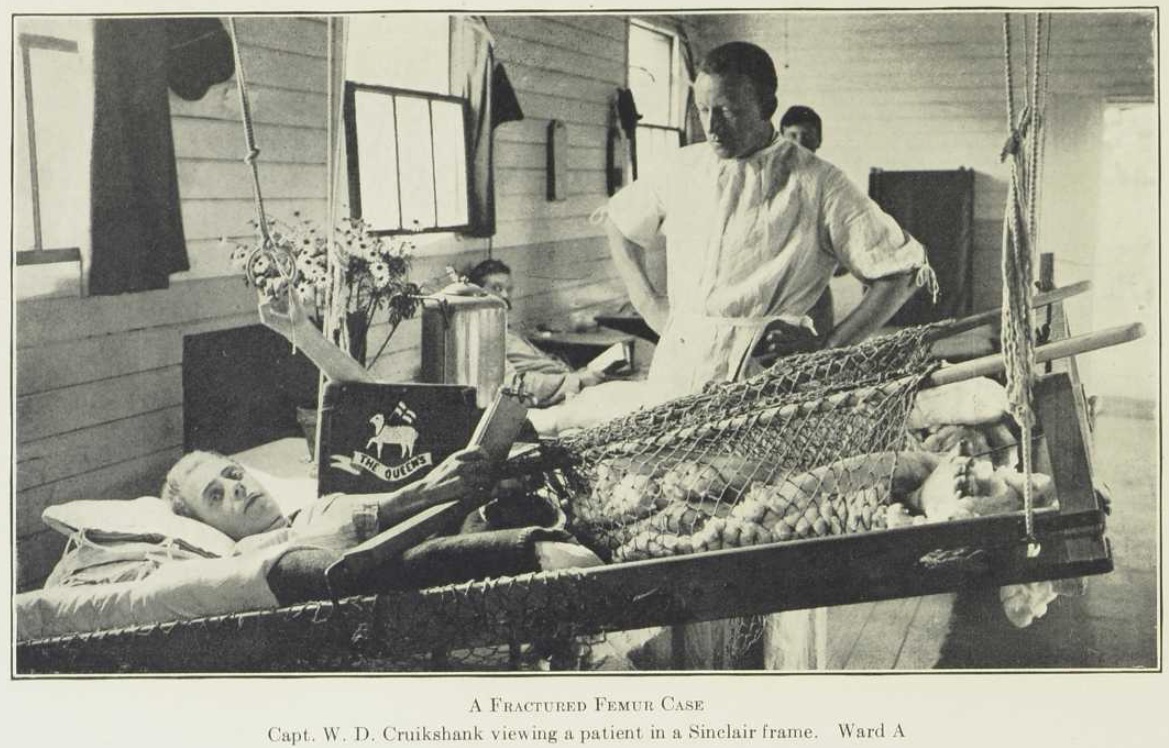
A Sinclair net frame a rectangular wooden frame in which the patient supported by a strong net. Each lower limb attached to its corresponding corner of this net. The frame suspended by ropes from overhead bars, and the foot raised till the necessary extension obtained.

Captain Cruickshank reposted to 27th Canadian Infantry Battalion, 22 August 1916, and later ToS of CAMC and attached to 27th CIB as Medical Officer, 23 August 1916.
Battle of Flers-Courcelette

MIKAN No. 3395791: A Captain (likely of the Canadian Army Medical Corps), wearing a ribbon for the Military Cross above his left chest pocket, accompanying the soldier, wounded in the arm, in addition, his leg, and face. At right, another photographer, likely Canadian War Records Office official kinematographer Lt. Oscar Bovill, is also filming.
Based on medical information in his service file, very likely identification of the wounded soldier as Corporal Douglas Horace Carter 71885. Carter a provincial employee of the Brandon Asylum, enlisted in October 1915 for Overseas service in the Canadian Expeditionary Force, and while serving with the 27th Canadian Infantry Battalion (City of Winnipeg), wounded on 15 September 1916.
He received Gun-shot wounds and shell wounds to the left face and jaw, right wrist, and right leg, and, after a lengthy recovery, returned to Canada in 1917 and discharged from the Canadian Expeditionary Force as medically unfit, later on 15 February 1918 in Brandon, Manitoba.
Captain William Douglas Cruikshank granted ten days leave, 8 December 1916, later returning to unit on 19 December 1916.
Captain Cruickshank granted ten days leave, 9 June 1917, later returning to unit on 21 June 1917. Ceases to be attached to 27th Battalion, 21 June 1917, then posted to No 3 Canadian General Hospital, 23 June 1917. Granted 14 days leave, 15 December 1917, later returning to unit on 31 December 1917.
PPCLI
Captain William Douglas Cruikshank SoS on posting to CAMC, attached to PPCLI, 3rd Canadian Division, 18 July 1918, then later on 15 October 1918, all officer’s of the PPCLI attend the funeral of Major General Louis Lipsett.

Armistice

Front Row (L-R): Captain James Arthur Haslam, Captain James H Carvosso, Captain Kenneth Charles Burness, Lieutenant Arthur Reginald Chipman, Major George Wilfred Little, Lieutenant Colonel Alfred Glynn Pearson, in addition, Major Thomas McCarthy (Chaplain), Major James N Edgar, Captain A C White, Captain L M Johnstone, Lieutenant Melville Allan (original PPCLI), and Lieutenant Albert John Kelly.
Middle Row (L-R): Lieutenant Thomas Samuel Heaslip, Lieutenant J G Donald, Captain William Douglas Cruikshank (Medical Officer), in addition, Lieutenant George Cathness Aldridge, Lieutenant Willis Lumgair Clark, Lieutenant C C Robinson, Lieutenant Edward Russell Donaldson, Lieutenant Charles Kemp McRorie, Lieutenant Nathaniel Cameron McFarlane, and Lieutenant Charles Francis Lalor.
Back Row (L-R): Lieutenant Carl Frederickson, Lieutenant John Christie, Lieutenant N W Murray, Lieutenant Ralph Stewart MacPherson, Lieutenant William J Popey (original PPCLI), in addition, Lieutenant Norman David Dow, Lieutenant Edwin Miller Jacques, Lieutenant Percy Carl Klaehn, Lieutenant Harold B J Ogilvie, Lieutenant Edward Crossley Plant, and Lieutenant Marcus Leslie Hancock.
Captain William Douglas Cruikshank attached to PPCLI until proceeding to England from Le Havre on 7 February 1919, then later medical examination at Bramshott on 22 February 1919, the day after meeting Princess Patricia.

Cruickshank then returned to Canada from Liverpool per SS CARMANIA, 8 March 1919. Captain Cruickshank attended the PPCLI Officers Homecoming at Ottawa, 20 March 1919, however, what became of him upon his return to civilian life remains a mystery today.