Private Albert J Mowatt a descendant of the original settlers of Harvey Station, New Brunswick. Albert killed on 9 April 1917 near HILL 145, in the Battle of Vimy Ridge.
Mowatt Family History
Harvey Settlement
Harvey Settlement founded by a group of 154 settlers who arrived on board the ‘Snow’ rigged Cornelius of Sunderland during it’s maiden voyage from Berwick-Upon-Tweed, Northumberland, United Kingdom to Saint John, New Brunswick, Canada (May 29 – July 12, 1837).

MOWATT (MOWET) – HULISTON
James Mowatt, his wife Catherine Huliston and their 8 months old daughter Agnes aboard the Cornelius along with James’s brother Thomas Mowatt and his wife Elizabeth “Betsy” Moffitt. James received Land Grant Lot #6W, of 100 acres. In the statistical report for Harvey Settlement for the year 1843, four in James family. They had 8 acres in crops, 4 acres new land ready for crop next year, and also 8 acres in meadow and 3 acres in pasture.
James Mowatt, Husband, aged ca. 30, b. 1807/1808, Northumberland, son of Andrew Mowatt & Margaret, d. Jan 1892, Harvey, buried Harvey Settlement Cemetery. Pre-emigration occupation labourer, post-emigration occupation farmer. Religion Presbyterian.
Catherine Huliston, Wife, aged 33, b. 1804, England, d.11 Oct 1866, Harvey, buried Harvey Settlement Cemetery.
Agnes Mowatt, Daughter, aged 8 months, b. 1836, England, d. 25 Jul 1868, Harvey, buried Harvey Settlement Cemetery.

MOWATT (MOWET) – MOFFITT
Andrew Mowatt, son of James Mowatt and Catherine Huliston. Occupation Farmer. Born 14 Oct 1839 in Harvey, and christened 28 Jun 1840 in Harvey Settlement By Rev Daniel McCurdy. Died 5 Nov 1920 in Harvey, and finally buried in Harvey Settlement Cemetery.
Andrew Mowatt married Isabella Watt, daughter of Michael Watt and Mary Ann Morecraft, 9 Jun 1870 in Harvey Presbyterian Church , by Rev Samuel Johnson. Born 2 Mar 1845 in Fredericton, and died 8 Mar 1932 in McAdam, finally buried 10 Mar 1932 in Harvey Settlement Cemetery.
Mrs Mowatt endeared herself to all who knew her. A member of the Presbyterian Church, later joining with the United Church. A life member of the W.M.S. She had a keen mind and was widely read.
Children of Andrew and Isabella Mowatt
They had the following children, Ellenor Johnson Mowatt, Catherine Huliston “Kate” Mowatt, Mary Edith “Ada” Mowatt, Jane W “Jennie” Mowatt, Albert J Mowatt born 16 Jun 1881 – died 9 Apr 1917, Battle of Vimy Ridge, Hartley A Mowatt, Margaret Rae “Maggie” Mowatt, and finally, Everett Edward Mowatt.
Enlistment of Private Albert Mowatt
Private Albert Mowatt 703806 enlisted 1 February 1916 in Thurlow, British Columbia with 102nd Battalion, also with 3 years previous service with 71st Regiment, New Brunswick. Promoted Corporal 26 February 1916.
Albert J Mowatt a logger/machinist standing 6 foot tall, 185 pounds, with ruddy complexion, hazel eyes, and light brown hair. In addition, Albert assigned $15 of his pay to a Mrs Ben Harris of McCallum Junction, NB.

Private Albert J Mowatt sailed from Halifax per SS EMPRESS OF BRITAIN, 18 June 1916.
Western Front
Albert landed in Le Havre, 12 August 1916.

Pte Mowatt wounded 10 November 1916, GSW to his head, yet miraculously returns to duty three days later.

Newspaper Obituary
Harvey Man Killed
Mr and Mrs Andrew Mowatt, of Harvey Station (N.B.) received a message last week informing them that their eldest son, Albert, who was a soldier in one of the Canadian regiments now serving in France, had been killed in one of the recent battles there. The deceased soldier left his home here about fourteen years ago and went to British Columbia, where he engaged in lumbering but shortly after the outbreak of the war enlisted in one of the British Columbia units. He is the fifth Harvey boy who has made the supreme sacrifice.

Albert’s service file notes unable to locate next of kin.
First Burial
Private Mowatt initially buried at Sheet 44a.S.22.a.8.3 (actually 36c.S.22.a.8.3). About 1,000 feet SSE of the Vimy Memorial, 2,500 feet east of Canadian Cemetery No 2.
Gunner’s Crater located at 36c.S.15.a, one of a string of four craters alongside RUSSEL ROW trench. This location 3,700 feet NE of Vimy Memorial, and close to Givenchy-en-Gohelle Canadian Cemetery, Souchez.
To understand these various locations of the body of Pte Mowatt, firstly consider the area in which his battalion fighting when he fell. Near BROADMARSH CRATER an enemy strongpoint captured (Sheet 36c.S.21.d). Immediately, this lends credence to the initial burial location of Albert. Appears likely Private Albert J Mowatt helped capture the enemy strongpoint, but perished a few hundred yards beyond this area, the limit of the 102nd Battalion’s penetration until 18h30, when the 85th Battalion captured HILL 145, and allowed the 102nd to leave their foxholes.
Other 102nd Battalion Casualties
About 120 Other Ranks in the 102nd Battalion died on 9 April 1917. Only 18 of these found on the Vimy Memorial, in addition, Pte Mowatt’s CoD reveals no evidence of having been buried in Canadian Cemetery No 2. The GRRF file for the cemetery therefore requires examination. Is Private Albert J Mowatt ever mentioned? Indeed, Row C with a Special Memorial A – Known To Be Buried In This Cemetery.
It appears, only slightly more accurately, Albert should have received a Kipling Memorial with these other men known to have been buried in Gunners’ Crater, although Albert’s action rather far from this location. Was he moved from his initial burial to Gunner’s Crater at some time? It seems rather arbitrary to have a Special Memorial in Canadian Cemetery No 2, rather than listed on the Vimy Memorial (believed to be among The Missing).
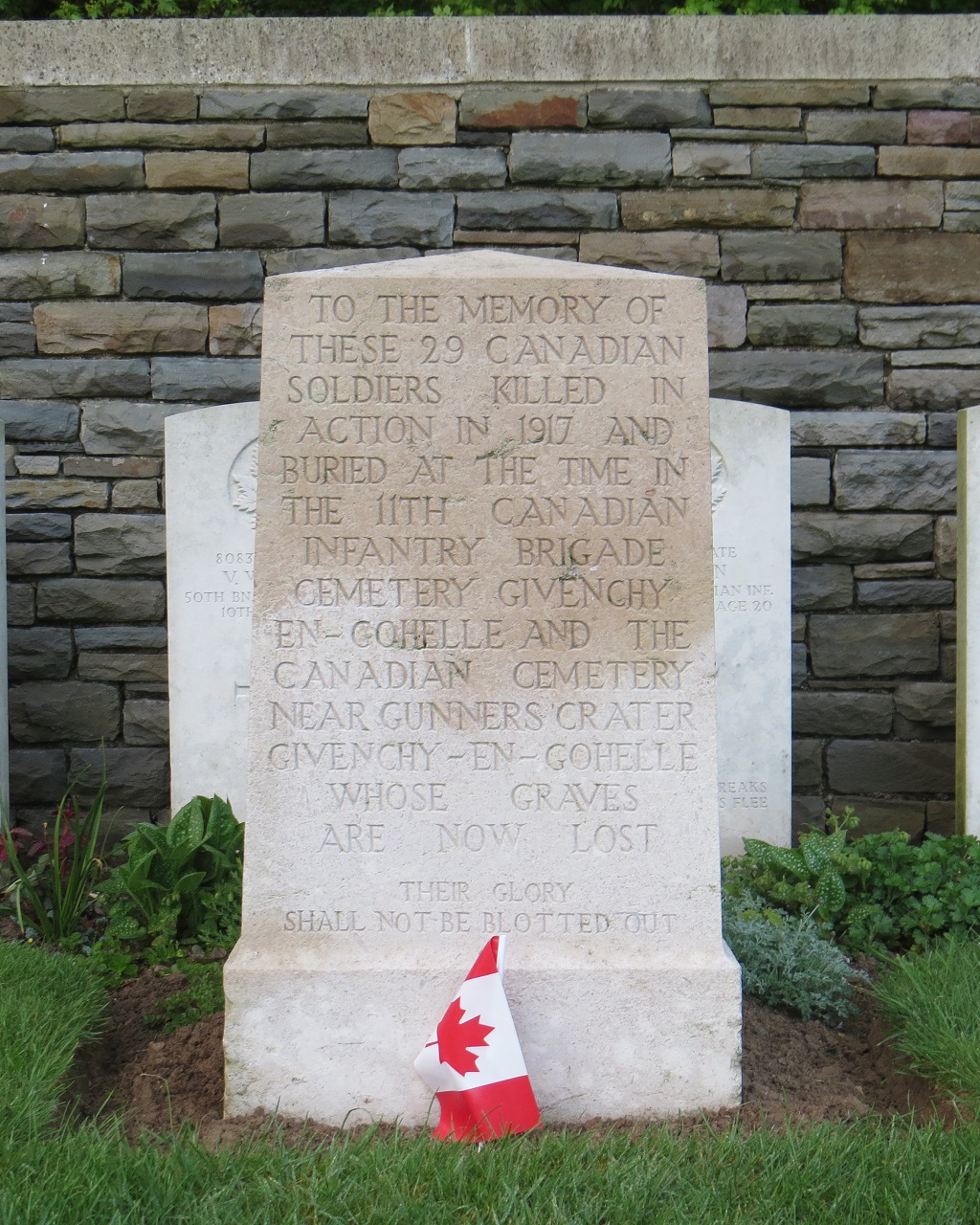
Gunner’s Crater Kipling Memorial
Perhaps the CoDs of the other 102nd Battalion soldiers in this row may reveal further information. Two headstones over Private F Copas 706492 (recovered from Sheet 36c.S.22.a.8.3, same location as Mowatt). The War Graves Register of Copas states only the Memorial Cross of the GRC found at this location. And another two headstones over, Private F Ince 252675, same circumstances. And, at the end of the row Private L Hanson 707103, also initially buried with Private Mowatt.

Why these men not given a Kipling Memorial, as one on the other side of the Cross of Sacrifice, a mystery. No evidence of these men at any time buried in Canadian Cemetery No 2, therefore, the Kipling Memorial above more appropriate for these men. Unfortunately, CWGC policy no longer provides Kipling Memorials, and these men shall continue to be honoured in Canadian Cemetery No 2 with a Special Memorial.
Canadian Cemetery No. 2, Pas de Calais, France
The cemetery established by the Canadian Corps after the successful storming of Vimy Ridge on 9 April 1917. Some of those buried in the cemetery fell in that battle or died of wounds received there. Although the majority of the graves made later for the burial of the dead recovered from surrounding battlefields and from isolated graves transferred into the cemetery over a period of years after the Armistice. The cemetery covers an area of 10,869 square metres and enclosed by low walls of coursed stone.
Nearly 3,000, Great War casualties commemorated in this site. 29 Canadian soldiers buried at the time in the 11th Canadian Infantry Brigade Cemetery, Givenchy-en Gohelle. And, the Canadian cemetery near Gunner’s Crater, Givenchy-en-Gohelle, but whose graves now lost commemorated by special memorial headstones, inscribed to this effect with the additional quotation, “Their Glory shall not be blotted out”.


