CEFRG.ca

Category: Soldiers

Between 1914 and 1919, over 650,000 Canadians served at home and overseas during the Great War. On the Western Front in Belgium and France, Canadian soldiers of the Great War distinguished themselves in numerous battles, including Second Battle of Ypres, Battle of Vimy Ridge, and Second Battle of Passchendaele. In Canada’s Last Hundred Days of the Great War, Canadian soldiers at the sharp end of the spear breaking through the enemy’s formidable trench defences, the Hindenburg Line. Their efforts have inspired these soldier stories.

Collections

Many collections used to bring the soldier stories to life. First, and foremost, the Personnel Records of the soldiers serving in the Canadian Expeditionary Force (CEF). This collection, like the others to follow, digitized and made available by Library and Archives Canada (LAC). Secondly, the War Diaries of the CEF often provide vital information about a soldier’s life not contained in their service file. Finally, Circumstances of Death (CoD), War Graves Registers (GRRF), and Veterans Death Cards provide further information on The Fallen. These three collections in conjunction with records of the Commonwealth War Graves Commission (CWGC) vital to cases of identification and recovery of The Missing.

Courts Martial Records (FGCM)

Additional collections used to present the soldier stories include Courts Martial Records. Courts martial had the authority to try a wide range of military offences that resembled civilian crimes like fraud, theft or perjury. Others, like desertion and cowardice – purely military crimes. Records of individual courts martial consist of an average of 20 to 25 documents, mainly standardized forms. These document the trial and the charges under the Army Act.

MIKAN photo collection

Finally, the most powerful way of bringing soldier stories of the Great War to life, the images of the MIKAN collection digitized by LAC.  Often complementing these photos – images held by the Imperial War Museum (IWM), some of which also contain images captured by the Official Canadian War Photographers (CWRO) during the Great War. Both LAC and IWM have film collections which further bring the reality of the soldier stories of the Great War to life.

  • Gunner George McDougall in the Great War

    Gunner George McDougall in the Great War

    Gunner George A McDougall born in Moncton, New Brunswick on 26 March 1881. Next of kin, his wife, Mrs Ella McDougall of 8 Pacific Avenue, Moncton, NB.

    Attestation of Gunner George McDougall

    Gunner George A McDougall 43901 attested 20 September 1914 in Valcartier, QC. Previous service with 74th Regiment, NB. A painter. Standing 5′ 5″ tall with fresh complexion, blue eyes and dark hair. Woman’s head on right forearm tattoo, and also Indian’s head, skull, snake, crosses, swords and letter through heart dagger, all on left arm tattoo.

    Gunner George McDougall
    1st Battalion Valcartier Camp

    1st Divisional Ammunition Column

    Organized in August 1914 initially under the command of Lieutenant-Colonel John Jenkins Penhale. Mobilized at Valcartier, and left Quebec on 30 September 1914 aboard SS MEGANTIC and SS MONTEZUMA, and later arrived in England on 14 October 1914 with a strength of 30 officers, 561 other ranks.

    Lieutenant-Colonel John Jenkins Penhale Christmas Card 1914
    Lieutenant-Colonel John Jenkins Penhale Christmas Card 1914

    Arrived in France later on 12 February 1915 with the 1st Canadian Divisional Artillery. Divisional Ammunition Columns responsible for the delivery of ammunitions to batteries and other units from ammunition refilling points.

    MIKAN No. 3194797 Gunner George McDougall
    Pack horses taking up ammunition to guns of 20th Bty. C.F.A., Neuville St. Vaast, April 1917. MIKAN No. 3194797

    Second Battle of Ypres

    Gunner George McDougall killed in action by rifle fire, 22 April 1915 near Bank Farm, 3 1/4 miles north east of Ypres. Grave registered later at Sheet 28.C.24.b.45.60.

    Gunner George A McDougall burial location Gunner George McDougall
    Gunner George A McDougall burial location.

    Victory Medal, British War Medal and ’15 Star sent to his mother Mrs A McDougall of 124 Lutes Street, Moncton, NB. Gunner George McDougall’s body brought back four kilometers to the west following the Armistice to New Irish Farm Cemetery.

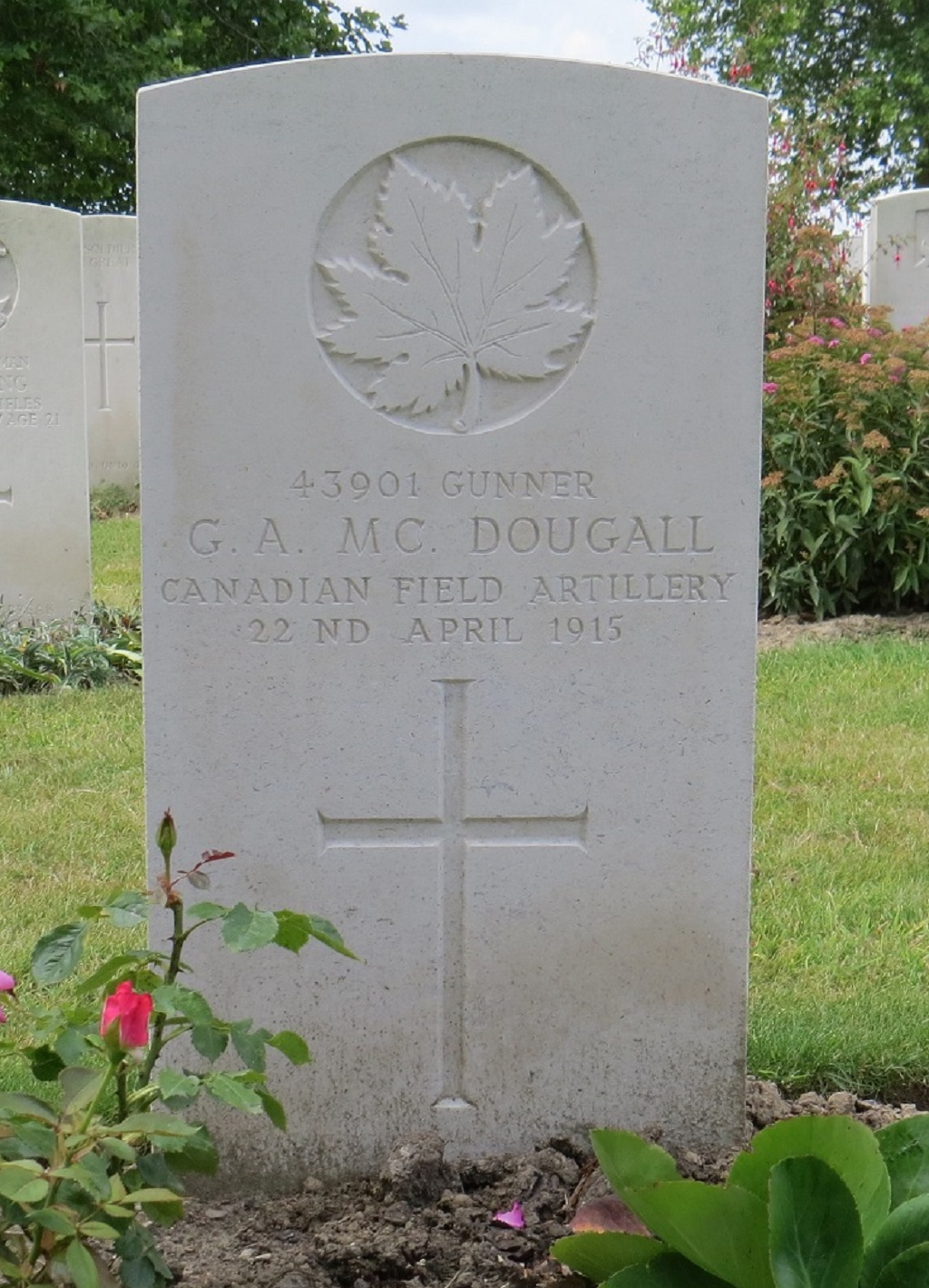
    Gunner George A McDougall 43901 CVWM Gunner George McDougall
    Grave of Gunner George A McDougall

    New Irish Farm Cemetery

    The cemetery located to the north-east of the town of Ieper. New Irish Farm Cemetery initially used from August to November 1917 and named after a nearby farm, known to the troops as ‘Irish Farm’ (originally an Irish Farm Cemetery immediately South of the Farm). New Irish Farm Cemetery about 300 metres North of the Farm at a crossing once known as Hammond’s Corner.

    The cemetery used again in April and May 1918 and at the Armistice it contained just 73 burials. The three irregular rows of Plot I – but greatly enlarged when more than 4,500 graves brought in from the battlefields north-east of Ypres (now Ieper) and from smaller cemeteries.

    New Irish Farm Cemetery, 8 August 2019 Gunner George McDougall
    There are more unidentified, rather than identified Canadian soldiers and pilots at New Irish Farm Cemetery. 8 August 2019, CEFRG

    4,719 commonwealth servicemen of the Great War buried or commemorated in this cemetery. 3,271 of the burials unidentified, but special memorials commemorate four casualties known, or believed buried among them. Other special memorials also record the names of 30 casualties buried in four of the cemeteries removed to New Irish Farm whose graves destroyed by shell fire.

    Private John Lambert

    The burial of Private John Lambert, two unknown British soldiers and also an unknown German soldier takes place at 11 am Central European Summer Time (CEST) on June 30, 2022 at New Irish Farm Cemetery, near Ypres in Belgium.

    Private John Lambert photo by family
    Private John Lambert photo by family

    In 2016, multiple sets of human remains found during a planned archaeological dig near Langemark, Belgium. The Canadian Armed Forces later confirmed the identity of one of these sets of remains to be those of Private John Lambert, a member of The Newfoundland Regiment perpetuated by the The Royal Newfoundland Regiment.