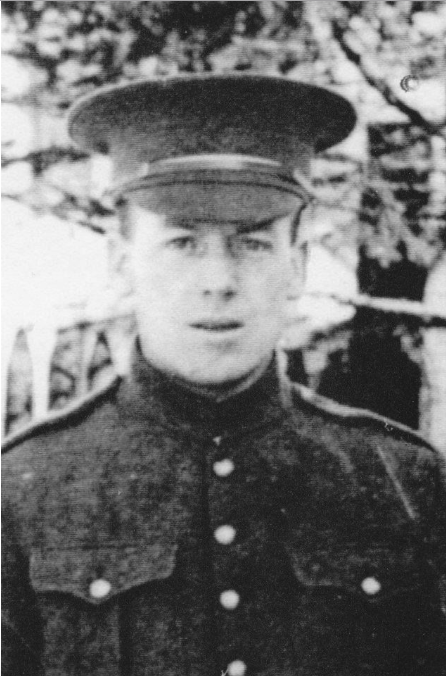
Private Frederick Horne born in Norfolk, England on 31 March 1894. A Laborer. Next of kin, his wife Molly Horne. Father of Sergeant Reginald Ernest Horne, who died 19 September 1944 during service with the Algonquin Regiment, R.C.I.C.

Attestation of Private Frederick Horne
Pte Frederick Horne 4319 attested 23 January 1915 in Chatam, Ontario. Two years previous service with Territorial Royal Field Artillery.

Private Frederick Horne sailed from Montreal per SS SCANDINAVIAN, 17 July 1915.
1st Battalion
Organized at Valcartier Camp September 1914 composed of recruits from MD 1 (Western Ontario), initially commanded by Lieutenant-Colonel F W Hill. Other Officers Commanding F A Creighton (24/1/16) and also G C Hodson (27/6/16). Embarked from Quebec 25 September 1914 aboard LAURENTIC, and later disembarked in England 14 October 1914 with a strength of 45 officers, 1121 other ranks.

The 1st Battalion arrived in France 11 February 1915 with the 1st Division, 1st Canadian Infantry Brigade, and later reinforced by 4th Canadian Reserve Battalion. Private Frederick Horne joined his unit six months later on 26 August 1915.
The Death of Private Frederick Horne
On 1 December 1916, 1st Battalion in Divisional Reserve at Dranoutre. Company parades, training of grenadiers, etc. Bathing parades the following day. On 4 December, the battalion relieves the 4th Canadian Infantry Battalion in the line, in front of trenches C3, C4, D1 and also D2. Supporting points 4 and 5, Souvenier Farm, as well as St Quentin Cabaret. Finally, trenches very wet and much damaged by rain.

Still holding the trenches on 7 December 1916, enemy artillery active during the afternoon. Supposed sounds of enemy mining heard in the afternoon. A mining officer investigated, but unable to give a definitive opinion.

Private Frederick Horne transferred by No 2 CFA to No 8 CCS, GSW abdomen, 7 December 1915.

Pte Frederick Horne died of wounds 8 December 1915. Widow Molly Horne 76 Murray Street, Chatham, Ontario.
Bailleul Communal Cemetery Extension, Nord
Bailleul occupied on 14 October 1914 by the 19th Brigade and the 4th Division. It later became an important railhead, air depot and hospital centre, with the 2nd, 3rd, 8th, 11th, 53rd, 1st Canadian and 1st Australian Casualty Clearing Stations quartered in it for considerable periods. A Corps headquarters until July 1917, when severely bombed and shelled, and after the Battle of Bailleul (13-15 April 1918), it fell into German hands and not retaken until 30 August 1918.


The earliest Commonwealth burials at Bailleul made at the east end of the communal cemetery and in April 1915, when the space available had been filled, the extension was opened on the east side of the cemetery. The extension used until April 1918, and again in September, and after the Armistice graves brought in from the neighbouring battlefields and several burial grounds.
Private Frederick Horne the grandfather of Margaret (Mikki) Allison who inspired this story.
Adegem Canadian War Cemetery
Frederick’s son Reginald buried 100 kilometers away at Adegem Canadian War Cemetery in Belgium. In the last week of September 1944, the Allies held the city of Antwerp, but the Germans held both shores of the Scheldt estuary, so that the port of Antwerp could not be used. The task of clearing the southern shore of the estuary initially allotted to the 3rd Canadian Division, aided by the 4th Canadian Armoured Division and the 52nd Division.

Their operations lasted from October until the beginning of November 1944, by 3 November the Germans had been cleared from the north-west corner of Belgium and the south shore of the Scheldt was free. There had been fierce fighting for two weeks for the crossing of the Leopold Canal.
The majority of the men buried at Adegem died during the operations for the clearance of the south bank of the Scheldt, but many Canadians who lost their lives elsewhere in Belgium were also brought here for burial. A number of isolated graves from various communal cemeteries and churchyards in Belgium have also been brought into this cemetery since the end of the war. The cemetery now contains 1,119 Commonwealth burials of the Second World War and also one unidentified burial of the Great War. There are also 33 Polish and two French burials.