CEFRG.ca

Category: Soldiers

Between 1914 and 1919, over 650,000 Canadians served at home and overseas during the Great War. On the Western Front in Belgium and France, Canadian soldiers of the Great War distinguished themselves in numerous battles, including Second Battle of Ypres, Battle of Vimy Ridge, and Second Battle of Passchendaele. In Canada’s Last Hundred Days of the Great War, Canadian soldiers at the sharp end of the spear breaking through the enemy’s formidable trench defences, the Hindenburg Line. Their efforts have inspired these soldier stories.

Collections

Many collections used to bring the soldier stories to life. First, and foremost, the Personnel Records of the soldiers serving in the Canadian Expeditionary Force (CEF). This collection, like the others to follow, digitized and made available by Library and Archives Canada (LAC). Secondly, the War Diaries of the CEF often provide vital information about a soldier’s life not contained in their service file. Finally, Circumstances of Death (CoD), War Graves Registers (GRRF), and Veterans Death Cards provide further information on The Fallen. These three collections in conjunction with records of the Commonwealth War Graves Commission (CWGC) vital to cases of identification and recovery of The Missing.

Courts Martial Records (FGCM)

Additional collections used to present the soldier stories include Courts Martial Records. Courts martial had the authority to try a wide range of military offences that resembled civilian crimes like fraud, theft or perjury. Others, like desertion and cowardice – purely military crimes. Records of individual courts martial consist of an average of 20 to 25 documents, mainly standardized forms. These document the trial and the charges under the Army Act.

MIKAN photo collection

Finally, the most powerful way of bringing soldier stories of the Great War to life, the images of the MIKAN collection digitized by LAC.  Often complementing these photos – images held by the Imperial War Museum (IWM), some of which also contain images captured by the Official Canadian War Photographers (CWRO) during the Great War. Both LAC and IWM have film collections which further bring the reality of the soldier stories of the Great War to life.

  • Private Wilfred James Ernest Young in the Great War

    Private Wilfred James Ernest Young in the Great War

    Private Wilfred James Ernest Young son of James Albert W. and Elizabeth Ada Young, of 15 Balfour Avenue, Toronto, Ontario. Wilfred posthumously awarded the Croix du Guerre for liberating the town of Monchy-le-Preux in August of 1918.

    Attestation of Private Wilfred James Ernest Young

    Private Wilfred James Ernest Young 171403 initially attested with 83rd Overseas Battalion, Queen’s Own Rifles of Canada on 10 August 1915 in Toronto. A machinisit born 24 October 1896 in Toronto, a brother Trooper A Young also served with the Royal Canadian Dragoons. Wilfred stood 5′ 7″ tall, 135 pounds with medium complexion, blue eyes and dark hair.

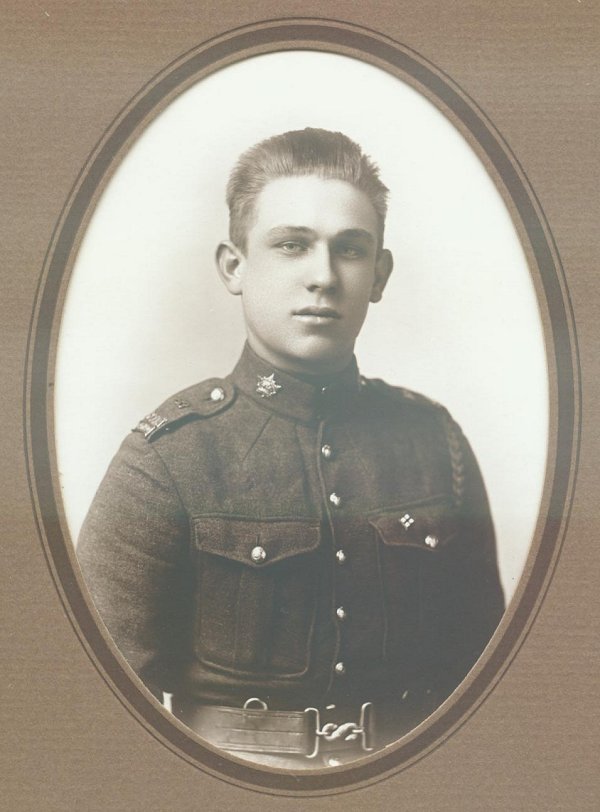
    Private Wilfred James Ernest Young, pictured shortly after his enlistment into the 83rd (Toronto)
    Private Wilfred James Ernest Young, pictured shortly after his enlistment into the 83rd (Toronto)

    The 83rd Battalion (Queen’s Own Rifles of Canada) authorized on 10 July 1915, and later embarked for Britain on 28 April 28 1916. It provided reinforcements for the Canadian Corps in the field until 7 July 1916, when its personnel absorbed by the 12th Reserve Battalion, CEF. Private Young sailed from Halifax per SS OLYMPIC on 16 April 1915.

    Private Wilfred James Ernest Young SS OLYMPIC
    Olympic (left) returning to Belfast for repairs in March 1912, and Titanic (right) This was the last time the two sister ships would be seen together

    5th Canadian Mounted Rifles (Quebec Regiment)

    5th Canadian Mounted Rifles organized in November 1914 initially under the command of Lieutenant-Colonel G H Baker. Mobilized at Sherbrooke, and recruited in the Eastern Townships. Left Quebec 18 July 1915 aboard HESPERIAN, and later arrived in England 27 July 1915 with a strength of 35 officers, 601 other ranks. Arrived in France later on 24 October 1915 with the 2nd Brigade, Canadian Mounted Rifles. Designation changed from regiment to battalion later on formation of 8th Canadian Infantry Brigade, 1 January 1916.

    To France

    Private Wilfred Young entered the Western Front on 17 June 1916. Pte Young temporarily attached to 2nd Canadian Tunneling Company, 7 August 1916.

    Grange crater was the site of tunneling operations and mining in the lead up to the Attack on Vimy Ridge. This photo depicts the site of these operations. An early memorial can be seen at the lip of the crater. Official photographer William Rider Rider's assistant, Cpl. Percy Reeves, can be seen in the crater. MIKAN No. 3397842
    Grange crater was the site of tunneling operations and mining in the lead up to the Attack on Vimy Ridge. This photo depicts the site of these operations. An early memorial can be seen at the lip of the crater. Official photographer William Rider Rider’s assistant, Cpl. Percy Reeves, can be seen in the crater. MIKAN No. 3397842

    Private Wilfred James Ernest Young Wounded

    Pte Young sent to No 8 Stationary Hospital, Wimereux on 22 September 1916 (wounded left leg). To No 1 Convalescent Depot, Boulogne-sur-Mer later on 30 September 1916.

    Private Wilfred James Ernest Young wounded
    Private Wilfred James Ernest Young wounded

    Private Wilfred Young VDG

    Pte Young admitted to No 10 Canadian Field Ambulance on 18 September 1917 (VDG). To No 22 Casualty Clearing Station on 20 September and No 51 General Hospital, Etaples later on 22 September 1917.

    13th Field Ambulance being paid in a village recently captured. August, 1917. Alexander Bunch may be in this photo. MIKAN No. 3521978
    13th Field Ambulance being paid in a village recently captured. August, 1917. Alexander Bunch may be in this photo. MIKAN No. 3521978

    Field Punishment No 1

    Private Wilfred Young sentenced to 21 days FP No 1 for having been AWOL from No 51 General Hospital, and later forfeits 14 days pay on 16 February 1918. Finally discharged to duty from No 51 General Hospital on 4 April 1918.

    French wounded in Montreal Ward, No. 8 General Hospital, Champ de Courses, Saint-Cloud, Paris. September, 1917.
    French wounded in Montreal Ward, No. 8 General Hospital, Champ de Courses, Saint-Cloud, Paris. September, 1917. MIKAN No. 3395853

    Private Wilfred James Ernest Young Killed in Action

    The 5th Battalion tasked with taking the town of Monchy-le-Preux on the morning of 26 August 1918. Pte Wilfred James Ernest Young died of wounds on 26 August 1918.

    Private Wilfred James Ernest Young killed in action
    Private Wilfred Young killed in action

    Croix du Guerre

    Private Wilfred Young awarded the French Croix du Guerre posthumously later on 26 August 1919 (London Gazette No. 31465 dated 21 July 1919).

    General Orth of the Belgian Army and General Sir Arthur Currie saluting. January, 1918. Maj. Gen. Sir Arthur Currie, commanding officer of the Canadian Corps, may be receiving the insignia showing he has been appointed by the King of Belgium a Grand Officer of the Order of the Crown,and also the Belgian Croix de Guerre in this photo
    General Orth of the Belgian Army and General Sir Arthur Currie saluting. January, 1918. Maj. Gen. Sir Arthur Currie, commanding officer of the Canadian Corps, may be receiving the insignia showing he has been appointed by the King of Belgium a Grand Officer of the Order of the Crown, and also the Belgian Croix de Guerre in this photo. MIKAN No. 3362395

    Ste Catherine British Cemetery

    Ste Catherine a village in the Department of Pas-de-Calais, adjoining the city of Arras on the north side. The cemetery on the left of the road to Therouanne (the Chassee Brunehaut), not far beyond the Church.

    Private Wilfred James Ernest Young , 21 April 2019, CEFRG
    Private Wilfred James Ernest Young , 21 April 2019. CEFRG

    From March 1916 to the Armistice, Ste Catherine occupied by Commonwealth forces and for much of that time also within range of German artillery fire. The cemetery started in March 1916 and used by the divisions and field ambulances stationed on that side of Arras until the autumn of 1917.

    The cemetery enlarged after the Armistice when graves brought in from the surrounding area. Ste Catherine British Cemetery contains 339 Great War burials.

    Ste Catherine British Cemetery CEFRG
    Ste Catherine British Cemetery. CEFRG