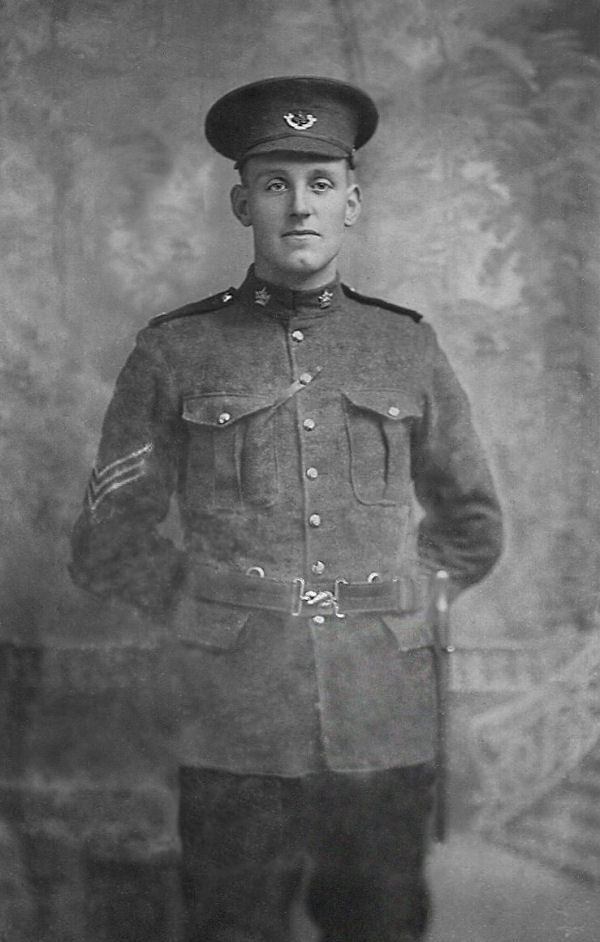
In May 2019, a research report (submitted by the late Richard Laughton of Milton, Ontario and Chris Wright of Lakewood, Colorado) received suggesting an unknown grave at Regina Trench Cemetery, Grandcourt, in France, could be identified. The Canadian Armed Forces and DND confirmed the grave in question belongs to Company Sgt Major David George Parfitt. Once again, the Canadian office of the CWGC in Ottawa has failed to acknowledge the contribution of the late Richard Laughton.

Why has Richard Laughton, once again, received no credit? The reason is simple. The Canadian agency of the CWGC in Ottawa does not wish to encourage such activity. Identifying and recovering remains from the Great War an expensive, and time consuming process for any commonwealth country.

But why do Canadian cases typically take five or more years to complete, when British and Australian cases resolved in about a year and a half? Clearly, a lack of resources and an unofficial policy of being non-pro-active in the recovery and identification of remains another insult to our military by a government supposed to represent us.
Enlistment of Sergeant David George Parfitt
Born 4 July 1891 in London, England. Father Frederick Parfitt, Keewatin, Ontario. Mother Mrs Elizabeth Parfitt. David a single miller by trade.

Sergeant David George Parfitt 602 enlisted 22 September 1914 at Valcartier, Quebec with the 8th Battalion. Four years previous experience in the Canadian Militia. David 23 years, 1 month of aga at this time, standing 5′ 11″ tall with fair complexion, grey eyes and brown hair.
1914

Sgt David Parfitt proceeded overseas on 4 October 1914 from Quebec per SS FRANCONIA.
![S.S. "Franconia" entering the Harbour, [Plymouth], October, 1914. MIKAN No. 3403489](https://i0.wp.com/cefrg.ca/wp-content/uploads/2022/07/3403489.jpg?resize=738%2C976&ssl=1)
1915
Sergeant David Parfitt entered France on 3 May 1915. The 16th Battalion in training during the Battle of Frezenburg Ridge.

The day after meeting General Currie in reserve trenches, David admitted to No 13 General Hospital and transferred to England with dysentery, 19 May 1915.

To convalescent depot Aire from 2nd London Clearing Stationary on 28 May 1915. David returns to duty on 10 June 1915.
Promotion
Sgt Parfitt promoted to Company Sergeant-Major in the Field, 27 September 1915.

The battalion treated to a Bath Parade on the same day. Only 200 of six hundred men receive a change of underwear. The 8th Battalion later takes a unit photo with Ploegsteert Wood in the background.

1916
Company Sgt Major David Parfitt admitted to No 1 CFA on 7 April 1916, Stomititis (VDG/Phimosis). To No 17 CCS and proceeded via No 21 Ambulance Train to No 12 Camp, Harfleur, then No 9 Stationary Hospital, Le Havre on 11 May 1916.

CSM Parfitt finally discharged to his unit on 13 May 1916. On 28 June 1916, David attends the farewell dinner of General Louis Lipsett.

Battle of Flers-Courcelette
The Battle of Flers-Courcelette, which took place 15-22 September 1916, an attempt by the British Corps to alleviate pressure on the Verdun Salient. The Canadian Corps, commanded by Sir Julian Byng, contributed two infantry divisions on the left of the attack. The first use of tanks occurred during this battle.
Schwaben Redoubt
On 26 September 1916, the Canadian Corps in cooperation with the 2nd Corps, attack the ridge which runs northwest of Courcelette to the Schwaben Redoubt.

One hundred forty-eight men of the 8th Battalion fell on 26 September 1916. Two-thirds of these casualties listed on the Vimy Memorial. Company Sgt Major David Parfitt presumed to have died on or since 26 September 1916. Forty-two of these casualties buried in Regina Trench Cemetery, Courcelette British Cemetery, Serre Road Cemetery No.1 and Serre Road Cemetery No.2.
Regina Trench Cemetery
On 1 July 1916, the first day of the Battle of the Somme, Grandcourt village reached by part of the 36th (Ulster) Division, but not until the German withdrawal to the Hindenburg Line, early in February 1917, occupied by patrols of the Howe Battalion, Royal Naval Division. To the south-east of it Courcelette, taken by the 2nd Canadian Division on 15 September 1916.
Regina Trench a German earthwork, captured for a time by the 5th Canadian Brigade on 1 October 1916, attacked again by the 1st and 3rd Canadian Divisions on 8 October, taken in part by the 18th and 4th Canadian Divisions on 21 October, and finally cleared by the 4th Canadian Division on 11 November 1916.
Case
The identification of the Company Sergeant-Major of the 8th Canadian Infantry Battalion a very straightforward affair. Simply put, the remains could not possibility be any other than CSM David George Parfitt.
He is the only Canadian company sergeant-major to have died on that date in France, a detail that greatly contributed to the identification of his grave.
Government of Canada
Greatly contributed? Quite likely this fact pointed out to the CWGC in the 1920s by another unnamed man recognizing low lying fruit. This individual had submitted many cases, some resolved, but likely most forgotten.
Extensive archival research by CWGC and DHH
Following extensive archival research by the CWGC and the Directorate of History and Heritage to corroborate the findings of an independent researcher, the identification was confirmed in November 2019 by the Casualty Identification Review Board, which includes representatives from the Canadian Forces Forensic Odontology Response Team and the Canadian Museum of History.
CWGC.org

It is a privilege for us to work with our partners in Canada to continue the Commission’s efforts to identify the graves of those who fell more than 100 years ago. We’re grateful to all those who contributed to this case and honoured to be able to erect a new CWGC headstone naming CSM Parfitt.
Mel Donnelly, Head of Commemorations Casework at CWGC
One hundred years later, the CWGC chose to act on the report submitted by the late Richard Laughton, formerly of Milton, Ontario and the CEFSG. More than five years have passed since Mr Laughton’s submission regarding the 40 Missing Soldiers of the 16th Battalion (see photo above). The CWGC has yet to even acknowledge the report.
Please subscribe to CEFRG to be notified by email when there are new posts. Subscription is free, and your email kept confidential.