CEFRG.ca

Category: Soldiers

Between 1914 and 1919, over 650,000 Canadians served at home and overseas during the Great War. On the Western Front in Belgium and France, Canadian soldiers of the Great War distinguished themselves in numerous battles, including Second Battle of Ypres, Battle of Vimy Ridge, and Second Battle of Passchendaele. In Canada’s Last Hundred Days of the Great War, Canadian soldiers at the sharp end of the spear breaking through the enemy’s formidable trench defences, the Hindenburg Line. Their efforts have inspired these soldier stories.

Collections

Many collections used to bring the soldier stories to life. First, and foremost, the Personnel Records of the soldiers serving in the Canadian Expeditionary Force (CEF). This collection, like the others to follow, digitized and made available by Library and Archives Canada (LAC). Secondly, the War Diaries of the CEF often provide vital information about a soldier’s life not contained in their service file. Finally, Circumstances of Death (CoD), War Graves Registers (GRRF), and Veterans Death Cards provide further information on The Fallen. These three collections in conjunction with records of the Commonwealth War Graves Commission (CWGC) vital to cases of identification and recovery of The Missing.

Courts Martial Records (FGCM)

Additional collections used to present the soldier stories include Courts Martial Records. Courts martial had the authority to try a wide range of military offences that resembled civilian crimes like fraud, theft or perjury. Others, like desertion and cowardice – purely military crimes. Records of individual courts martial consist of an average of 20 to 25 documents, mainly standardized forms. These document the trial and the charges under the Army Act.

MIKAN photo collection

Finally, the most powerful way of bringing soldier stories of the Great War to life, the images of the MIKAN collection digitized by LAC.  Often complementing these photos – images held by the Imperial War Museum (IWM), some of which also contain images captured by the Official Canadian War Photographers (CWRO) during the Great War. Both LAC and IWM have film collections which further bring the reality of the soldier stories of the Great War to life.

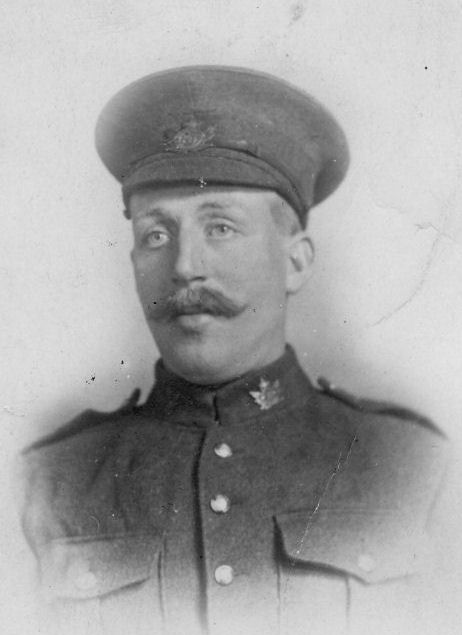
  • Private James Noble Bowman in the Great War

    Private James Noble Bowman in the Great War

    Private James Noble Bowman enlisted with the 147th Grey Overseas Battalion on 1 February 1916 in Owen Sound, Ontario. Born 21 April 1884 in Scotland Cockpen Parish. NoK Mrs Mary Bowman of Kevock Cottages, Lasswade, Scotland. James stood 6 feet tall, 178 pounds, great physical condition, with fair complexion, blue eyes and fair hair.

    MIKAN No. 3405513 Private James Noble Bowman
    4th C.M.R. resting in a barn. October, 1917. MIKAN No. 3405513

    147th Battalion

    Organized in November 1915 initially under the command of Lieutenant-Colonel G F McFarland. Mobilized at Owen Sound, and recruited in Grey County. Embarked from Halifax 14 November 1916 aboard OLYMPIC, and later disembarked England 20 November 1916 with a strength of 32 officers, 910 other ranks. Later absorbed by 8th Canadian Reserve Battalion on 1 January 1917.

    3404523 Private James Noble Bowman
    Type of dummy used in Canadian Forces for instructing troops in Bayonet fighting, designed and constructed by Q.M.S. E.Drake 4th Reserve Battalion. Lt.-Col. H.G. Mayes Canadian Army Gymnastic Staff 3404523

    Private James Noble Bowman appointed Acting Lance Corporal on 1 December 1916. With 8th Reserve Battalion from 4 January 1917.

    8th Canadian Reserve Battalion (Central Ontario)

    Organized at Seaford on 4 January 1917 initially under the command of Lieutenant-Colonel A E Carpentier. Formed by absorbing Royal Canadian Regiment and PPCLI Depot. Later absorbed 240th Battalion on 14 May 1917 and 207th Battalion and 10 June 1917. Yukon Infantry Company attached after arrival in England (6 February 1917) but transferred to 3rd Machine Gun Company of 5th Division on 24 March 1917. Reinforced 38th Battalion and Princess Patricia’s Canadian Light Infantry, and later absorbed by 6th Canadian Reserve Battalion on 15 February 1918.

    Princess Patricia
    Princess Patricia reviewing the P.P.C.L.I. at Bramshott before her marriage, 21 February 1919. MIKAN No. 3397730

    James transferred to 4th CMR, 2 April 1917.

    Private James Noble Bowman
    The 2nd Annual Ceremony for Children placing flowers on the graves of Canadians buried at Shorncliffe, Kent. Girls placing flowers. June 23rd 1918. MIKAN No. 3395025

    James reverts in ranks at own request on 21 April 1917 at Shorncliffe, a typical request in order to proceed overseas with too many higher ranks at the front.

    4th Canadian Mounted Rifles

    Organized in November 1914 initially under the command of Lieutenant-Colonel Vaux Chadwick. Mobilized at Toronto, and recruited from Governor General Body Guards, 2nd Dragoons, 9th Mississauga Horse and 25th Brant Dragoons. Left Quebec 18 July 1915 aboard HESPERIAN, and later arrived in England 27 July 1915 with a strength of 31 officers, 602 other ranks.

    Officers of the 4th C.M.R.s in France, February 1918. MIKAN No. 3405514
    Officers of the 4th C.M.R.s in France, February 1918. MIKAN No. 3405514

    Arrived in France 22 September 1915 with the 2nd Brigade, Canadian Mounted Rifles. Designation changed from regiment to battalion on formation of 8th Canadian Infantry Brigade, 1 January 1916.

    Canadian Corps Tramways yard, Villers-aux-Bois. MIKAN No. 3329409
    Canadian Corps Tramways yard, Villers-aux-Bois. MIKAN No. 3329409

    Pte James Noble Bowman arrived at his unit along with 124 Other Ranks on 27 April 1917. In billets at Villers-au-Bois until 2 May, supplying working parties to 3rd Canadian Railway Company at Pylones, and on to La Folie Ridge on 6 May 1917.

    42nd Battalion Officers inspect guns captured by them in Folie Wood during Vimy fighting. Royal Highlanders of Canada. MIKAN No. 3520003
    42nd Battalion Officers inspect guns captured by them in Folie Wood during Vimy fighting. Royal Highlanders of Canada. MIKAN No. 3520003

    Private James Noble Bowman enters the front lines for the first time on 2 June 1917.

    MIKAN No. 3403945 Private James Noble Bowman
    Ablain St. Nazaire. The ruins of the Church and Notre Dame de Lorette, from Carency. MIKAN No. 3403945

    The battalion moved to COMOX CAMP near Carency on 1 July 1917, later relieving the PPCLI in the line on 10 July 1917.

    Massed Canadian Pipe Band (266 men) playing before the Duke of Connaught, Camblain le Abbe. 22 October 1917. MIKAN No. 3396920
    Massed Canadian Pipe Band (266 men) playing before the Duke of Connaught, Camblain le Abbe. 22 October 1917. MIKAN No. 3396920

    Training

    Training at CANADA CAMP from 19 to 25 July 1917, with more training at Auchel until mid-August, when the battalion moves into billets at Camblain l’Abbe. In training at Cambligneul during the September, James finally moves north to the Ypres Salient on 21 October 1917.

    (Centre) Pte. T.W. Holmes, V.C., 4th C.M.R., 19 years old. Private Thomas W. Holmes (centre) of the 4th Canadian Mounted Rifles was awarded the Victoria Cross for his actions on Oct. 26th, 1917, at Passchendaele, Belgium, when he single-handedly silenced a German Machine Gun pillbox that was holding up the Canadian advance. He is photographed wearing the ribbon for the V.C., and is the youngest Canadian ever to win this award. His two comrades are armed with Short Model Lee Enfield rifles with breech covers fitted.
    (Centre) Pte. T.W. Holmes, V.C., 4th C.M.R., 19 years old. Private Thomas W. Holmes (centre) of the 4th Canadian Mounted Rifles was awarded the Victoria Cross for his actions on Oct. 26th, 1917, at Passchendaele, Belgium, when he single-handedly silenced a German Machine Gun pillbox that was holding up the Canadian advance. He is photographed wearing the ribbon for the V.C., and is the youngest Canadian ever to win this award. His two comrades are armed with Short Model Lee Enfield rifles with breech covers fitted.

    Second Battle of Passchendaele

    Private James Noble Bowman wounded 27 October 1917. One hundred Other Ranks detailed to carry the wounded to No 9 Canadian Field Ambulance on 30 October 1917.

    Casualties: Stretcher bearers bringing in a wounded man over muddy ground at Passchendaele. Canadian wounded being brought through the mud. Battle of Passchendaele. November, 1917. MIKAN No. 3397040
    Casualties: Stretcher bearers bringing in a wounded man over muddy ground at Passchendaele. Canadian wounded being brought through the mud. Battle of Passchendaele. November, 1917. MIKAN No. 3397040

    No 10 Canadian Field Ambulance took James in, but he died of wounds shortly afterwards.

    Private James Noble Bowman
    A man being operated on in a Canadian Field Ambulance within an hour after being wounded. MIKAN No. 3194278

    Oxford Road Cemetery

    Oxford Road the name given to a road running behind the support trenches, from a point west of the village of Wieltje south-eastwards to the Potijze-Zonnebeke road.

    Private James Noble Bowman
    Private James Noble Bowman

    Plot I the original Oxford Road Cemetery and used by the units fighting on this front from August 1917 to April 1918. In October 1917, another cemetery, known as Oxford Road Cemetery No.2, started close by and now forms Plot V of the cemetery as it appears today.

    Armistice

    After the Armistice, Plots II, III and IV were added when scattered graves from the battlefields east and south-east of Ypres (now Ieper) were brought into the cemetery. Now 851 Commonwealth casualties of the Great War buried or commemorated in this cemetery. 297 of the burials are unidentified and special memorials commemorate three casualties known to have been buried in the cemetery, but whose graves could not be located. The cemetery designed by Sir Reginald Blomfield.

    Contact Us

    ← Back

    Thank you for your response. ✨

    Please subscribe to CEFRG to be notified by email when there are new posts. Subscription is free, and your email kept confidential.