Private Manuel Bermudez a son of Venezuela who fought, and died for God’s justice on earth. The only son of Venezuela who fought, and died for Canada while the dictator Juan Vicente Gómez maintained neutrality throughout the Great War.

In Venezuela, the Great War or Federal War a civil war fought between 1859 and 1863. About 10% of the population died from hunger or disease, in addition to the casualties of war.
Private Manuel Bermudez
Private Manuel Bermudez 919831, son of Manuel Bermudez Lecuna, and his wife, Carlota Valdez de Bermudez, 33/3 Punceres a Plaza Lopez, Caracas, Venezuela. Manuel was born 22 May 1894 in Caracas.

Enlistment
Manuel Bermudez residing at the Victoria Hotel, in Montreal, when he attested 16 August 1916 in Montreal. Manuel puts aside $25 a month for his father. He stood 5’7″ tall, with dark hair, brown eyes, and dark hair. He was Roman Catholic. Manuel’s trade listed as “Correspondence – Spanish”.

When he enlists with 199th Battalion, Irish Canadian Rangers, he notes he has prior experience with 55th I.C.R. Manuel also has a tendency to hernia. Admits to Alexandria Hospital, with measles, 9 December 1916. Discharges 2 February 1917, and transfers to unit for sick leave until 3 March 1917. Then, on 21 March 1917, Manuel leaves everything to his father in his will. He is about to proceed to England.
England
Private Manuel Bermudez embarks for England from Halifax, 26 March 1917, and disembarks Liverpool, 7 April 1917. Then, upon arrival, Taken-on-Strength by the 22nd Reserve Battalion, 7 April 1917.

Then, transfers to 23rd Reserve Battalion, 9 May 1917. Finally, transfers to 14th (Royal Montreal Regiment) Battalion, 26 August 1917, Manuel proceeding overseas.
First tour
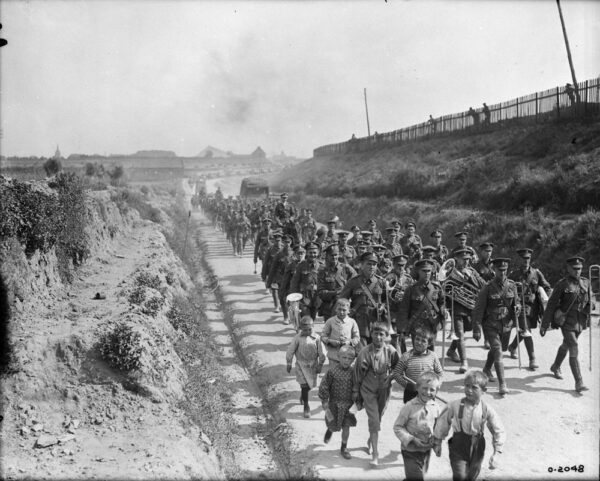
Private Manuel Bermudez first arrives in France, on 28 August 1917. Manuel sees his first action at the Battle of Hill 70, in October 1917. The 14th Battalion came out of the line on 10 October 1917, and Manuel is somewhere in the photos below taken by Lieutenant William Rider-Rider.


Then, after a couple of months in the trenches, Manuel admits to No.12 Canadian Field Ambulance, (PUD) peptic ulcer disease, 30 October 1917. A week later, discharges to duty, 8 November 1917. Manuel has missed the Second Battle of Passchendaele.
Wounded
In February of 1918, Private Manuel Bermudez is back at Hill 70. Much of the month is spent in Divisional Reserve at Bully-Grenay.

Back in the line at the ST EMILE sector at the end of the month, Manuel wounded at St. Pierre, 27 February 1918. Then, invalided to England, 4 March 1918, and transfers to Canadian Hospital, Epsom, 9 March 1918. GSW Left arm. Movement of arm at shoulder limited. Movement of fingers slightly impaired. On Command, No.2 Canadian Casualty Depot, Bramshott, 26 April 1918. Finally, S.o.S. to 23rd Reserve Battalion on 31 May 1918. However, Manuel remains in England until after the Battle of Amiens, in August 1918.
Second tour
With less than a hundred days of fighting left in the Great War, Manuel arrives in France, for the second time, on 23 August 1918. Then, T.o.S. by his old battalion, the 14th, in the field, on 29 August 1918. Then, Private Manuel Bermudez sees action in the Battle of the Drocourt-Quéant Line, and the Battle of the Canal du Nord.
The Death of Private Manuel Bermudez
During the Battle of Canal du Nord, the 14th Battalion assembled in depth on a one Company frontage immediately south west of the CAMBRAI-DOUAI road facing the village of Sancourt. It was raining heavily. The battalion advanced at 05h00. But, despite the rain, cold, and the fact that there was no rum issue, the spirit of the men was excellent. Shortly after the attack commences, Lieutenant Close, DCM, an original member of the Battalion, and Private Manuel Bermudez, Killed-in-Action.

Forty-one men of the Royal Montreal Regiment, Killed-in-Action, 1 October 1918. Thirteen buried at Sancourt British Cemetery, including Company Sergeant Major Gilbert Fairbairn, DCM, MM and Sergeant Gaudet MM and Bar.
Venezuela, strictly neutral during the Great War. The leaders of Venezuela would not have appreciated Manuel’s efforts. Strict neutrality meant Venezuela was actually pro-German during the Great War.
Sancourt British Cemetery
The village of Sancourt is in the Department of the Nord, 5 kilometres north-west of Cambrai, and one kilometre east of the main road to Douai. Sancourt British Cemetery is about 635 metres north-west of the village, on the old Douai-Cambrai road.
Note Private Manuel Bermudez lies with another Unknown soldier of the Great War. Also, their headstone is buried next to the perimeter wall. Furthermore, it is much closer than usual to the adjacent stones. In addition, headstones on the perimeter wall bear an inscription like Buried Near This Spot, or Buried Elsewhere, or Known to Be Buried in This Cemetery.

In this case, the arrangement by the wall with multiple burials per grave, signify this is a mass-grave, from shortly after the battle. Unlike the aforementioned cases, the men are known to be buried beneath the markers, but perhaps not exactly below them.
More
Cadet John E. Ludford Royal Flying Corps, son of E. H. and Luisa Odina Ludford, of Caracas, Venezuela, is the only other Venezuelan-born to serve in Canada during the Great War. He signed up in Canada with the Royal Flying Corps, but never made it overseas, and died 18 September 1917. He lies buried at Barrie (St. Mary’s) Roman Catholic Cemetery, Barrie, Ontario.
Thus, Private Manuel Bermudez the only son of Venezuela who fought, and died for Canada in the Great War.
Please subscribe to CEFRG to be notified by email when there are new posts. Subscription is free, and your email kept confidential.

