CEFRG.ca

Category: Soldiers

Between 1914 and 1919, over 650,000 Canadians served at home and overseas during the Great War. On the Western Front in Belgium and France, Canadian soldiers of the Great War distinguished themselves in numerous battles, including Second Battle of Ypres, Battle of Vimy Ridge, and Second Battle of Passchendaele. In Canada’s Last Hundred Days of the Great War, Canadian soldiers at the sharp end of the spear breaking through the enemy’s formidable trench defences, the Hindenburg Line. Their efforts have inspired these soldier stories.

Collections

Many collections used to bring the soldier stories to life. First, and foremost, the Personnel Records of the soldiers serving in the Canadian Expeditionary Force (CEF). This collection, like the others to follow, digitized and made available by Library and Archives Canada (LAC). Secondly, the War Diaries of the CEF often provide vital information about a soldier’s life not contained in their service file. Finally, Circumstances of Death (CoD), War Graves Registers (GRRF), and Veterans Death Cards provide further information on The Fallen. These three collections in conjunction with records of the Commonwealth War Graves Commission (CWGC) vital to cases of identification and recovery of The Missing.

Courts Martial Records (FGCM)

Additional collections used to present the soldier stories include Courts Martial Records. Courts martial had the authority to try a wide range of military offences that resembled civilian crimes like fraud, theft or perjury. Others, like desertion and cowardice – purely military crimes. Records of individual courts martial consist of an average of 20 to 25 documents, mainly standardized forms. These document the trial and the charges under the Army Act.

MIKAN photo collection

Finally, the most powerful way of bringing soldier stories of the Great War to life, the images of the MIKAN collection digitized by LAC.  Often complementing these photos – images held by the Imperial War Museum (IWM), some of which also contain images captured by the Official Canadian War Photographers (CWRO) during the Great War. Both LAC and IWM have film collections which further bring the reality of the soldier stories of the Great War to life.

  • CSM Thomas Thompson Watson in the Great War

    CSM Thomas Thompson Watson in the Great War

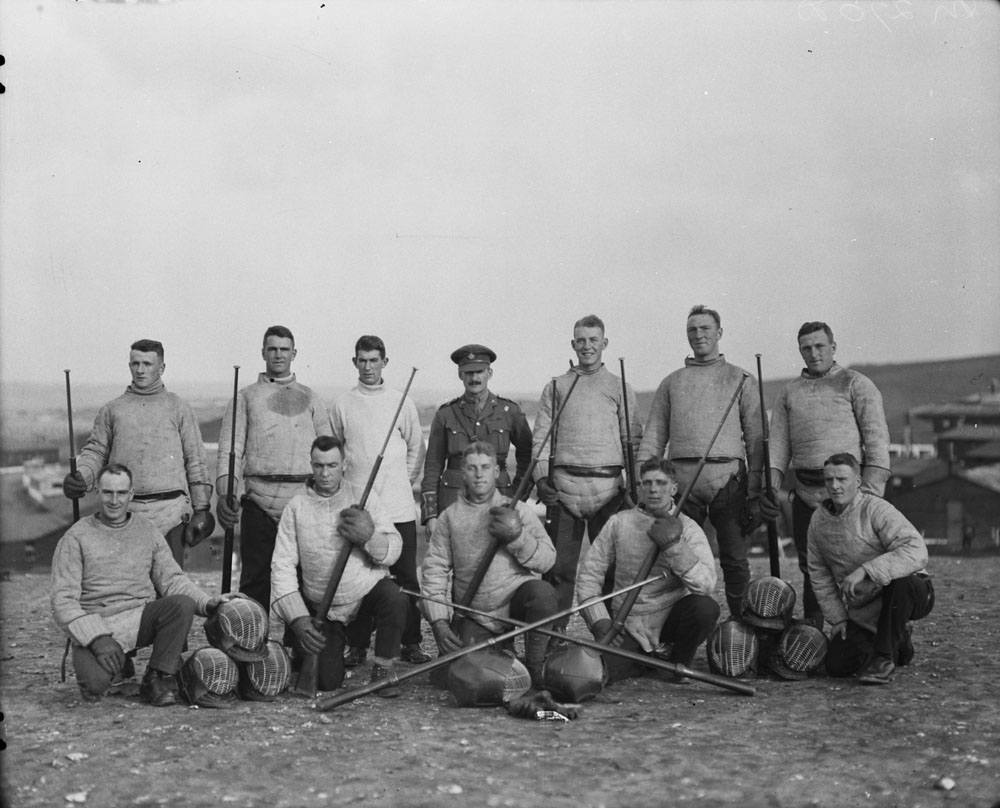
    CSM Thomas Thompson Watson, first contingent, rose in the ranks of the 1st Battalion to become Physical and Bayonet Instructor on Special Duty in Canada before the end of the Great War.

    MIKAN No. 3404351 CSM Thomas Thompson Watson
    Type of dummy used in Canadian Forces for instructing troops in Bayonet fighting, designed and constructed by Q.M.S. E.Drake 4th Reserve Battalion. Lt.-Col. H.G. Mayes Canadian Army Gymnastic Staff. MIKAN No. 3404351

    Thomas Thompson Watson born in Penicuik, Scotland. Mother Mrs W Watson of 73 Laurie Terrace, Flemington, Motherwell, England. A steel worker.

    Do you have a photo of my grandfather?

    Most common question asked of CEFRG. Unfortunately, Other Ranks seldom identified in photos. But, this certain – Private Thomas Thompson Watson present when this panorama of the 1st Battalion taken at Valcartier Camp.

    Troops of the 1st Infantry Battalion, Canadian Expeditionary Force, Valcartier, P.Q., 1914. MIKAN No. 3405877 CSM Thomas Thompson Watson
    Troops of the 1st Infantry Battalion, Canadian Expeditionary Force, Valcartier, P.Q., 1914. MIKAN No. 3405877

    Private Thomas Thompson Watson 6514 medical exam on 21 August 1914, and enlisted 22nd September at Valcartier with the 5th Battalion. Eighteen years and six months of age, standing 5′ 9″ tall, 147 pounds, with fair complexion, blue eyes and light brown hair. Previous experience with 22nd Regiment Oxford Rifles. Single, but later married in 1917 to a Mrs T T Watson of 43 Ladysmith St, Wishaw, Scotland.

    Pte Watson on 1st Battalion paylist as of 31 October 1914.

    1st Battalion (Ontario Regiment)

    Organized at Valcartier Camp September 1914 composed of recruits from MD 1 (Western Ontario), initially commanded by Lieutenant-Colonel F W  Hill. Other Officers Commanding: F. A. Creighton (24/1/16) G.C. Hodson (27/6/16). Embarked from Quebec 25 September 1914 aboard LAURENTIC, and later disembarked in England 14 October 1914 with a strength of 45 officers, 1121 other ranks. Arrived in France 11 February 1915 with the 1st Division, 1st Canadian Infantry Brigade, and later reinforced by 4th Canadian Reserve Battalion.

    SS LAURENTIC sank after striking two mines north of Ireland on 25 January 1917, with the loss of 354 lives.
    SS LAURENTIC sank after striking two mines north of Ireland on 25 January 1917, with the loss of 354 lives.

    Private Thomas Thompson Watson entered the Western Front on 7 February 1915 with the 1st Battalion, and Canadian Army Gymnastic Staff from 7 February 1915 to 13 September 1916.

    Second Battle of Ypres

    Pte Watson wounded 28 April 1915. GSW chest, hand. The 1st Battalion constructing trenches on farms in 28.C.22.a and 28.C.22.b, and also assisting the Rifle Brigade later in the day. The area incredibly historic. The location just south of Kitcheners Wood.

    To Canadian Base Depot, Rouen on 3 May 1915.

    On 26 April 1916, the Germans tried to occupy Sap Trench 46, but driven back. Captain Blatchford (attached) killed and Lt Bailey wounded. For actions in the engagement, Pte Watson appointed Lance/Corporal in the Field, 30 April 1916.

    Battle of Mont Sorrel

    Lance/Corporal Thomas Thompson Watson appointed Corporal in the Field, 18 June 1916. On this day, General Lipsett addressed the Battalion, thanking them for their courage during the Battle of Mont Sorrel.

    Farewell dinner to General Lipsett. 2nd Infantry Brigade. 28 June 1916. Photo depicts soldiers sitting at trestle tables in camp in the open air. The commanding officer of the 2nd Brigade, Louis Lipsett, was given a promotion to lead the entire 3rd Canadian Division in June, 1916 when his superior, General Mercer, was killed. MIKAN No. 3394730
    Farewell dinner to General Lipsett. 2nd Infantry Brigade. 28 June 1916. Photo depicts soldiers sitting at trestle tables in camp in the open air. The commanding officer of the 2nd Brigade, Louis Lipsett, was given a promotion to lead the entire 3rd Canadian Division in June, 1916 when his superior, General Mercer, was killed. MIKAN No. 3394730

    Corporal Thomas Thompson Watson appointed Sergeant in the Field, 2 July 1916.

    On 13 September 1916, 7 days leave to England. An illness, and his skills prevent his return to the front.

    Return to UK

    Sergeant Thomas Thompson Watson admitted to Scott General Hospital, Glasgow, sick, 19 September 1916. To Canadian Convalescent Hospital, Uxbridge, on 17 October 1916 with Scabies, and later discharged on 27th October.

    To be A/CSM 19 April 1917, St Leonora.

    The Duke of Connaught inspects 1st Battalion Guard of Honour, Canadian Corps Sports, 1 July 1918, Tinques, Pas-de-Calais. MIKAN No. 3405874 Corporal Francis Pegahmagabow
    The Duke of Connaught inspects 1st Battalion Guard of Honour, Canadian Corps Sports, 1 July 1918, Tinques, Pas-de-Calais. MIKAN No. 3405874

    A/CSM Thomas Thompson Watson marriage approved, 15 September 1917.

    MIKAN No. 3394391 CSM Thomas Thompson Watson
    The wedding of Gnr. Wells, 2nd Heavy Bty. arriving home after the ceremoney, Andenne. March 1919. MIKAN No. 3394391

    A/CSM Watson attended eight week course of Drill Instruction, Bexhill-on-Sea from 28 December 1917 to 25 February 1918.

    Groups taken at O.T.C. Canadians, Bexhill-on-Sea. [No. 4 Co.] CSM Thomas Thompson Watson
    Groups taken at O.T.C. Canadians, Bexhill-on-Sea. [No. 4 Co.]. MIKAN No. 3397669

    Anti-Gas School course at Bramshott on 22 April 1918. CSM Thomas Thompson Watson also very likely in the image below.

    "Views Taken at Bexhill Command School": Staff, School of Anti-gas. CSM Thomas Thompson Watson
    “Views Taken at Bexhill Command School”: Staff, School of Anti-gas. MIKAN No. 3404359

    Return to Canada

    CSM Thomas Thompson Watson ceases to be attached to Depot Company on return to Canada for Special Duty as a Physical and Bayonet Instructor, 5 October 1918.

    8th Battalion. Winnipeg Rifles, on Salisbury Plain. Bayonet Practice with bags of straw
    8th Battalion. Winnipeg Rifles, on Salisbury Plain. Bayonet Practice with bags of straw. MIKAN No. 3404362

    Contact Us

    ← Back

    Thank you for your response. ✨

    Please subscribe to CEFRG to be notified by email when there are new posts. Subscription is free, and your email kept confidential.