CEFRG.ca

Category: Soldiers

Between 1914 and 1919, over 650,000 Canadians served at home and overseas during the Great War. On the Western Front in Belgium and France, Canadian soldiers of the Great War distinguished themselves in numerous battles, including Second Battle of Ypres, Battle of Vimy Ridge, and Second Battle of Passchendaele. In Canada’s Last Hundred Days of the Great War, Canadian soldiers at the sharp end of the spear breaking through the enemy’s formidable trench defences, the Hindenburg Line. Their efforts have inspired these soldier stories.

Collections

Many collections used to bring the soldier stories to life. First, and foremost, the Personnel Records of the soldiers serving in the Canadian Expeditionary Force (CEF). This collection, like the others to follow, digitized and made available by Library and Archives Canada (LAC). Secondly, the War Diaries of the CEF often provide vital information about a soldier’s life not contained in their service file. Finally, Circumstances of Death (CoD), War Graves Registers (GRRF), and Veterans Death Cards provide further information on The Fallen. These three collections in conjunction with records of the Commonwealth War Graves Commission (CWGC) vital to cases of identification and recovery of The Missing.

Courts Martial Records (FGCM)

Additional collections used to present the soldier stories include Courts Martial Records. Courts martial had the authority to try a wide range of military offences that resembled civilian crimes like fraud, theft or perjury. Others, like desertion and cowardice – purely military crimes. Records of individual courts martial consist of an average of 20 to 25 documents, mainly standardized forms. These document the trial and the charges under the Army Act.

MIKAN photo collection

Finally, the most powerful way of bringing soldier stories of the Great War to life, the images of the MIKAN collection digitized by LAC.  Often complementing these photos – images held by the Imperial War Museum (IWM), some of which also contain images captured by the Official Canadian War Photographers (CWRO) during the Great War. Both LAC and IWM have film collections which further bring the reality of the soldier stories of the Great War to life.

  • Private Thomas Chester Rudolph in the Great War

    Private Thomas Chester Rudolph in the Great War

    Private Thomas Chester Rudolph born 30 November 1892, in Ellsworth, Pierce, Wisconsin. His father, Alexander Rudolf Jr, 41 and his mother, Sarah Jane Francis or Jenette Webster, 35 at this time.

    Private Thomas Chester Rudolph 160859
    Private Thomas Chester Rudolph 160859

    Thomas married to Lillian Daisy (Whymark) Rudolph living at Suite 4, Calhoun Block, 934 – 17th Ave West, Calgary. Also notify Mrs J D Bunny, Ellsworth, Wisconsin.

    Enlistment of Private Thomas Chester Rudolph

    Private Thomas Chester Rudolph 160859 attested 25 October 1915 in Calgary, Alberta with the 82nd Overseas Battalion. Standing 5′ 9″ tall, 175 pounds with dark complexion, blue eyes and dark hair.

    Sick

    La Grippe, Military Hospital, Calgary, 9 January 1916, later discharged on 24 January.

    Pte Rudolph sailed 20 May 1916, and posted to 9th Reserve Battalion upon arrival in England. Following a summer of training, Pte Rudolph proceeds overseas.

    France

    Private Thomas Chester Rudolph entered the Western Front on 17 August 1916 with the 31st Battalion. However, Thomas sick upon arrival in Le Havre, and admitted to No 39 General Hospital, Le Havre.

    Prize Platoon of 31st Canadian Infantry Battalion receiving Medals. May 1918. MIKAN No. 3522123 Private Thomas Chester Rudolph
    Prize Platoon of 31st Canadian Infantry Battalion receiving Medals. May 1918. MIKAN No. 3522123

    Hospitalized

    Pte Rudolph admitted 19 March 1917, Le Havre, and later discharged to Reinforcements. Thomas spends considerable time ‘recovering’, and forfeits field allowance from 20 August 1916 to 19 March 1917.

    Return to France

    After a seven month abscence, Thomas finally rejoined the 31st Battalion on 15 September 1917, just in time for the Battle of Passchendaele.

    Battle of Passchendaele

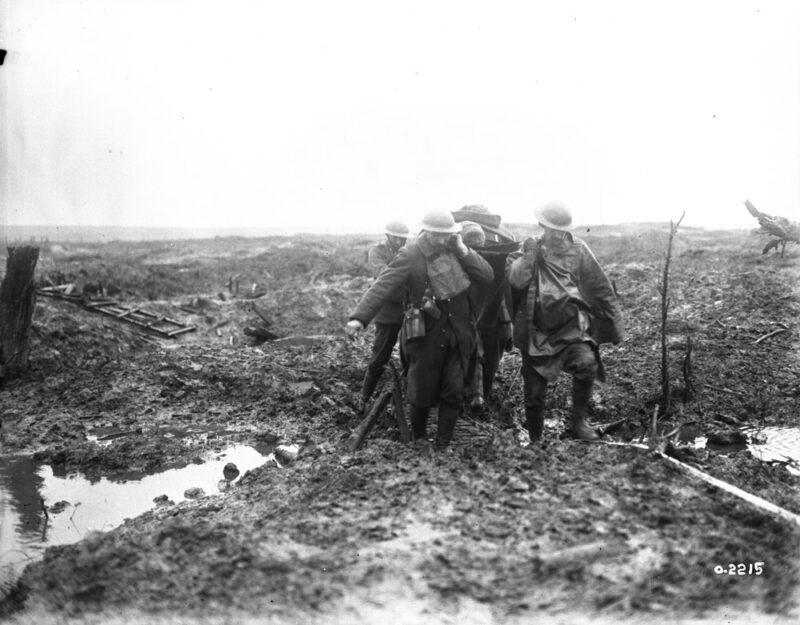
    During the final push in the Second Battle of Passchendale, Private Thomas Rudolph wounded. GSW both arms (slight), and admitted to No 1 Western General Hospital, 12 November 1917.

    Prussian Guards acting as stretcher-bearers. Battle of Passchendaele. November, 1917. Private Thomas Chester Rudolph
    Prussian Guards acting as stretcher-bearers. Battle of Passchendaele. November, 1917.

    To Military Convalescent Hospital, Epsom, 13 March 1918. Finally discharged on 31 May 1918 to the 21st Reserve Battalion. Pte Rudolph never returns to the Western Front.

    5000 Canadians leaving Southampton on S.S. 'Olympic' on April 16th, 1919
    5000 Canadians leaving Southampton on S.S. ‘Olympic’ on April 16th, 1919

    Demobilization

    Pte Rudolph discharged from Overseas Service 18 November 1918. Returned to Canada on HS CARMANIA, 30 December 1918.

    MIKAN No. 3523301
    Canadian troops returning to Canada in R.M.S. “Carmania”, 1919. MIKAN No. 3523301

    Posted to Casualty Company upon arrival in Calgary, 4 January 1919. Private Thomas Chester Rudolph finally discharged from HM Service on 14 February 1919.

    Thomas Chester Rudolph
    Thomas Chester Rudolph photo courtesy Renae Burgess Linn

    Chester died on 30 June 1970, in Calgary, and later buried in Calgary.

    Gordon R. Pennell
    Grave of Private Thomas Chester Rudolph photo by Gordon R. Pennell

    Also surviving a daughter, Mrs Edward (Helen) Benner, of Calgary. Two sons, Frank, Camrose and Allan, Calgary. Six grandchildren, and six great grandchildren. Also a sister, Mrs Em Bonney in Wisconsin.

    Contact Us

    ← Back

    Thank you for your response. ✨

    Subscribe

    Please subscribe to CEFRG to be notified by email when there are new posts. Subscription is free, and your email kept confidential.