CEFRG.ca

Category: Soldiers

Between 1914 and 1919, over 650,000 Canadians served at home and overseas during the Great War. On the Western Front in Belgium and France, Canadian soldiers of the Great War distinguished themselves in numerous battles, including Second Battle of Ypres, Battle of Vimy Ridge, and Second Battle of Passchendaele. In Canada’s Last Hundred Days of the Great War, Canadian soldiers at the sharp end of the spear breaking through the enemy’s formidable trench defences, the Hindenburg Line. Their efforts have inspired these soldier stories.

Collections

Many collections used to bring the soldier stories to life. First, and foremost, the Personnel Records of the soldiers serving in the Canadian Expeditionary Force (CEF). This collection, like the others to follow, digitized and made available by Library and Archives Canada (LAC). Secondly, the War Diaries of the CEF often provide vital information about a soldier’s life not contained in their service file. Finally, Circumstances of Death (CoD), War Graves Registers (GRRF), and Veterans Death Cards provide further information on The Fallen. These three collections in conjunction with records of the Commonwealth War Graves Commission (CWGC) vital to cases of identification and recovery of The Missing.

Courts Martial Records (FGCM)

Additional collections used to present the soldier stories include Courts Martial Records. Courts martial had the authority to try a wide range of military offences that resembled civilian crimes like fraud, theft or perjury. Others, like desertion and cowardice – purely military crimes. Records of individual courts martial consist of an average of 20 to 25 documents, mainly standardized forms. These document the trial and the charges under the Army Act.

MIKAN photo collection

Finally, the most powerful way of bringing soldier stories of the Great War to life, the images of the MIKAN collection digitized by LAC.  Often complementing these photos – images held by the Imperial War Museum (IWM), some of which also contain images captured by the Official Canadian War Photographers (CWRO) during the Great War. Both LAC and IWM have film collections which further bring the reality of the soldier stories of the Great War to life.

  • Corporal Edwin Sherman Tuck in the Great War

    Corporal Edwin Sherman Tuck in the Great War

    The death of Corporal Edwin Sherman Tuck, 18 January 1918. One of the first of the Victoria men to volunteer for service overseas, leaving in August 1914 with the draft from the 50th Gordon Highlanders, which afterwards became part of the 16th Canadian Scottish.

    Corporal Edwin Sherman Tuck 16 August 2019 CEFRG
    Sucrerie Cemetery, Ablain-St. Nazaire, Plot III, Row B, Grave 12, Corporal Edwin Sherman Tuck, 16 August 2019 CEFRG

    Enlistment of Private Edwin Sherman Tuck

    Corporal Tuck married in May 1913, leaving his widow and child. His brother, Lt Douglas Campbell Tuck (d.13-4-49) with the 29th Battalion.

    Private Edwin Sherman Tuck 28585 enlisted 25 September 1914 at Valcartier. A Telephone Engineer, standing 5′ 8″ tall, 170 pounds. Previous experience 18 months in 50th Regiment, Highlanders of Canada our of Victoria, BC. Prior to embarking for England, Edwin rises in the ranks to Sergeant.

    MIKAN No. 3404873
    Canadian Scottish 16th Canadian Infantry Battalion on their way up the line. 25 February 1918. MIKAN No. 3404873

    16th Canadian Infantry Battalion

    Sergeant Edwin Sherman Tuck admitted to No 1 General Hospital, 13 January 1915, chronic otitis media. Admitted to Netheravon Hospital, 16 January 1915, Ch catarrah otitis media. Later discharged to duty on 25 January 1915. However, recommended Edwin be returned to Canada and discharged. Transferred to the 17th Reserve Battalion at Tidworth on 3 February 1915.

    Corporal Edwin Sherman Tuck The Daily Colonist 2nd Paragraph 1918 02 02
    2nd Paragraph

    Sailed per SS CORSICAN on 26 February 1915. Discharged for His Majesty’s Service on 15 March 1915.

    Reenlistment of Edwin Sherman Tuck

    Likely sometime in 1916, Edwin had an operation on one or both ears. Now able to pass the medical, Private Edwin Sherman Tuck 2025191 reenlisted 8 February 1917 in Victoria. Now 35 years and 10 months of age.

    To be Acting Corporal with pay, Seaford Camp, 18 July 1917.

    Corporal Edwin Sherman Tuck reverts to Ranks in order to proceed overseas, 26 September 1917. Once again, he does not hold the rank of Private for long.

    3522787 Platoon of the 47th Battalion
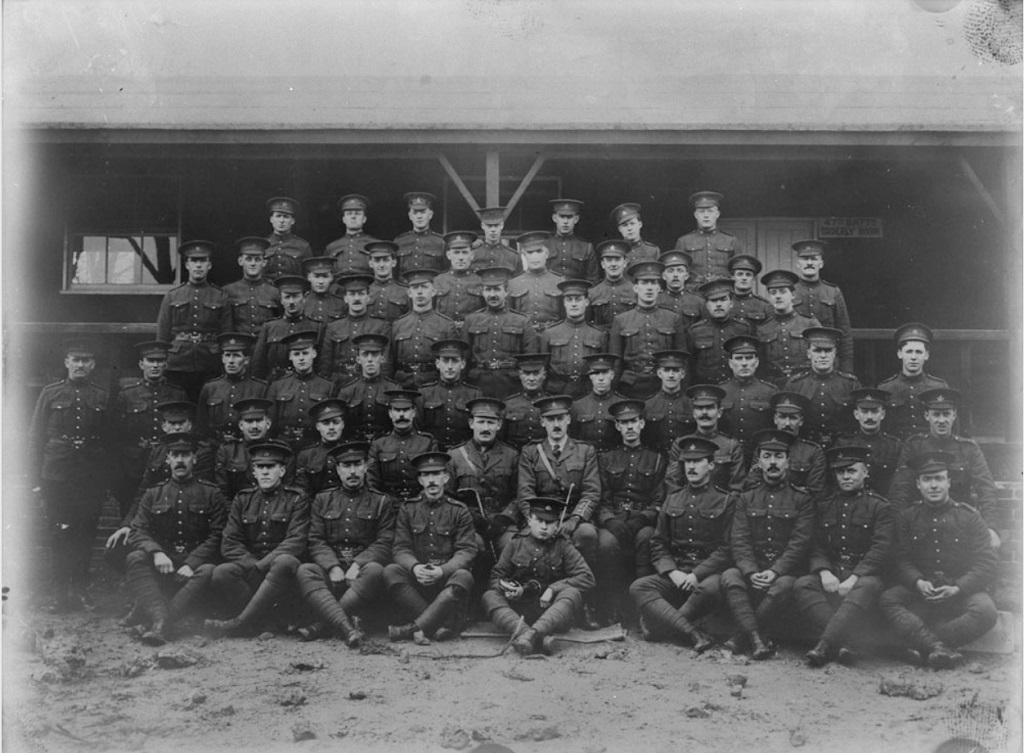
    Platoon of the 47th Battalion MIKAN No 3522787

    47th Battalion

    Private Edwin Sherman Tuck promoted Corporal in the Field, 13 November 1917.

    Corporal Edwin Sherman Tuck The Daily Colonist Headline 1918 02 02
    The Daily Colonist Headline 1918 02 02

    Pte Tuck killed in action, 18 January 1918.

    Corporal Edwin Sherman Tuck The Daily Colonist 1st Paragraph 1918 02 02
    1st Paragraph

    Promotions

    Corporal Edwin Sherman Tuck The Daily Colonist 3rd Paragraph 1918 02 02
    3rd Paragraph

    Canadian Virtual War Memorial (CVWM)

    The Canadian Virtual War Memorial (CVWM) is a registry to honour and remember the sacrifices of the more than 118,000 Canadians and Newfoundlanders who, since Confederation, have given their lives serving in uniform. The names of fallen soldiers found in the CVWM are also inscribed in the seven Books of Remembrance.

    Sucrerie Cemetery, Ablain-St. Nazaire

    The village and the neighbourhood of Ablain-St. Nazaire the scene of very severe fighting between the French and the Germans in May and June 1915. Sucrerie Cemetery named from a sugar factory, destroyed in the war and since replaced by a farm. Begun in April 1917, next to a French Military Cemetery, now removed, of 1900 graves, and used until October 1918.

    At one time called Saskatchewan Cemetery, and, in accordance with the Canadian Burial Officer’s practice, numbered CD 43 (43rd cemetery of the 4th Canadian Division). The village later adopted by the Urban District of Teddington. Nearly 400 Great War casualties commemorated in this site. The cemetery covers an area (without the footpath leading to it) of 1,918 square metres and enclosed by a low brick wall.

    Corporal Edwin Sherman Tuck The Daily Colonist 4th Paragraph 1918 02 02
    Corporal Edwin Sherman Tuck The Daily Colonist 4th Paragraph 1918 02 02

    Contact Us

    ← Back

    Thank you for your response. ✨

    Subscribe

    Please subscribe to CEFRG to be notified by email when there are new posts. Subscription is free, and your email kept confidential.