CEFRG.ca

Category: Soldiers

Between 1914 and 1919, over 650,000 Canadians served at home and overseas during the Great War. On the Western Front in Belgium and France, Canadian soldiers of the Great War distinguished themselves in numerous battles, including Second Battle of Ypres, Battle of Vimy Ridge, and Second Battle of Passchendaele. In Canada’s Last Hundred Days of the Great War, Canadian soldiers at the sharp end of the spear breaking through the enemy’s formidable trench defences, the Hindenburg Line. Their efforts have inspired these soldier stories.

Collections

Many collections used to bring the soldier stories to life. First, and foremost, the Personnel Records of the soldiers serving in the Canadian Expeditionary Force (CEF). This collection, like the others to follow, digitized and made available by Library and Archives Canada (LAC). Secondly, the War Diaries of the CEF often provide vital information about a soldier’s life not contained in their service file. Finally, Circumstances of Death (CoD), War Graves Registers (GRRF), and Veterans Death Cards provide further information on The Fallen. These three collections in conjunction with records of the Commonwealth War Graves Commission (CWGC) vital to cases of identification and recovery of The Missing.

Courts Martial Records (FGCM)

Additional collections used to present the soldier stories include Courts Martial Records. Courts martial had the authority to try a wide range of military offences that resembled civilian crimes like fraud, theft or perjury. Others, like desertion and cowardice – purely military crimes. Records of individual courts martial consist of an average of 20 to 25 documents, mainly standardized forms. These document the trial and the charges under the Army Act.

MIKAN photo collection

Finally, the most powerful way of bringing soldier stories of the Great War to life, the images of the MIKAN collection digitized by LAC.  Often complementing these photos – images held by the Imperial War Museum (IWM), some of which also contain images captured by the Official Canadian War Photographers (CWRO) during the Great War. Both LAC and IWM have film collections which further bring the reality of the soldier stories of the Great War to life.

  • Private Arthur Pelham Walker in the Great War

    Private Arthur Pelham Walker in the Great War

    Valentine’s Day Death

    Private Arthur Pelham Walker the son of the Reverend C L and Mrs Walker, of Colchester, England. Born in Fingringhoe, Essex, England on 29 October 1890. Sister Gladys L Walker of London, England, and brother Basil E C Walker of Alberni, BC.

    Enlistment of Private Arthur Pelham Walker

    Arthur enlisted 23 August 1915 in Vernon, BC with the 62nd Overseas Battalion. At this time, he stood 5’4″ tall with dark complexion, grey eyes, and brown hair.

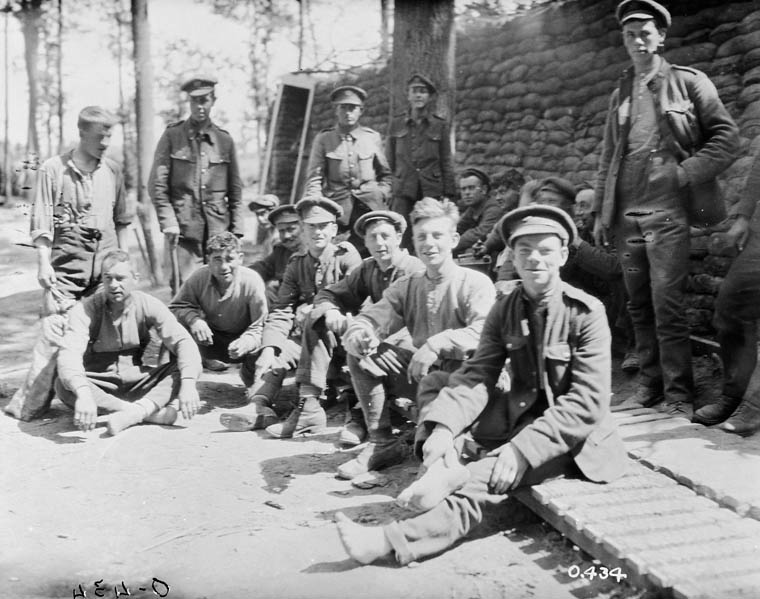
    A merry bunch (29th Canadian Infantry Battalion). July, 1916. MIKAN No. 3520993
    A merry bunch (29th Canadian Infantry Battalion). July, 1916. MIKAN No. 3520993

    Sergeant Basil Edward C Walker

    Arthur’s brother Basil Edward C Walker A30593 had enlisted on 18 March 1915 with the 48th Overseas Battalion. Sergeant Basil Edward C Walker would serve with the 29th Battalion and the 3rd Pioneer Battalion. Mowbray, England

    England

    Pte Arthur Walker sailed from Canada per SS BALTIC on 20 March 1916.

    RMS_Baltic_old_postcard
    RMS_Baltic_old_postcard

    Private Arthur Pelham Walker deficiency in kit, 23 May 1916 at West Sandling.

    Last Will of Private Arthur Pelham Walker 463947
    Last Will of Private Arthur Pelham Walker 463947

    Pte Walker proceed on draft to 29th Battalion, 25 May 1916.

    29th Battalion

    29th Vancouver Battalion organized in October 1914 under the command of Lieutenant-Colonel Henry Seymour Tobin. Also known as “Tobin’s Tigers”. Tobin was a veteran of the R.N.W.M.P., and the South African War (Lord Strathcona’s Horse). The 29th mobilized at Vancouver, and recruited in Vancouver, and New Westminster.

    The morning paper (29th Canadian Infantry Battalion). July, 1916. MIKAN No. 3396681
    The morning paper (29th Canadian Infantry Battalion). July, 1916. MIKAN No. 3396681

    Private Arthur Pelham Walker arrived at the Canadian Base Depot, 26 May 1916.

    Pte Walker left for unit, 30 May 1916, and joined the 29th Battalion the next day.

    Private Arthur Pelham Walker to Grenade Course, 20 July 1916.
    to 6th Canadian Infantry Brigade as Guide, 6 April 1917.

    MIKAN No. 3404759
    Canadians examine a German aerial torpedo. This photograph shows Canadian soldiers examining a captured German Granatenwerfer grenade, pointing out the pin and fuse. MIKAN No. 3404759

    Pte Walker granted 10 days leave from 16 April 1917.

    Private Arthur Pelham Walker the only member of the 29th Battalion killed in action on 14 February 1918. Medals sent to his brother Basil E C Walker, at White Lodge, Melton, Mowbray, England.

    Sucrerie Cemetery, Ablain-St. Nazaire

    Ablain-St Nazaire is a village in the Department of the Pas-de-Calais, approximately 13 kilometres north of Arras.

    Ruins of the Church at Ablain St. Nazaire showing Notre Dame de Lorette. February, 1918. This photograph shows the small ruined church (Notre-Dame de Lorette) on the battlefield (site of 3 First World War battles) at the village of Ablain St. Nazaire, north of Arras. Today this site is the largest French military cemetery in the World."
    Ruins of the Church at Ablain St. Nazaire showing Notre Dame de Lorette. February, 1918. This photograph shows the small ruined church (Notre-Dame de Lorette) on the battlefield (site of 3 First World War battles) at the village of Ablain St. Nazaire, north of Arras. Today this site is the largest French military cemetery in the World.” MIKAN No. 3403937

    The village and the neighbourhood of Ablain-St. Nazaire the scene of very severe fighting between the French and the Germans in May and June 1915. Sucrerie Cemetery named from a sugar factory, destroyed in the War and replaced by a farm. Begun in April 1917, next to a French Military Cemetery, now removed, of 1900 graves, and used until October 1918.

    Sucrerie Cemetery, Ablain-St. Nazaire, 16 August 2019. CEFRG
    Sucrerie Cemetery, Ablain-St. Nazaire, 16 August 2019. CEFRG

    Called at one time Saskatchewan Cemetery, and, in accordance with the Canadian practice, numbered C.D. 43. The village later “adopted” by the Urban District of Teddington. Nearly 400, Great War casualties commemorated in this site. The cemetery covers an area (without the footpath leading to it) of 1,918 square metres and is enclosed by a low brick wall.

    Private Arthur Pelham Walker 463947 CEFRG
    Private Arthur Pelham Walker 463947 CEFRG

    A very difficult CWGC cemetery to photograph – very few of the headstones have been refurbished. Private Arthur Pelham Walker’s headstone quite weathered. The cemetery however in a most scenic location.

    Contact Us

    ← Back

    Thank you for your response. ✨

    Subscribe