CEFRG.ca

Category: Soldiers

Between 1914 and 1919, over 650,000 Canadians served at home and overseas during the Great War. On the Western Front in Belgium and France, Canadian soldiers of the Great War distinguished themselves in numerous battles, including Second Battle of Ypres, Battle of Vimy Ridge, and Second Battle of Passchendaele. In Canada’s Last Hundred Days of the Great War, Canadian soldiers at the sharp end of the spear breaking through the enemy’s formidable trench defences, the Hindenburg Line. Their efforts have inspired these soldier stories.

Collections

Many collections used to bring the soldier stories to life. First, and foremost, the Personnel Records of the soldiers serving in the Canadian Expeditionary Force (CEF). This collection, like the others to follow, digitized and made available by Library and Archives Canada (LAC). Secondly, the War Diaries of the CEF often provide vital information about a soldier’s life not contained in their service file. Finally, Circumstances of Death (CoD), War Graves Registers (GRRF), and Veterans Death Cards provide further information on The Fallen. These three collections in conjunction with records of the Commonwealth War Graves Commission (CWGC) vital to cases of identification and recovery of The Missing.

Courts Martial Records (FGCM)

Additional collections used to present the soldier stories include Courts Martial Records. Courts martial had the authority to try a wide range of military offences that resembled civilian crimes like fraud, theft or perjury. Others, like desertion and cowardice – purely military crimes. Records of individual courts martial consist of an average of 20 to 25 documents, mainly standardized forms. These document the trial and the charges under the Army Act.

MIKAN photo collection

Finally, the most powerful way of bringing soldier stories of the Great War to life, the images of the MIKAN collection digitized by LAC.  Often complementing these photos – images held by the Imperial War Museum (IWM), some of which also contain images captured by the Official Canadian War Photographers (CWRO) during the Great War. Both LAC and IWM have film collections which further bring the reality of the soldier stories of the Great War to life.

  • Corporal Daniel Carman McArthur in the Great War

    Corporal Daniel Carman McArthur in the Great War

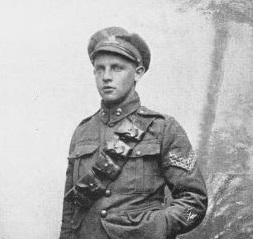
    Corporal Daniel Carman McArthur born in Brooklyn, New York City, on 12 August 1897, the son of Canadian poet Peter McArthur (d. 1924).

    Corporal Daniel Carman McArthur
    Corporal Daniel Carman McArthur

    – Le Caporal –

    Tremble! ye signallers, every man,
    Under the glance of Corporal Dan!
    Brand new clothes from tip to toe,—
    —All dressed up, and no place to go—
    Looks like a scarecrow up the line
    But back in billets it’s polish and shine.
    —When the photographer turned his crank
    Dan struck an attitude—”beaucoup swank”
    Exposed his flags and stripes and knife,
    And the camera took him true to life!

    Cpl Daniel Carman McArthur

    McArthur attended Ontario Agricultural College in Guelph, and enlisted with Canadian Field Artillery in 1916, serving overseas as a signaller.

    55th Battery Siegeburg, Germany, January 1919
    55th Battery Siegeburg, Germany, January 1919

    Daniel Carman McArthur became the first chief news editor of the Canadian Broadcasting Corporation. The annual RTNDA Dan MacArthur Award, given to the station with the best in-depth or investigative reporting, named in his honour.

    Enlistment of Daniel Carman McArthur

    Private Daniel Carman McArthur 324897 enlisted 15 March 1916 at Guelph, Ontario. Major Kent, OC of the 56th Battery approving. Daniel stood 5′ 7″, 154 pounds, with dark complexion, blue eyes and dark hair.

    56th Overseas Battery

    Organized in March 1916 under the command of Major V J Kent. Mobilized at Guelph, and recruited mainly from students at the Ontario Agriculture College. Left Halifax 13 September 1916 aboard METAGAMA. Arrived in England 22 September 1916. Absorbed by 55th (Daniel) and 66th Batteries on 22 January 1917.

    Daniel admitted with Measles, London Military Hospital, 13 April 1916.

    Driver_training_in_England_1915_thought_to_be_in_the_Witley_area
    Driver training in England 1915 thought to be in the Witley area. William Okell Holden Dodds fonds University of Victoria

    Private Daniel Carman McArthur promoted to Signal-Corporal, 15 June 1916.

    Daniel appointed A/Cpl, Witley Camp, 30 September 1916.

    55th Battery

    Organized in February 1916 under the command of Major E N Lewis. Mobilized at Guelph, and also recruited in the Guelph district. Left Halifax 13 September 1916 aboard METAGAMA. Arrived in England 22 September 1916. Transferred from 14th Brigade to 13th Brigade, 4th (later 5th) Canadian Divisional Artillery on 22 January 1917. Arrived in France 21 August 1917, 13th Brigade, 5th Canadian Divisional Artillery.

    Corporal Daniel Carman McArthur image of Bombardier C P McTague, 56th Battery
    Corporal Daniel Carman McArthur image of Bombardier C P McTague, 56th Battery

    Corporal McArthur entered the Western Front on 21 August 1917 with the 55th Battery of the 13th Brigade, 5th CDA.

    Daniel confirmed in rank of Corporal, 9 September 1916.

    Wounded

    Corporal Daniel Carman McArthur admitted to No 14 Canadian Field Ambulance, Gas shell, 11 October 1918. Discharged three days later.

    Two soldiers wearing gas masks examining a Lee Enfield rifle
    Two soldiers wearing gas masks examining a Lee Enfield rifle

    Cpl McArthur awarded 14 Days Leave to Paris, 29 November 1918.

    Corporal Daniel Carman McArthur promoted Sergeant, 16 April 1919.

    Sergeant McArthur proceeded to England, 16 May 1919.

    Sergeant Daniel Carman McArthur SoS to Canada, 11 June 1919, and later discharged in Toronto on 23 June 1919.

    Post Great War

    After the war McArthur worked as a journalist, and became editor of the Toronto Farmers’ Sun. In 1940 appointed supervisor of news at the Canadian Broadcasting Corporation, and became chief news editor when the CBC began doing its own reporting. In 1953 he became an executive assistant to management at the CBC’s Ottawa headquarters, and later became its director of special projects.

    Fought Legendary Battles

    Daniel Carman McArthur 20 March 1967 The Ottawa Citizen
    Daniel Carman McArthur 20 March 1967 The Ottawa Citizen

    The annual RTNDA Dan MacArthur Award, given to the station with the best in-depth or investigative reporting, named in his honour.

    Please Subscribe for New Posts

    Or Contact CEFRG

    ← Back

    Thank you for your response. ✨