CEFRG.ca

Category: Soldiers

Between 1914 and 1919, over 650,000 Canadians served at home and overseas during the Great War. On the Western Front in Belgium and France, Canadian soldiers of the Great War distinguished themselves in numerous battles, including Second Battle of Ypres, Battle of Vimy Ridge, and Second Battle of Passchendaele. In Canada’s Last Hundred Days of the Great War, Canadian soldiers at the sharp end of the spear breaking through the enemy’s formidable trench defences, the Hindenburg Line. Their efforts have inspired these soldier stories.

Collections

Many collections used to bring the soldier stories to life. First, and foremost, the Personnel Records of the soldiers serving in the Canadian Expeditionary Force (CEF). This collection, like the others to follow, digitized and made available by Library and Archives Canada (LAC). Secondly, the War Diaries of the CEF often provide vital information about a soldier’s life not contained in their service file. Finally, Circumstances of Death (CoD), War Graves Registers (GRRF), and Veterans Death Cards provide further information on The Fallen. These three collections in conjunction with records of the Commonwealth War Graves Commission (CWGC) vital to cases of identification and recovery of The Missing.

Courts Martial Records (FGCM)

Additional collections used to present the soldier stories include Courts Martial Records. Courts martial had the authority to try a wide range of military offences that resembled civilian crimes like fraud, theft or perjury. Others, like desertion and cowardice – purely military crimes. Records of individual courts martial consist of an average of 20 to 25 documents, mainly standardized forms. These document the trial and the charges under the Army Act.

MIKAN photo collection

Finally, the most powerful way of bringing soldier stories of the Great War to life, the images of the MIKAN collection digitized by LAC.  Often complementing these photos – images held by the Imperial War Museum (IWM), some of which also contain images captured by the Official Canadian War Photographers (CWRO) during the Great War. Both LAC and IWM have film collections which further bring the reality of the soldier stories of the Great War to life.

  • Private Wilson Norman Ling in the Great War

    Private Wilson Norman Ling in the Great War

    Last Canadian Shot at Dawn

    Private Wilson Norman Ling twice convicted of desertion in the Great War, the last Canadian Shot at Dawn in August of 1918. He enlisted under the name of Norman Ling.

    Private Wilson Norman Ling

    Private Wilson Norman Ling 454610 son of Albert E and Fannia Ling, of Toronto, Ontario, enlisted 7 May 1915 at Lindsay, Ontario.

    Enlistment of Wilson Norman Ling

    Wilson Norman Ling enlisted at Lindsay, Ontario on 7 May 1915. He stood 5′ 6″ tall, with fair complexion, brown eyes and dark brown hair. Just shy of 19 years of age.

    Disciplined

    From July 1915, Ling reprimanded several times, twice forfeiting pay, and once placed in detention, October 1915.

    Ling’s ToS by the 39th Battalion at West Sandling on 24 November 1915.

    Private Wilson Norman Ling entered France on 15 March 1916.

    A Canadian Battalion going over the top, October 1916. This famous image was originally believed to have been taken at the front, but later proven to have actually been a composite of shell bursts at a trench-mortar school near St. Pol and rehearsal attacks. Photographer Captain William Ivor Castle. MIKAN No. 3206096
    A Canadian Battalion going over the top, October 1916. This famous image was originally believed to have been taken at the front, but later proven to have actually been a composite of shell bursts at a trench-mortar school near St. Pol and rehearsal attacks. Photographer Captain William Ivor Castle. MIKAN No. 3206096

    Ling reported missing 22 June 1916, but later found with his unit.

    Wounded

    Pte Norman Ling wounded, to hospital on 22 September 1916, later rejoining his unit on 28th October.

    Missing

    Missing from 5 October 1916, and later believed to be killed, but Ling soon reported as safe with his unit.

    Sentenced to Death

    Private Wilson Norman Ling tried and convicted by FGCM, and to be Sentenced to Suffer Death by Being Shot for Desertion, 2 January 1917.

    MIKAN No. 3404042
    Railway track damaged by shell fire. January 1917. MIKAN No. 3404042

    Sentence commuted, admitted to No 5 Military Prison, Les Attaques, for 2 Years Hard Labour, 28 January 1917.

    Hospitalized

    Bed Patients in the Sunlight Outside Ward G No 3 General Hospital
    Bed Patients in the Sunlight Outside Ward G No 3 General Hospital

    To No 30 General Hospital, Calais, NYD, 30 March 1917 and later discharged to Military Prison on 9 June 1917.

    Private Wilson Norman Ling’s sentence suspended, 16 June 1917, and entrained for unit.

    MIKAN No. 3396718
    A little French paper boy selling English papers in Canadian line. June, 1917. MIKAN No. 3396718

    Missing 320 Days

    Pte Ling rejoined his unit on 20th June, but AWOL from 9 am on 21 June 1917 at Neuville-St-Vaast.

    Missing for 320 days, apprehended by Military Police at Les Brebis, 7 May 1918. Handed over to the 2nd Battalion on 27 June 1918.

    Sentenced to Death

    In confinement awaiting trial from 7 July 1918. Private Wilson Norman Ling sentenced to death by FGCM, 8 July 1918.

    Charles Valentine Lester
    Winnipeg Court Martial Miitary School, 1891. MIKAN No. 3299294

    To APM, 1st Division, 13 July 1918. Sentence approved by Haig, 4 August 1918. Sentence promulgated 11 August 1918, and duly carried out.

    13th Battalion Scots outside funk-holes cleaning Lewis gun 22 July 1918. MIKAN No. 3406015
    13th Battalion Scots outside funk-holes cleaning Lewis gun 22 July 1918. MIKAN No. 3406015

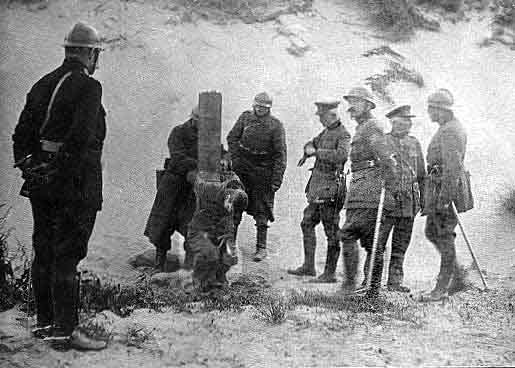
    Private Ling Shot at Dawn

    Pte Ling Shot at Dawn, 12 August 1918 and immediately buried at the New French Military Cemetery in Cerisy-Gailly.

    Private Wilson Norman Ling

    The Toronto Star reported Wilson had died of wounds. His execution was the fifth and last shooting during the month of August 1918.

    Private Wilson Norman Ling

    Cerisy-Gailly Military Cemetery

    Cerisy-Gailly Military Cemetery (originally called the New French Military Cemetery) begun in February 1917 and used by medical units until March 1918.

    Cerisy-Gailly

    After the recapture of the village used by Australian units.

    Private Wilson Norman Ling

    The cemetery increased after the Armistice when graves brought in from the battlefields of the Somme.

    https://www.ww1cemeteries.com/cerisy-gailly-military-cemetery.html

    Picture © Geerhard Joos

    Contact CEFRG

    ← Back

    Thank you for your response. ✨