Video and image blog posts relating to significant events and dates of the Great War. The origins of the Great War are complex. Presenting a chronology of the Great War on the Western Front would be a daunting task. Instead, CEFRG presents a random look at the Great War in these blog posts.
Battle of Liege
The first battle on the Western Front was the Battle of Liege which opened on 5 August 1914. Before the end of 1914, no less than 25 battles or actions on the Western Front. The battles also significant, including such battles as the Battle of Mons, the First Battle of the Marne, First Battle of Arras, and First Battle of Ypres.
Battle of Neuve-Chapelle
Canada’s first action came at the Battle of Neuve-Chapelle which opened on 10 March 1915. While not a large battle, the first time the Canadian Expeditionary Force fully involved in action with the enemy. Under the British 1st Army, Canada’s role in the battle to prevent the Germans in this sector from reinforcing the combat zone. Unfortunately, the artillery bombardment provided too light to suppress the enemy trenches.
March to the Rhine
Canada’s final actions in the Great War came after the Armistice. The March to the Rhine by the 1st and 2nd Canadian Division with select Corps Troops, saw Canada crossing the Rhine river at Cologne, and Bonn, Germany. This action was followed by the Allied Occupation of Germany which lasted for ten years.
Canada’s role completed before the spring of 1919, and most of our troops home before the official end to the war on 28 June 1919, when Germany and the Allied Nations (including Britain, France, Italy and Russia) signed the Treaty of Versailles, formally ending the war. Therefore, many blog posts of On This Day in the Great War extend into 1919, particularly concerning demobilization.
The 1st and 2nd Canadian Divisions, along with selected Corps Troops, marched to the Rhine in December of 1918 to assume occupation duties. A very rainy Friday, 13 December 1918 began ten continuous years of the Allied Occupation of Germany, as the Rhine river officially crossed at Cologne and Bonn.
Rhein Bridge, Bonn
Rheinbrücke
General Sir Arthur Currie and Staff crossing the Rhine at Bonn,, 13 December1918. MIKAN No. 3522440
Sir Arthur Currie
The Canadian and II Corps (Lieut.-Generals Sir A. Currie and Sir Claud Jacob) would carry out the occupation. Thus, in the occupation of the Rhineland the Dominions were represented by the Canadian Corps, by the New Zealand Division, the 13th Australian Light Horse, the 50th South African Heavy Battery, and by the 1st Royal Newfoundland Regiment.
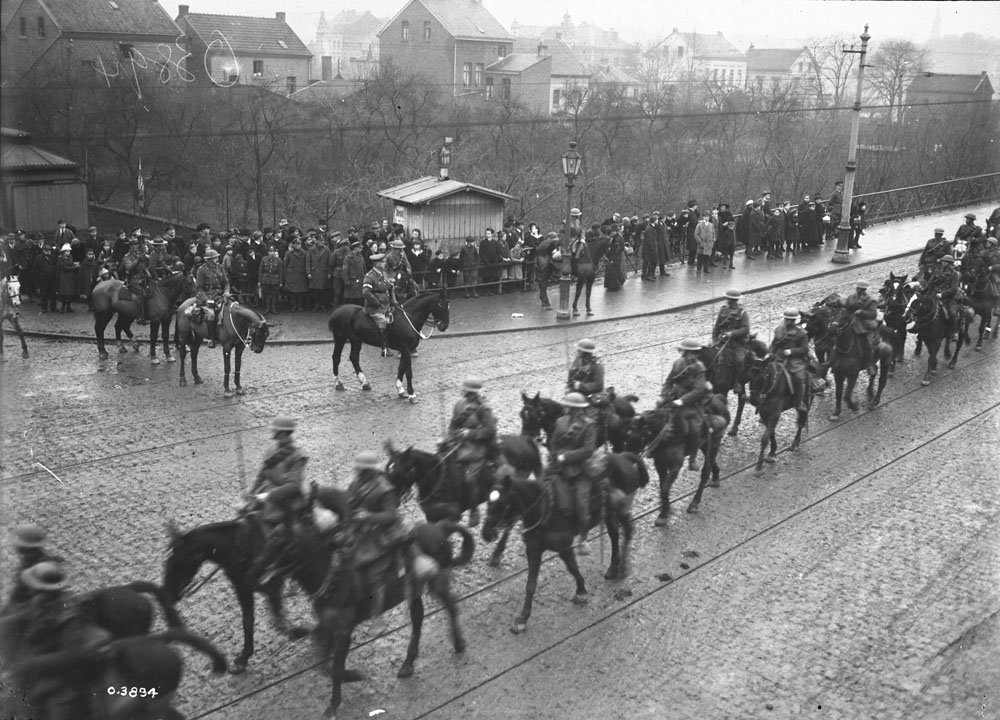
General Sir Arthur Currie takes the salute as the British Cavalry cross the Rhine at Bonn (Rheinbrücke at Bonn). December 13, 1918 MIKAN No. 3522439General Sir Arthur Currie takes the salute as the British Cavalry cross the Rhine at Bonn. December 13, 1918. MIKAN No. 3522451MIKAN No. 3522452General Sir Arthur Currie takes the salute as the British Cavalry cross the Rhine at Bonn (Rheinbrücke at Bonn). December 13, 1918 MIKAN No. 3522445
2nd Canadian Division
Corps Commander, General Sir Arthur Currie, taking the salute of the 2nd Canadian Division on the Bridge at Bonn, December 13th, 1918, (24th Battalion passing Saluting Base). MIKAN No. 3522482G.O.C. and H.Q. Staff, 2nd Canadian Division, passing the Saluting Base [on the Bridge over the Rhine at Bonn] December 13, 1918 MIKAN No. 3522444
Canadian Light Horse
Canadian Light Horse passing Saluting Base on Bonn Bridge. December 13, 1918 MIKAN No. 3522443General Sir Arthur Currie takes the salute as the British Cavalry cross the Rhine at Bonn. Friday, 13 December 1918 MIKAN No. 3522419
13th Brigade, CFA
13th Brigade, Canadian Field Artillery passing Saluting Base on Bonn Bridge. December 13, 1918 MIKAN No. 3522421General Sir Arthur Currie takes the salute as the British Cavalry cross the Rhine at Bonn. December 13, 1918 MIKAN No. 3522420
Canadian Field Artillery
Artillery crossing the Rhine at Bonn December 13, 1918 MIKAN No. 3522422A Canadian Infantry Battalion crossing the Rhine at Bonn. December 13, 1918 MIKAN No. 352242321st Battalion crossing the Rhine at Bonn, December 13, 1918 MIKAN No. 352242419th Canadian Infantry Battalion passing the Corps Commander on Bonn Bridge (Rheinbrücke at Bonn). December 13, 1918 MIKAN No. 352242524th Canadian Infantry Battalion passing the Corps Commander on Bonn Bridge (Rheinbrücke at Bonn). December 13, 1918 MIKAN No. 3522426
Van Doos
22nd Canadian Infantry Battalion crossing the Rhine at Bonn, 13 December 1918. Lt.-Col. Sir Arthur Currie saluting. MIKAN No. 3194827
Battalions of 2nd Canadian Division passing Corps Commander on Bonn Bridge. MIKAN No. 3522427Battalions of 2nd Canadian Division passing Corps Commander on Bonn Bridge. MIKAN No. 3522428 Battalions of 2nd Canadian Division passing Corps Commander on Bonn Bridge. MIKAN No. 352242919th Canadian Infantry Battalion passing Corps Commander on Bonn Bridge. December, 1918 MIKAN No. 3522430
Sir Douglas Haig
Sir Douglas Haig meets officers of the 2nd Canadian Division Headquarters on the other side of the Rhine. Friday 13 December 1918. MIKAN No. 3522431 MIKAN No. 3522432Sir Douglas Haig MIKAN No. 35224333522434 MIKAN No. 3522435Sir Douglas Haig meets Officers of the Canadian Corps Headquarters at the Chateau of the sister-in-law of the late Kaiser in Bonn, Germany. Friday 13 December 1918. Sir Arthur Currie sleeps in her bed tonight. MIKAN No. 3522436
Schiff Bridge, Cologne
Schiffbrücke
The Royal Newfoundland Regiment began a march with the British 9th Division to the German border. Their task to provide part of the Allied occupation force in Germany. Setting out from Cuerne, near Harlebeke, Belgium, on 15 November, their route took the Regiment past Brussels, then to the Meuse River, and on to the German border at Rotgen. On 4 December 1918, after 14 days of marching an average of 13 miles a day, the Regiment reached the border, and on 8 December arrived in Cologne on the Rhine River.
Royal Newfoundland Regiment crossing the south bridge over the Rhine at Cologne, 13 December 1918, led by CO Maj AE Bernard (right) and Adjt Capt A Raley
On Friday 13 December 1918, The Royal Newfoundland Regiment crossed the Rhine River and took up bridgehead duties near Cologne as part of the Allied occupation force in the Rhineland.
Plumer stands with his staff to one side of the road leading across the bridge. With him are Lieutenant-General C Jacob, commanding II Corps, and Lieutenant-General Sir Charles Kavanagh commanding the Cavalry Corps.
Contains information related to marketing campaigns of the user. These are shared with Google AdWords / Google Ads when the Google Ads and Google Analytics accounts are linked together.
90 days
__utma
ID used to identify users and sessions
2 years after last activity
__utmt
Used to monitor number of Google Analytics server requests
10 minutes
__utmb
Used to distinguish new sessions and visits. This cookie is set when the GA.js javascript library is loaded and there is no existing __utmb cookie. The cookie is updated every time data is sent to the Google Analytics server.
30 minutes after last activity
__utmc
Used only with old Urchin versions of Google Analytics and not with GA.js. Was used to distinguish between new sessions and visits at the end of a session.
End of session (browser)
__utmz
Contains information about the traffic source or campaign that directed user to the website. The cookie is set when the GA.js javascript is loaded and updated when data is sent to the Google Anaytics server
6 months after last activity
__utmv
Contains custom information set by the web developer via the _setCustomVar method in Google Analytics. This cookie is updated every time new data is sent to the Google Analytics server.
2 years after last activity
__utmx
Used to determine whether a user is included in an A / B or Multivariate test.
18 months
_ga
ID used to identify users
2 years
_gali
Used by Google Analytics to determine which links on a page are being clicked
30 seconds
_ga_
ID used to identify users
2 years
_gid
ID used to identify users for 24 hours after last activity
24 hours
_gat
Used to monitor number of Google Analytics server requests when using Google Tag Manager


![1918-12-13 3522444 O-3892 PA-003799 G.O.C. and H.Q. Staff, 2nd Canadian Division, passing the Saluting Base [on the Bridge over the Rhine at Bonn] December 13, 1918](https://i0.wp.com/cefrg.ca/wp-content/uploads/2021/12/3522444-a003799-v8.jpg?ssl=1)


