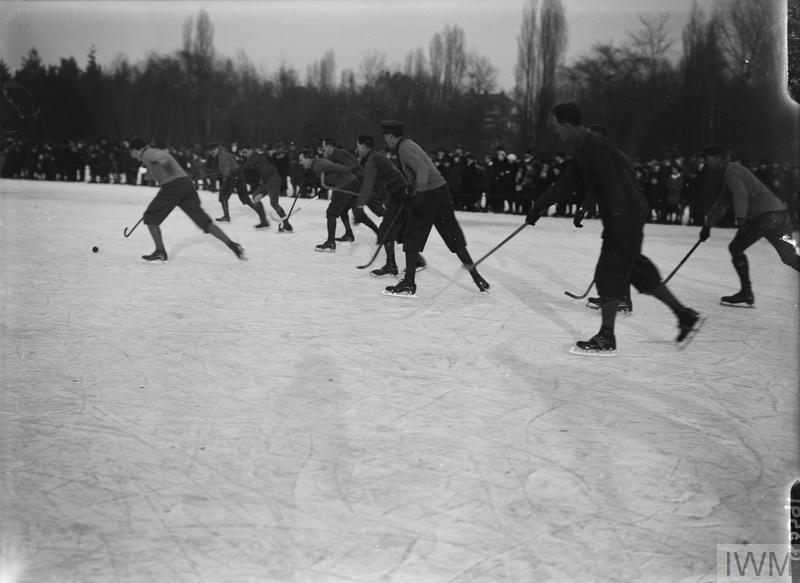
While Spartacans on the rampage in Berlin, the Irish Guards hockey game held at Cologne, Germany on Monday, 10 February 1919. No Canadians attended – 1st Canadian Division HQ had closed at Marienburg on 12 January 1919. CEF participation in the Allied Occupation of Germany lasted only a month.

Meanwhile in Paris, the Supreme War Council reached a decision at yesterday’s meeting. Decided to impose more severe conditions upon Germany for the renewal of the armistice because of Germany’s attitude toward the fulfilment of her obligations.
Irish Guards Hockey Game
The 1st Battalion, Irish Guards deployed to France, eight days after the United Kingdom had declared war upon the German Empire. They served as part of 4th (Guards) Brigade of the 2nd Division.

The battalion immediately engaged in the Retreat from Mons.

The 1st Battalion suffered huge casualties between November 1–8, 1914 holding the line against near defeat by German forces.

By the end of First Battle of Ypres on 22 November 1914, the battalion suffered over 700 casualties. Only two companies left to rebuild the battalion.

The original battalion of 1st Irish Guards which had been decimated, and had to be reconstructed with new recruits.

In February 1915, Lance-Corporal Michael O’Leary performed an act of bravery at Cuinchy, earning the first of four Irish Guards VC’s in the Great War.
Public Skating

Second Lieutenant John Kipling, the 18-year-old son of author Rudyard Kipling. Listed as missing during the Battle of Loos in September 1915.

Kipling
In tribute to his son’s regiment, Kipling composed the poem “The Irish Guards”. After the war he wrote a two-volume history of the regiment’s service in the war.

When the Armistice signed on 11 November 1918, the 1st Battalion, Irish Guards at Maubeuge. Near to where the Irish Guards began their war in 1914 at Mons.

On 13 December 1918, under a steady down pour, the Irish Guards crossed the south bridge at Cologne, and began their occupation of the west bank of the Rhine.

The Allied Occupation of Germany ended ten years later on 13 December 1928. The Irish Guards had returned home in 1919.

Both battalions returned to Britain victoriously in the spring of 1919. After a final parade through London, the 2nd and 3rd Irish Guards, now surplus to requirements, and disbanded.

In 1920, for St Patrick’s Day, the regiment donned its full-dress for the first time since before the outbreak of the Great War.
Cologne Cathedral

The regiment’s continued existence threatened briefly by Winston Churchill, Secretary of State for War in 1921. He had sought the elimination of the Irish Guards as an economy measure.
More
- Home of CEFRG
- Blog
- CEFRG on FaceBook
- CEFRG on YouTube
- Soldiers and Nursing Sisters
- Units (Brigades, Battalions, Companies)
- War Diary of the 18th Battalion (Blog)
- 48th Highlanders of Canada
- 116th Battalion CEF – The Great War
- Les Soldats du Québec Morts en Service
- The Aerodrome (Aces and Aircraft)
- Montreal Aviation Museum
- Battles of the Great War
- Cases
- Cemeteries
- Memorials
- On This Day
- About CEFRG

