CEFRG.ca

Category: Memorials

Memorials of the Great War

Over 20,000,000 soldiers, sailors, pilots, Nursing Sisters, and civilians commemorated by Memorials of the Great War.  Canada must be proud, for the Canadian National Vimy Memorial in France, regarded as the finest example of a tribute to War Dead. Nearly as inspiring, the St Julien Memorial in Belgium, commonly known as The Brooding Soldier Monument. Each of these memorials Honour Canada’s War Dead in the respective countries.

Battlefield Memorials

Canada has many memorials on the Western Front, and in recent years, many have been added to the list. Eight memorials, known as Battlefield Memorials erected by the Government of Canada to include notable battles such as Vimy RidgeBourlon WoodCourceletteDuryHill 62 (Sanctuary Wood)Le QuesnelPasschendaele and St. Julien. These memorials dedicated soon after the Great War.

Trail of the Caribou

Five memorials mark places of historical significance to the then Dominion of Newfoundland: Beaumont-HamelGueudecourtMonchy-le-PreuxMasnières, and Courtrai. Collectively, these memorials referred to as the Trail of the Caribou.  A sixth monument added to commemorate the losses of the Royal Newfoundland Regiment (RNR) in Gallipoli. The memorial placed 25 metres northwest of the Hill 10 Cemetery in Gallipoli, the resting place for a dozen RNR soldiers, including Private Hugh McWhirter, the Regiment’s first casualty in the fighting at Gallipoli during the Great World War.

15th Battalion Memorial Project

The 15th Battalion Memorial Project initiated in 2007 with a simple objective: to commemorate all of the members of the 48th Highlanders of Canada who served, especially those who gave their lives, in the 15th Battalion, CEF during The Great War. Two memorials in Belgium at St Julien and Gravenstafel Ridge commemorate the 1915 gas attack during the 24 April 1915 battle of 2nd Ypres. A memorial in France at Hendecourt-les-Cagnicourt commemorates the 1 September 1918 capture of ‘The Crow’s Nest during the battle of The Drocourt-Queant Line.  Another in Belgium  at Observatory Ridge commemorates the 3 June 1916 attack during the fighting for Mount Sorrel. Another at Festubert in France commemorates the 20 May 1915 action at Canadian Orchard and The North Breastworks. Finally, two memorials at Hill 70 and Marquion (Canal du Nord) complete this collection.

Hill 70 Memorial

The most recent major memorial the Hill 70 Memorial Park, dedicated to the Canadian Corps that achieved victory at the Battle of Hill 70 in August, 1917. Finally completed on 2 October 2019, after given a pre-mature, and closed-to-the-public inauguration for the Vimy Centennial in 2017. The centerpiece of the Memorial – an obelisk signifying the victory of the Canadian Corps at the Battle of Hill 70. In addition to the obelisk, a series of walkways dedicated to the six Victoria Cross awards, plazas dedicated to Regiments, and soldiers who figured prominently in the battle.

  • Canadian National Vimy Memorial of the Great War

    Canadian National Vimy Memorial of the Great War

    Construction

    The construction of Canadian National Vimy Memorial began in 1925. Completed just after the intended unveiling of 1 July 1936. 15,000 tonnes of concrete, hundreds of tons of steel, and 6,000 tonnes of specially selected limestone from Croatia were used. Walter S. Allward designed the most magnificent war memorial in the world.

    Walter Seymour Allward in August 1933. MIKAN No. 3214276
    Allward in August 1933. MIKAN No. 3214276

    Described by some as too difficult to work with, truth be Allward was extremely demanding. He refuses to compromise, and his vision, dedication, and hard work are the reason why Canada has such a beautiful monument to our Missing of the Great War.

    Construction of Vimy Memorial carving Stone Sarcophagus. As with the reconstruction of Vimy, large structures were placed over the monument so that work could continue irregardless of the weather conditions. MIKAN No. 3612539
    Construction of Vimy Memorial carving Stone Sarcophagus. MIKAN No. 3612539

    The design for Vimy is the work of Toronto-based architect Walter S. Allward. From an original field of 162 designs, eight were selected. One for each of the specially designated sites. The runner-up chosen as Canada’s memorial to the Fallen in Belgium. The St. Julien Memorial (The Brooding Soldier Monument) stands at Vancouver Corner in Sint-Juliaan, Belgium. The remaining sites are chosen for what are known as the Battlefield Memorials.

    Construction of Vimy Memorial Rear View. MIKAN No. 3612534
    Construction of Vimy Memorial Rear View. MIKAN No. 3612534
    Construction of Vimy Memorial North Side. MIKAN No. 3612533
    Construction of Vimy Memorial North Side. MIKAN No. 3612533

    The necessary road building and landscaping was carried out by French and British veterans employed by the Imperial War Graves Commission, later the CWGC. In 1925, Allward moved to Paris to supervise the construction of the monument.

    Construction of Vimy Memorial, left front entrance steps shows panel where names to be carved begin. MIKAN No. 3612537
    Left front entrance steps shows panel where names to be carved begin. MIKAN No. 3612537

    Change

    During the fifteen years between Allward’s design of the monument, and the installation of the last dramatic sculptures, the world had changed. And, so did the design. Allward agreed to inscribe the names of The Missing on the base of the monument. This was not a compromise, from a very uncompromising man. This was true understanding.

    Official caption reads: His Majesty King Edward VIII descends from Vimy Memorial to greet Canadian pilgrims at the Unveiling ceremony. L. to r., front row: Brig.-Gen. Alex Ross, President, Canadian Legion, Major-General S. H. Burstall, wartime commander of 2nd Canadian Division, His Majesty, Hon. Ian Mackenzie, Minister of National Defense; 2nd row: Maj. Gen. Sir Richard Turner, V.C., Maj-Gen. Sir Archibald Macdonald, wartime commander of 1st Canadian Div., Hon. Ernest lapointe, Hon. C. G. Power; 3rd row: H.R.H. Prince Arthur of Connaught; Lt.-Col. Alexander; Col. W.W. Foster, 1st vice-president, Canadian Legion, Hon. Philippe Roy, Canadian Minister to France. Taken by an official canadian Government Motion Picture Bureau photographer who accompanied Canadian pilgrims to the unveiling ceremony. MIKAN No. 3377866
    His Majesty King Edward VIII descends from Vimy Memorial to greet Canadian pilgrims at the Unveiling ceremony. L. to r., front row: Brig.-Gen. Alex Ross, President, Canadian Legion, Major-General S. H. Burstall, wartime commander of 2nd Canadian Division, His Majesty, Hon. Ian Mackenzie, Minister of National Defense; 2nd row: Maj. Gen. Sir Richard Turner, V.C., Maj-Gen. Sir Archibald Macdonald, wartime commander of 1st Canadian Div., Hon. Ernest Lapointe, Hon. C. G. Power; 3rd row: H.R.H. Prince Arthur of Connaught; Lt.-Col. Alexander; Col. W.W. Foster, 1st vice-president, Canadian Legion, Hon. Philippe Roy, Canadian Minister to France. MIKAN No. 3377866

    Inauguration

    The intended unveiling of Dominion Day, 1 July 1936, cannot be met – the memorial is not yet finished. The date is pushed to 26 July 1936. The choice for who was to represent Canada, and unveil the monument, meant much to Canadian Veterans. For British Veterans too. Many of them fought with the CEF, and for Canada. They too, are here in the thousands.

    It would have been a huge mistake to have the Canadian Prime Minister unveil the monument. Not because he was the political leader of the country, but because he was MacKenzie King. And it was not so much about his lack of a military background. Worse, King was despised by the Veterans. They felt King had disrespected their former commander, General Julian Byng (Baron Byng of Vimy).

    General Horne, General Sir Julian Byng, General Sir Arthur Currie and Major-General Sir H.F. Mercer at unveiling of Memorial to Artillerymen who fell on Vimy Ridge, February, 1918. MIKAN No. 3395023
    General Horne, General Sir Julian Byng, General Sir Arthur Currie and Major-General Sir H.F. Mercer at unveiling of Memorial to Artillerymen who fell on Vimy Ridge, February, 1918. MIKAN No. 3395023

    Byng-King Affair

    There was a great scandal during Byng’s tenure as Governor-General of Canada, 1921 – 1926. So scandalous, it became known as the King-Byng Affair. Byng would have made a perfect choice, had he been the current Governor-General. Alas, the current man in the role was John Buchan. Though well versed in Canadian history, he was also not from a military background.

    Sir Arthur Currie had passed away in 1933. He also would have been a perfect choice, as their former commander. However, Currie had not chosen a political career, that is, he had not become Governor-General. Finally, the most suitable person for the role, and the correct one, was chosen. But would he accept the invitation?

    King Edward VIII

    King George V had passed away earlier on 26 January 1936. Now, his son, the former Prince of Wales reigned. His Majesty graciously accepted Canada’s request to unveil the Canadian National Vimy Memorial. It would be the King of Canada’s first engagement since the death of his father. It would also be his last and only public engagement. King Edward VIII would abdicate in December of 1936.

    The Prince of Wales with General Currie and General Watson in Denain, October 27, 1918. MIKAN No. 3522306
    The Prince of Wales with General Currie and General Watson in Denain, October 27, 1918. MIKAN No. 3522306

    Edward was the perfect choice, especially to the Veterans. They knew him, and they liked him. Many had met the former Prince of Wales on the battlefields of the Western Front. King George V and the Prince of Wales visited the front many times during the war. They went out of their way to visit the soldiers of all Commonwealth Nations. Edward was not comfortable in the role of King. However, photos of him during the Great War, reveal he was always comfortable among the soldiers. And again, he will be among the Veterans at Vimy.

    Embarkation

    In mid-July 1936, the Vimy Pilgrims left on five ships departing from Montreal. Canadian Pacific Steamships provided the Duchess of Bedford, S.S. MONTROSE, and S.S. MONTCALM. Two ships, S.S. ASCANIA, and S.S. ANTONIA, came from the Cunard-White Star Line.

    Vimy Pilgrimage, leaving Montreal, motion picture camera in foreground. MIKAN No. 3408479
    Vimy Pilgrimage, leaving Montreal, motion picture camera in foreground. MIKAN No. 3408479
    Members of Vimy Pilgrimage embarked in S.S. "Antonia", Montreal, returning from Liverpool on 31 July 1936. MIKAN No. 3408478
    Members of Vimy Pilgrimage embarked in S.S. “Antonia”, 16 July in Montreal, disembarking from Liverpool on 31 July 1936. MIKAN No. 3408478

    All of the ships arrive barely in time for the unveiling. Already rescheduled to 26 July 1936. S.S. ANTONIA arrived at Le Havre on the morning of 25 July 1936. And now, 6,200 Pilgrims were now on their way by rail, and bus to the ceremony. Everyone makes it, but just in time. When they arrive at the memorial, they are surrounded by 20,000 French civilians.

    Ceremony

    The event is broadcast worldwide by the BBC, and in Canada by the CBC. King Edward arrived at 2:15 pm. The day is sunny, and beautiful. The programme of the ceremony is so well-planned, and orchestrated. However, it comes with much relief to the organizers, as the event appeared in jeopardy that very morning. Would everyone arrive in time?

    H.M. King Edward VIII, accompanied by H.R.H. Prince Arthur of Connaught and Hons. Ernest Lapointe, Ian Mackenzie and C.G. Power inspecting guard of honour at the unveiling of the Vimy Ridge Memorial. MIKAN No. 3224328
    H.M. King Edward VIII, accompanied by H.R.H. Prince Arthur of Connaught and Hons. Ernest Lapointe, Ian Mackenzie and C.G. Power. Inspecting guard of honour at the unveiling of the Vimy Ridge Memorial. MIKAN No. 3224328

    Unveiling

    H.M. King Edward VIII unveiling the figure of Canada on the Vimy Ridge Memorial MIKAN 3224327 26 July 1936
    H.M. King Edward VIII unveiling the figure of Canada on the Vimy Ridge Memorial MIKAN 3224327 26 July 1936

    Flypast

    Flypast of military aircraft during the unveiling of the Vimy Ridge Memorial MIKAN 3224320 26 July 1936
    Flypast of military aircraft during the unveiling of the Vimy Ridge Memorial MIKAN 3224320 26 July 1936

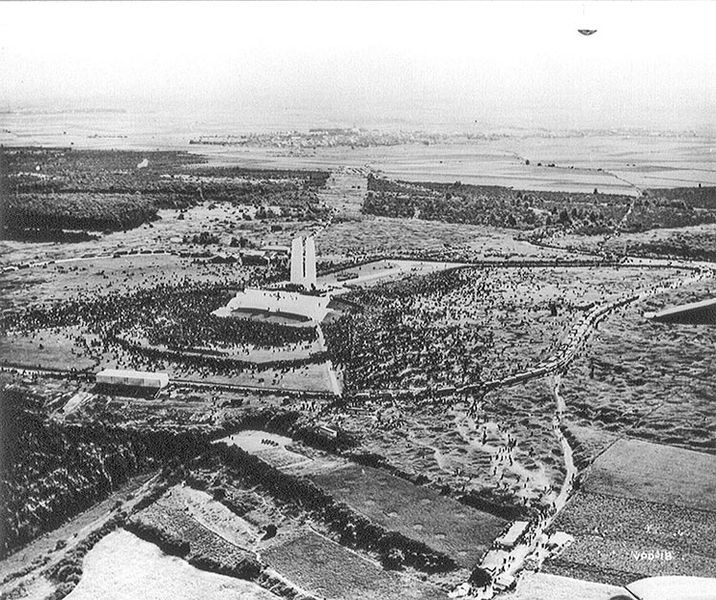
    The ceremony is solemn and dignified. King Edward is most impressed. Thousands are impressed by the King, and the words he chose to say. The flypast certainly brings back the past for many a soldier. It is the image of the familiar planes, and their unmistakable sound, that brings the reality of the trenches back to the men.

    Note thousands of people in areas which are today restricted. Signs indicate ordinance from the Great War still remain in these sections now grazed by sheep. Nevertheless, an impatient, corralled crowd, broke through these areas following the ceremony on 9 April 2017.

    Meeting the Pilgrims

    Following the unveiling, the King spent some time with the Vimy Pilgrims. Especially, with a group of disabled Veterans. First, he walked down into the amphitheater to meet the Veterans. It was at this point the crowd could not contain their serenity any longer. Upon his appearance, the veterans, offered “such a roar you never heard in war or peace.” After speaking with many Veterans, the King also had a very pleasant conversation with Silver Cross Mother, Mrs. Charlotte Susan (nee Fullman) Wood.

    Silver Cross Mother Charlotte Susan Wood

    On 24 August 1914, Mrs. Wood’s son, Private Frederick Francis Wood, was killed at Mons, Belgium. Frederick serving with the Duke of Cambridge’s Own (Middlesex Regiment). Then, less than three years later, on 5 May 1917, a second son, Private Peter Percy Wood was killed at Vimy Ridge. Peter serving with the Canadian Infantry (Saskatchewan Regiment). His body was never recovered. Mrs. Wood saw his name for the first time on the Vimy Memorial.

    Before she returned to Canada, Mrs. Wood placed a wreath on the tomb of the Unknown Soldier at Westminster Abbey in London, England. On behalf of all Canadian mothers who have lost a child in military service to their country.

    Mrs. C.S. Wood, who represented the Silver Star Mothers of Canada at the unveiling of the Vimy Ridge Memorial. MIKAN No. 3224323
    Mrs. Charlotte Susan Wood. Silver Star Mothers of Canada. At the unveiling of the Vimy Ridge Memorial. MIKAN No. 3224323

    Charlotte Susan Wood was Canada’s first Silver Cross Mother.

    More

    This is CEFRG‘s first post about a Great War memorial. Like the selection of the monument, the Canadian National Vimy Memorial was the perfect choice.

    Canadian National Vimy Memorial
    French History students seated on the Canadian National Vimy Memorial, 6 May 2014.

    The second most appropriate choice, must be the Menin Gate Memorial. Though, not a Canadian memorial, the Menin Gate, is much like Vimy. It also names The Missing who have Fallen, but in the country of Belgium, during the Great War.

    However, the memorials, like the cemeteries, and battles, are chosen at random. Next memorial to be featured, will be the Canadian Field Artillery Memorial in Thélus, which was shown in a photograph above, and here below.

    Monument erected to Canadian Artillery-men who fell during Vimy Battle at Les Tilleuls crossroads. December, 1917. The Canadian Artillery Memorial near the village of Thelus, Vimy, as completed. MIKAN No. 3379680
    Monument to Canadian Artillery men who fell during Vimy Battle. Les Tilleuls crossroads, December, 1917. The Canadian Artillery Memorial near the village of Thélus. MIKAN No. 3379680