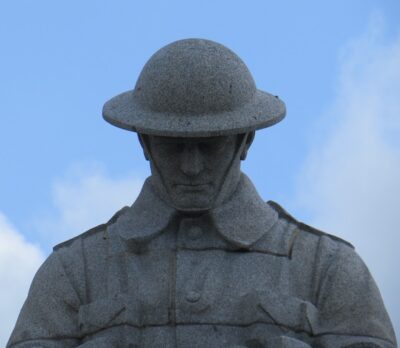
The Brooding Soldier Monument
Unlike the Vimy Memorial, the St Julien Canadian Memorial designed by an architect serving in the Canadian Expeditionary Force during the Great War. However, Frederick Chapman Clemesha slightly wounded serving with the 46th Battalion, South Saskatchewan Regiment in 1918. Then, Clemesha returned to his Regina architectural practice for a short time after the war.

Encouraged by his business partner, another veteran, he submitted a design to the 1920 national competition to commemorate eight Canadian Great War battles in Belgium and France. Though he had won other competitions, St Julien Canadian Memorial became his only design to reach fruition.
Lieutenant Frederick Chapman Clemesha
Frederick Chapman Clemesha born 3 August 1876 in Preston, Lancashire, England. Note Frederick an architect by trade. This quite relevant to all Canadians following the Great War. Firstly, he emigrated to Saskatchewan in the early 20th century and opened an architectural practice, Clemesha and Portnall, in Regina. For some unknown reason, Clemshaw changed his surname to Clemesha during his career as an architect. His partner, 10 years his junior, Private Francis Henry Portnall, also served with the 46th Battalion.
Career
Frederick Chapman Clemesha entered several competitions, winning two, yet the designs never realized. Soon, Clemesha & Portnall quickly became known for their residential designs. Then, against strong international competition, their design for the Manitoba Legislative Building in Winnipeg placed second.
REGINA, SASK., Civic Hospital, 14th Avenue, 1908.
Eight different architects from the United States and Canada submitted a design for major institutional project. However, the proposal by Clemesha passed over in favour of the scheme by Storey & Van Egmond.
REGINA, SASK., Public Library, 1911
Clemesha was awarded Second Premium for his design. The winners were Storey & Van Egmond of Regina.
WINNIPEG, MAN., Legislative Buildings, 1912.
Sixty seven designs submitted in this international competition and Clemesha & Portnall placed among the five finalists. Again, their refined Edwardian design was a mature and sophisticated scheme, but the winner was Frank Simon of Liverpool, Engl.

VANCOUVER, B.C., University of British Columbia Campus, 1912.
Clemesha & Portnall one of twenty Canadian firms submitting plans, but their scheme not permeated. First Prize awarded to Sharp & Thompson of Vancouver.
WINNIPEG, MAN., City Hall, 1913.
A striking design for a suitably monumental Edwardian building submitted by Clemesha & Portnall and declared the winner, but the scheme never realized.
REGINA, SASK., City Police Station, Osler Street, 1913.
More than sixty architects from across North America entered this major competition, but Clemesha & Portnall were not among the six finalists. However, none of the projects ever built.
Isabel B. Clemesha
Married 4 August 1914 to Isabel B. Clemesha of London, England. Following the marriage, Clemesha’s practice relatively quiet – they do not enter another competition after the declaration of war in August 1914.
Service
Clemesha claimed previous service with No. 20 Coy., C.A.S.C. Firstly, he attested 15 September 1915 at Camp Hughes, Manitoba with 46th Battalion, South Saskatchewan Regiment, CEF. At 39 years-of-age, he stood 5’6″ tall, 154 pounds, with fair complexion, blue-grey eyes, and fair hair. He was a Quaker. His partner, Private Francis Henry Portnall, enlisted in July 1915.
To England
Sailed to England, SS LAPLAND, 22 October 1915. Detailed to attend course at Chelsea Barracks, 27 March 1916.

To France
Proceeded overseas with 46th Battalion, 10 August 1916. Then, proceeded on course, Pernes, 9 December 1916, returning 30 December. Granted 10 days leave of absence, 14 July 1917. Then, attached to 10th C.I.B. HQ, 1 November 1917. Finally, rejoins 46th Battalion, 9 August 1918.
Wounded
Wounded, GSW cheek, 9 August 1918. Admitted to General Hospital, Rouen, 11 August 1918. Rejoined unit 19 August 1918.
Demobilization
Granted 14 days leave, 30 April 1919. Attached to 15th Reserve Battalion, 9 May 1919. Returned to Canada, from Liverpool, 9 June 1919. Demobilized 14 June 1920. Returned to live with his wife and 3-year-old son in Regina, Saskatchewan.
St Julien Canadian Memorial
FRANCE, Canadian Battlefields Memorial, 1921
Returning to his Regina architectural practice and encouraged by his business partner, another veteran, he submitted a design to the 1920 national competition to commemorate eight Canadian Great War battles in Belgium and France.
The 160 entrants winnowed down to 17 finalists who prepared final drawings and maquettes (small-scale models). The international jury selected two designs — one by Walter Allward of Toronto, the other by Clemesha. Also decided the same monument not used at all eight sites.
Second Place
The major monument, designed by Allward, would be placed at Vimy, France. Clemesha’s Brooding Soldier, on the other hand, would be located at St. Julien, Belgium. That’s where Canadian troops sustained the first gas attack on the Western Front and suffered 2,000 dead during the Second Battle of Ypres in April 1915. The other six sites given simple block memorials.

Clemesha’s proposal for a monument to mark several sites where Canadians died in France and Belgium during the Great War selected as the ‘winner’ from one hundred and sixty sets of drawings submitted. Actually, he had finished second in the competition to build a memorial in France. Only one monument built to his design, at St. Julien in Belgium.
St Julien Canadian Memorial Construction
Clemesha travelled to Ypres, Belgium in 1922 to oversee construction of the monument. Once the site confirmed — just north of the village of St. Julien at a place known as Vancouver Corner — the nearly 11-metre (35 feet, 3 inches) monument quickly took shape with grey granite from Brittany.
St Julien Canadian Memorial Unveiling

The formal unveiling was July 8, 1923 — 13 years before the Vimy Monument dedication. French General Ferdinand Foch, commander of the Allied forces in the closing months of the war, offered words of remembrance at the ceremony.

He paid special tribute to the valour of the untested Canadian soldiers in defiantly holding the line during the gas attack.


French architect Paul Cret, one of the jurors for the memorial competition, was equally effusive — albeit in an amusing way. “What I admire above all,” he wrote after visiting St. Julien in 1923, “is the fact that the lines of the memorial are simple enough to withstand the vastness of the battlefields, where so many others look like a piece of furniture dropped in a field by a moving van.”
Centennial

And it was at the memorial, on April 22, 2015, the 100th anniversary of the beginning of the Second Battle of Ypres, the King of Belgium presided at a ceremony marking the battle and decrying the use of chemical weapons. Finally, Mister Robert Missinne spoke about the first use of chemical weapons.
In Flanders Fields
Ironically, Clemesha almost didn’t enter the monument contest. Firstly, he wasn’t happy with his initial design for the Brooding Soldier and threw it away in frustration (as had Lt.-Col. John McCrae while first composing In Flanders Fields).

However, thankfully, his partner retrieved the sketch from the waste paper basket and put it back on Clemesha’s drafting desk. Finally, McCrae too convinced to publish his poem after his first crumpled draft returned to him by a member of his unit (either Edward Morrison, J. M. Elder or Cyril Allinson).
Legacy
Today, Clemesha’s Brooding Soldier is one of Canada’s most recognized war memorials, second only to the Vimy Memorial. However, a most recognized memorial in Canada, must be taken with a grain of salt. Because, only one in ten Canadians recognize the Vimy Memorial (even less can name it). However, in Saskatchewan, the image appears on licence plates for veterans.

St Julien Canadian Memorial the crowning achievement in Clemesha’s career. He would not enter another competition. Afterwards, Clemesha immigrated to California immediately after the unveiling in 1923 (he never returned to Saskatchewan). Then, he took up a position at the Theosophical Seminary outside San Diego.
More
The Canadian National Vimy Memorial in the Great War

Please subscribe to CEFRG to be notified by email when there are new posts. Subscription is free, and your email kept confidential.