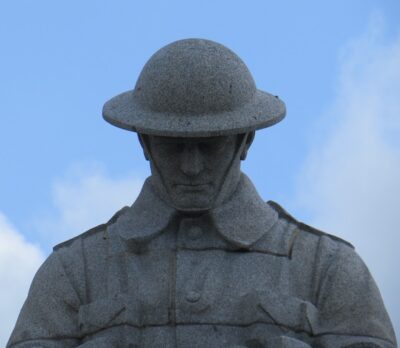
At the end of the Great War, an IWGC committee awarded Canada eight battle sites — three in Belgium and five in France — on which to construct memorials. In the summer of 1922, the Canadian Battlefields Memorial Commission selected Vimy Ridge as the only site for Walter Allward’s winning memorial. The other battle sites, with the exception of that at St. Julien, which received the competition’s second-place design, made do with less distinguished monuments. These six sites are informally known as the Battlefield Memorials.
Hill 62 (Sanctuary Wood) Canadian Memorial
Canadian Battlefield Memorials presented according to the chronology of significant battles of the CEF during the Great War.

Battle of Mount Sorrel
At the battle of St. Eloi the Canadian Corps’ 2nd Division received its “baptism of fire” in a battlefield of water-filled craters and shell holes. The Canadians, wearing the new steel helmets just introduced. They suffered 1,375 casualties in 13 days of confused attacks and counter-attacks over six water-logged mine craters.

3rd Canadian Division
For the 3rd Division, the initiation to battle was even more devastating. On the morning of June 2, the Germans mounted an attack to dislodge the Allies from their positions at Mount Sorrel just north of the Ypres-Menin road. In the fiercest bombardment yet experienced by Canadian troops, whole sections of trench obliterated and the defending garrisons annihilated. Human bodies and even the trees of Sanctuary Wood hurled into the air by the explosions. As men literally blown from their positions, the 3rd Division fought desperately until overwhelmed by enemy infantry. By evening, the enemy advance checked, but the important vantage points of Mount Sorrel and Hills 61 and 62 lost. A counter-attack by the Canadians the next morning failed. And on June 6, after exploding four mines on the Canadian front, the Germans assaulted again and captured Hooge on the Menin Road.
Lt-Gen. Sir Julian Byng
The newly appointed Commander of the Canadian Corps, Lt-Gen. Sir Julian Byng, determined to win back Mount Sorrel and Hill 62. He gave orders for a carefully planned attack. Well supported by artillery, carried out by the 1st Canadian Division under the Command of Major-General Currie. Preceded by a vicious bombardment. The Canadian infantry attacked on June 13 at 1:30 a.m. in the darkness, wind and rain. Careful planning paid off and the heights lost on June 2 retaken. The first Canadian deliberately planned attack in any force, the British Official History was to record. Had resulted in an unqualified success. The positions regained by the Canadians would remain part of the Allied line in front of Ypres. Until, the massive German offensives in the spring of 1918.
Hill 62 (Sanctuary Wood) Canadian Memorial
Hill 62 (Sanctuary Wood) Canadian Memorial is a block of white Quebec granite weighing almost 15 tonnes. Set in a large circle of green lawn at the top of three landscaped terraces. Each ablaze with solid beds of roses in season. It bears the inscription:
HERE AT MOUNT SORREL ON THE LINE FROM HOOGE TO ST. ELOI, THE CANADIAN CORPS FOUGHT IN THE DEFENCE OF YPRES APRIL – AUGUST 1916
From the top of the steps leading up to the Hill 62 (Sanctuary Wood) Canadian Memorial, the visitor, looking down past Sanctuary Wood and Maple Copse along the broad spur of Observatory Ridge, can see the church towers of Ypres, five kilometres to the west. A great many of the Canadian headstones in the Maple Copse and Hooge Crater Cemeteries nearby bear a date in June 1916.

The cost was high. At Mount Sorrel Canadian troops suffered 8,430 casualties.
Courcelette Canadian Memorial
The second of the Canadian Battlefield Memorials presented according to the chronology of significant battles of the CEF during the Great War.

Battle of Flers-Courcelette
The Canadian Corps moved from the Ypres Salient to the Somme River region at the beginning of September 1916. Its first major action was the Battle of Flers-Courcelette. A two-army assault launched by Sir Douglas Haig on September 15.
Courcelette
In the offensive that began at dawn, the Canadian Corps assaulted on a two-kilometre front near the village of Courcelette. Advancing behind a creeping barrage (a tactic only recently adopted by the artillery). The infantry aided by the “new engine of war”, the armoured tank. It only caused the enemy confusion. However, the attack went well. By 8:00 a.m. the main objective, a defence bastion known as the Sugar Factory taken. Then, the Canadians pushed ahead to Courcelette. Numerous German counter-attacks successfully repulsed and by the next day the position was consolidated. It is fitting, therefore, that the memorial to mark the 11 weeks of bloody fighting by Canadians on the battlefields of the Somme should be sited at the scene of their initial victory in that long and costly struggle.

Regina Trench
In the weeks that followed, the three Canadian divisions again and again attacked a series of German entrenchments. The final Canadian objective was that “ditch of evil memory,”Regina Trench. It repeatedly defied capture. And, when the first three divisions relieved in the middle of October, Regina Trench closer. But, still not taken.
When the newly arrived 4th Division took its place in the line, it faced an unbelievable ordeal of knee-deep mud and violent, murderous, enemy resistance. However, despite the almost impenetrable curtain of fire, on November 11, the Division captured Regina Trench. Only to find it reduced to a mere depression in the chalk.
Desire Trench
A week later, in the final attack at the Somme, the Canadians advanced to Desire Trench. A remarkable feat of courage and endurance. The 4th Division then rejoined the Corps opposite Vimy Ridge.
There were no further advances that year. The autumn rains turned the battlefield into a bog and the offensive staggered to a halt. The line moved forward only ten kilometres; the Allies suffered 600,000 casualties and 236,000 Germans were killed. The Germans refer to the Battle of the Somme as das Blutbad – the blood bath.
The Somme
The Somme had cost Canada 24,029 casualties. But, it was here that the Canadians confirmed their reputation as hard-hitting shock troops. “The Canadians,” wrote Lloyd George, “played a part of such distinction that thenceforward marked them as storm troops. For the remainder of the war they were brought along to head the assault in one great battle after another. Whenever the Germans found the Canadian Corps coming into the line they prepared for the worst.”
Courcelette Canadian Memorial
On the granite block of the Courcelette Canadian Memorialis recorded the simple inscription:
THE CANADIAN CORPS BORE A VALIANT PART IN FORCING BACK THE GERMANS ON THESE SLOPES DURING THE BATTLES OF THE SOMME SEPT. 3RD – NOV. 18TH 1916

A circular park surrounds the memorial, screened from the road by tall trees. More than ten varieties of maples planted beside wide paths of well-tended turf. There are few bright colours to distract the eye from the pleasing shades of green. Making the memorial park at Courcelette a place for meditation.
Passchendaele Canadian Memorial
The third of the Canadian Battlefield Memorials presented according to the chronology of significant battles of the CEF during the Great War.

Second Battle of Passchendaele
The village of Passchendaele (now Passendale) and surrounding area associated with every phase of the Great War. In the middle of October 1914, Passchendaele briefly under Allied control. But, by 20 October in German hands, where it remained for the next three years. On 6 November 1917, in most unfavourable weather, the 5th Canadian Infantry Brigade took, and passed, the village. This fight was part of the Second Battle of Passchendaele, the last of the Battles of Ypres, 1917.

Passchendaele Canadian Memorial
On the slopes overlooking the peaceful fields that today carpet the valley of the Ravebeek. This memorial marks the site of Crest Farm. Where Canadian soldiers encountered some of the fiercest resistance they were to meet during the war. A large block of Canadian granite set in a grove of maple trees. Encircled with a low hedge of holly carries the inscription:
THE CANADIAN CORPS IN OCT.- NOV. 1917 ADVANCED ACROSS THIS VALLEY – THEN A TREACHEROUS MORASS – CAPTURED AND HELD THE PASSCHENDAELE RIDGE

From the centre of the memorial grounds one can see, down a long avenue of trees, the rebuilt spires of Ypres.
Le Quesnel Canadian Memorial
The fourth of the Canadian Battlefield Memorials presented according to the chronology of significant battles of the CEF during the Great War.

Battle of Amiens
On March 21, 1918, the Germans suddenly and unexpectedly struck at two British armies on the Western Front. That night they broke through the Fifth Army front. However, on April 5, held short of Amiens. The Canadian Cavalry Brigade, fighting both as cavalry and infantry (dismounted) helped bring this about.

Halted at Amiens. Not having driven a wedge between the British and French, the Germans mounted offensives elsewhere on the Western Front. By now the Americans had arrived in force and the Allies had superior numbers. The time had come for a counter-blow.
Secrecy
The Canadian Corps, as such, had not taken part in these offensives. Haig had ordered the Canadians, piecemeal by divisions, to shore up the crumbling British front. By the time the German offensives had ended, the Canadians fielded a strong, fresh, well-trained and well-organized corps. Ready to play an important part in the fighting that lay ahead.
For Amiens it was more important to conceal from the enemy the intentions of the Canadian Corps than any other formation. Regarding them as storm troops, wrote Sir Basil Liddell Hart, an eminent British military historian. The enemy tended to greet their appearance as an omen of a coming attack. A mock attack therefore launched on the Arras front to delude the enemy. And then, at the last possible moment, the Corps moved south to Amiens by night. The front of the attack extended 22.5 kilometres with the French in the southern half. The Fourth Army named two corps for the assault. The Canadians on the right and the Australians on the left. In addition, the British 3rd Corps acting as flank-guard on the extreme left.
Zero Hour
An hour before dawn on August 8, the attack began and surprise was total. More than 2,000 guns suddenly flashed out in barrage. While 420 tanks, closely followed by the infantry, surged forward over ground heavily shrouded in mist. German machine-gunners found few targets as the tanks, accompanied by determined men, crashed through their positions. The enemy artillery, might have been counted on to break up the attack despite the fog. But, had been effectively neutralized by counter-battery fire. Batteries quickly overrun, many of them without having fired a shot.
In what was then open warfare, massed cavalry and light “whippet” tanks swept ahead to exploit success. On that first victorious day, “The Black Day of the German Army”, as the enemy termed it. The Canadians gained 13 kilometres, the Australians 11, the French eight and the British three. The Germans lost 27,000 men and 400 guns as well as hundreds of mortars and machine-guns. The Canadian Corps alone captured 5,033 prisoners and 161 guns. Against this, Fourth Army’s casualties totalled 9,000 – about 4,000 for the Corps. The Battle of Amiens continued until August 11.
Le Quesnel Canadian Memorial
At Le Quesnel, on the road from Amiens to Royce, the Le Quesnel Canadian Memorial. Made of Quebec granite. Pays tribute to the achievements of the Canadian Corps in the Battle of Amiens, 8-11 August, 1918. As with the others, its massive sides inscribed in English and in French.
THE CANADIAN CORPS ONE HUNDRED THOUSAND STRONG ON 8TH AUGUST 1918 ATTACKED BETWEEN HOURGES AND VILLERS-BRETONNEUX AND DROVE THE ENEMY EASTWARD FOR EIGHT MILES

A maple-bordered avenue leads to this memorial. Set in a bed of low growing conifers and enclosed by a holly hedge. There are many variations of green. Provided by the fine specimens of shrubs and small trees that have been planted around the hedge. The effect low-keyed, dignified and restrained.
Dury Canadian Memorial
The fifth of the Canadian Battlefield Memorials presented according to the chronology of significant battles of the CEF during the Great War.

Second Battle of Arras
After the Allied success in the Battle of Amiens, August 8-11, a renewal of the offensive. On an extended front the Canadian Corps again into action, with the British First Army in the Arras sector. Sir Douglas Haig directed the First Army to strike eastward from Arras. Then, the Canadian Corps once again became the spearhead of the attack. The Corps would assault astride the Arras-Cambrai road, with the canalized River Scarpe forming its left-hand boundary.

The assignment given the Corps Commander, Lieutenant-General Sir Arthur Currie, was both important and difficult. A series of formidable defence positions barred the Canadian path. Fortifying these the Germans made full use of the deeply cut valleys and intervening ridges crossing the battle area. Strongest of all, about nine miles east of Arras, was the Drocourt-Quéant (or D-Q) Line. Extending northward as a switch-line from the main Hindenburg position. This formidable deep system of trenches, fortified with concrete shelters and thick belts of wire. Constructed by the Germans to contain any Allied advance into the Douai plain.
51st Highland Division
The Canadians struck before dawn on August 26, with the 2nd Division on the right, south of the Cambrai road. The 3rd Division between the road and the Scarpe and on the left, north of the river. The 51st Highland Division, temporarily under Currie’s command. Aided by a powerful artillery and machine-gun barrage, the attack made good progress. Early in the day, the 3rd Division took Monchy in a skilfully executed encircling attack. On the right, the 2nd Division captured the villages of Guémappe and Wancourt during the afternoon. By nightfall the Canadian Corps was holding a line 914 metres east of Monchy. Repulsed several counter-attacks launched by the enemy in a determined attempt to regain the battered town.
Orders issued by General Currie for the 27th were to break through the strong Fresnes-Rouvroy Line. An advance of eight kilometres. It took two more days of hard fighting before the strong defence system pierced near Boiry-Notre-Dame. The Battle of the Scarpe ended on August 30. Resolute enemy garrisons were still clinging stubbornly to sections of the Fresnes-Rouvroy Line.
Major Georges Vanier
In the first three days of the battle the 2nd and 3rd Canadian Divisions had advanced more than eight kilometres. Over difficult, broken country beset with a maze of stoutly held trenches. Had captured 3,300 prisoners and a large number of guns. One of the 6,000 casualties in the two divisions was Major Georges Vanier. Future Governor General of Canada. He lost his right leg while commanding the 22nd Battalion near Chérisy.
Battle of the Drocourt-Quéant Line
After a brief respite Currie launched the assault of the Drocourt-Quéant Line on September 2. As day was breaking, armour and infantry began advancing behind a strong barrage. Coming towards the enemy’s main defensive line in the west. South of the Cambrai road battalions of the 1st Division swept forward. Their tanks knocked out enemy posts and flattened wire that had survived the preliminary gunfire. By 7:30 a.m. one battalion had overrun the main trenches. Then, into the German support line, as a fresh battalion passed through to seize the village of Cagnicourt. Suffering crippling casualties, the Canadians gained their objective in the Buissy Switch before mid-night.
Dury
In the centre the 4th Canadian Division. They had taken over much of the 4th British Division’s front, had been fighting its own hard battle. Between Dury and the main road the front trenches of the D-Q line sited. Along the forward slope of the long low hill of Mont Dury. The attacking infantry had, therefore, to advance up an open incline swept by the enemy’s machine-guns. At the crest they came under deadly fire from more machine-guns. As well, from shelling by the German field batteries in the rear.
In spite of mounting casualties the Canadian battalions, aided greatly by tanks, reached the crest by mid-morning. Then,drove the enemy from a sunken road linking Dury with the highway. With the capture of Dury village in vicious fighting, the 4th Canadian Division had gained its first objective. During the night the enemy fell back. Then, on September 3 the Canadian Corps, meeting no resistance, advanced some four miles. Finally, taking up positions over-looking the next obstacle-the Canal du Nord.
Victoria Cross
In the bitter fighting of September 2, seven Victoria Crosses awarded to Canadians. The enemy’s enforced withdrawal had taken place on a wide front. With no fewer than four German armies retiring into the Hindenburg Line, and two more falling back in the north. Such was the measure of the Canadian achievement in smashing defences of the Drocourt-Quéant position. In the first four days of September the Canadian Corps captured more than 6,000 unwounded prisoners. Inflicted heavy German casualties. Its own losses numbered 5,600.
Dury Canadian Memorial
At Dury Mill, 16 kilometres southeast of Arras. The memorial preserves in stone the memory of hard-fought actions to break the Drocourt-Qué ant Line. A beautifully landscaped park, complete with stately maples, surrounds the solid block of granite that tells the story:
THE CANADIAN CORPS 100,000 STRONG ATTACKED AT ARRAS ON AUGUST 26TH 1918, STORMED SUCCESSIVE GERMAN LINES AND HERE ON SEPT. 2ND BROKE AND TURNED THE MAIN GERMAN POSITION ON THE WESTERN FRONT AND REACHED THE CANAL DU NORD

Bourlon Wood Canadian Memorial
The sixth and last of the Canadian Battlefield Memorials presented according to the chronology of significant battles of the CEF during the Great War.

Battle of Canal du Nord
On September 3, 1918, the day after the Canadian Corps breached the Drocourt-Quéant Line, a directive issued for a general Allied offensive on the entire front. From the Meuse to the English Channel, with four great hammer-strokes to be delivered at crucial points. The timetable for these blows called for striking the enemy on four successive days. The second of these assaults was to take place on September 27. A joint attack by the First and Third British Armies in the general direction of Cambrai. Objective – to capture the northern part of the Hindenburg Line.

Field-Marshal Sir Douglas Haig ordered the First Army to seize Bourlon Wood. Then, to cover the Third Army’s left flank as the latter advanced on Cambrai and subsequently on to Valenciennes. The capture of Bourlon Wood assigned to the Canadian Corps. Currie would then push forward to establish a defensive flank northeast of Cambrai. Farther south the British Fourth Army, supported by the French First Army. They would join the battle on September 29 in an assault on the main Hindenburg position.
Canal du Nord
The first obstacle General Sir Arthur Currie’s forces had to overcome was the Canal du Nord. The Canal du Nord was impassable on the northern part of his front. General Currie had his boundary with the Third Army shifted 2,377 metres to the south. Then proceeded with preparations to make its initial attack through a dry area between Sains-lez-Marquion and Moeuvres. It was an intricate operation, and extremely vulnerable period. Moving the entire Corps through a narrow opening before fanning out. All four divisions engaged on a battlefront that would rapidly expand to over 10,000 metres.
In the dusk of the evening of 26 September the Canadians moved forward. By midnight, assembled opposite the dry section of the canal. Huddled together for warmth, and for the most part in the open. The night wore on and there was no evidence of enemy counter-preparation. Suddenly, as dawn was breaking, the opening barrage flashed out, shocking the enemy into action. Before they could retaliate, the initial waves had crossed the canal and were fanning out from the bridgehead. Nevertheless, the follow-up troops suffered casualties. The enemy, alive to the danger, subjected the canal bed to a violent bombardment. The results justified Currie’s generalship. He acquired the canal at relatively light cost, but more than that, Bourlon Wood the essential objective, also taken.
Battle of Cambrai
The Canadians then went on to free Cambrai. Leaving the Amiens front, the Corps liberated 54 towns and villages on more than 300 square kilometres of French soil. In its hard fighting the Corps suffered more than 20,000 casualties.
On the night of November 10-11 the Canadians entered Mons. The return had been long and arduous and the hard years of the war a bitter experience. Then, on November 11 at eleven o’clock the Armistice was in effect, and hostilities ceased.
Bourlon Wood Canadian Memorial
Today, the Bourlon Wood Canadian Memorial commemorates the attack across the Canal Du Nord. On ground donated by the Comte de Franqueville, then Mayor of Bourlon. The great stone block is at the top of a hill. Approached by climbing steep, stone steps past terraces cut into the hillside, and bears the message:
THE CANADIAN CORPS ON 27TH SEP. 1918 FORCED THE CANAL DU NORD AND CAPTURED THIS HILL. THEY TOOK CAMBRAI, DENAIN, VALENCIENNES & MONS; THEN MARCHED TO THE RHINE WITH THE VICTORIOUS ALLIES

Ancient lime trees line both sides of the steps that lead to the Memorial. Original trees, and though shattered by shellfire in the battle, nursed back to health. The terraces planted with a rich variety of coniferous shrubs and shade-loving plants. The Memorial is beyond the village of Bourlon, which is just south of the Arras-Cambrai road, three kilometres beyond Marquion.
More
Two other special Canadian Battlefield Memorials, of course, the St. Julien Canadian Memorial at Vancouver Corner, and Canadian National Vimy Memorial. These memorials commemorate all the Canadian casualties in the countries of Belgium and France. Another five, and soon a sixth memorial, commemorate all the casualties of the Dominion of Newfoundland in the Great War. Collectively, these monuments known as The Caribou Trail.
St. Julien Canadian Memorial in the Great War

Canadian National Vimy Memorial of the Great War

Please subscribe to CEFRG to be notified by email when there are new posts. Subscription is free, and your email kept confidential.