Battle of Vimy Ridge
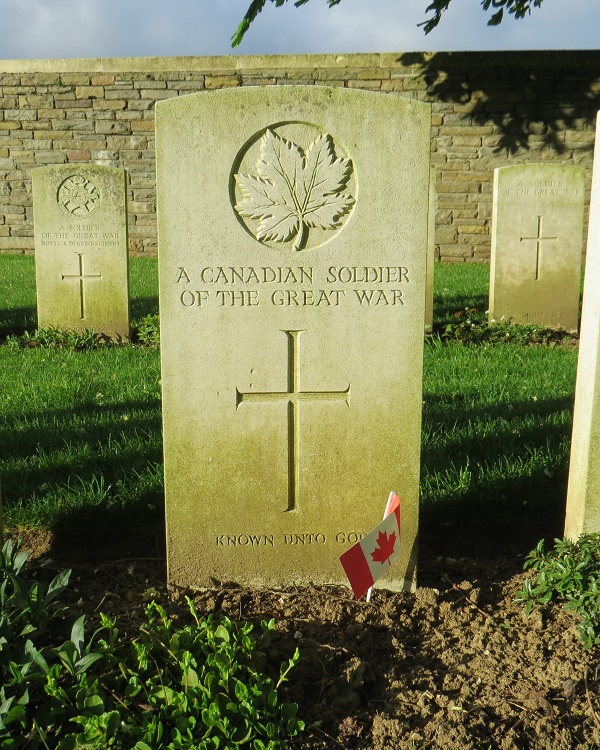
Canadian Cemetery No 2 established by the Canadian Corps. Following the successful storming of Vimy Ridge led by General Julian Byng on 9 April 1917. Some of those buried in the cemetery fell in the battle or died of wounds received there. Although, the majority of the graves transferred here in the years following the Great War. Later, the dead recovered from surrounding battlefields and isolated graves over a period of years after the Armistice, 1919 – 1923.
Canadian Cemetery No 2 Neuville-St. Vaast
The cemetery covers an area of 10,869 square metres. Enclosed by low walls of coursed stone. There are nearly 3,000 Great War casualties commemorated in this site.
Their Glory shall not be blotted out
Twenty-nine soldiers once buried in the 11th Canadian Infantry Brigade Cemetery. Many graves destroyed during the Great War. The 11th C.I.B. cemetery was located near Gunner’s Crater in Givenchy-en-Gohelle. These graves are commemorated by special memorial headstones, inscribed with an additional quotation. Their Glory shall not be blotted out.
Open Cases – the late Richard VanWyck Laughton
There are no case files for this cemetery on the CWGC list as of April 2019. However, the late Richard Laughton had uncovered a plethora of compelling cases prior to his death, in Milton, Ontario, in September 2020 – for this single CWGC cemetery! Laughton responsible for the positive identification of many Unknowns, and unrecognized for so many more in other cemeteries across the Western Front.
One such example at Canadian Cemetery No. 2 reveals the contributions of the late Mr. Laughton are sorely missed.
UBS (“Tyne” on knife) from the East Yorkshire Regiment at Sheet 51b.H.30.c.1.8. Which is 6,000 yards due east of Arras, north of Monchy-le-Preux. Private William Tythe #34267 is missing at that location on 21 April 1917. Thus, listed on the Arras Memorial. They were digging a new connecting trench from 51b.I.31.c.9.5 to 51b.H.36.d.6.6. Suddenly, 7 O.R. were KIA. Others lost that day were recovered. Such as Saxby at 51b.H.20.d.8.4 and Windas at 51b.I.25.d.1.5. That puts Tythe and Windas less than 600 yards apart. About 1,000 yards north of the trench line. Probably on the road (track) to Pelves on the southside of the Scarpe.
There is a map showing them on that Pelves Lane in 51b.H.30 as early as 12 April 1917. Remaining there until the major attack on 23 April 1917. This has to be more than just coincidence! There were 30 men on the Medal Rolls with the last name Tyne. One of whom had an affiliation to the East Yorkshire Regiment #38036, prior to the Royal Munster Fusiliers #18587. And, one #TR/581586 discharged sick. No Tyne’s with the East Yorkshire Regiment were killed in the Great War.
Richard VanWyck Laughton
Location Information
Neuville-St. Vaast a village about 6 kilometres north of Arras. One kilometre east of the main road from Arras to Bethune. The Cemetery within the Canadian National Vimy Memorial Park. North of Neuville-St. Vaast. The main entrance to the Park signposted from the Arras to Lens road (N17).

Please subscribe to CEFRG to be notified by email when there are new posts. Subscription is free, and your email kept confidential.