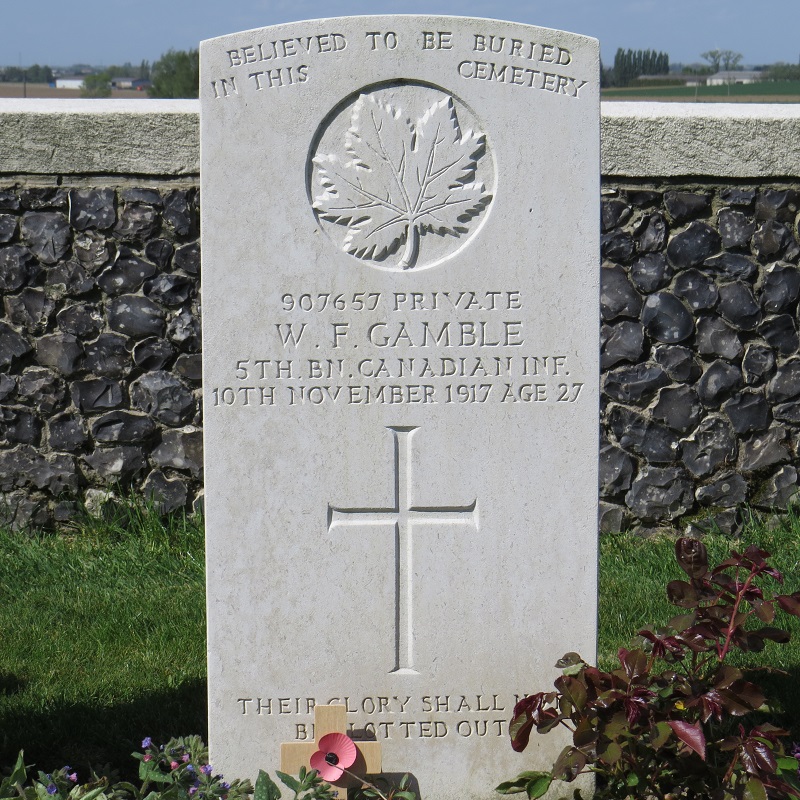
Occasionally, the Commonwealth War Graves Commission (CWGC) receives requests for Special Memorials to be placed in a cemetery when research indicates a soldier, or soldiers, may have been buried. Accordingly, these are headstones with ‘superscription’ text at the top, only used in very specific circumstances. Generally speaking, they are not an alternative to commemoration on a Memorial to the Missing.

Superscriptions previously, but no longer used for new commemorations, include: “KNOWN TO BE BURIED IN THIS CEMETERY”, “BURIED IN THIS CEMETERY”, “KNOWN TO BE BURIED IN GRAVE …” and “BELIEVED TO BE BURIED IN THIS CEMETERY”.
In either case, in sites where these superscriptions exist, they continue to be used on replacement headstones.
Kipling Memorial
A Kipling or Special Memorial used to reference a grave or graves that were no longer identifiable but whose whereabouts were once known. Two Cape Corps soldiers in Mwembe commemorated by a Kipling memorial in Mangochi Town Cemetery, Malawi. The last Kipling Memorial erected in Pemba, Mozambique. Special memorial built in 2019 for those Africans, buried in Beira Cemetery but who were originally included in the cemetery register only.

Policy
Above all, CEFRG believes the reason the CGWC has abandoned the use of such superscriptions has everything to do with a policy change contrary to their mandate. Recently, a Special Committee on Non-commemoration, agreed to by the six member Governments (UK, Canada, Australia, New Zealand, South Africa, and India), produced a report in April of 2021.
However, the definitive position of the CWGC regarding the commemoration by name of all Empire war dead of the two World Wars has already changed. The CWGC no longer entertains the notion of erecting memorials for the previously mentioned superscriptions.
Note, the CWGC flagrantly maintains it “is committed to doing the right thing, and addressing any deficits in commemoration which are identified.”
Mr. Norm Christie
Often, knowing the location, rank, and Regiment of a soldier, or soldiers, can lead to an identification. This was done more than 50 times in the early 1990s according to the former Chief Records Officer of the CWGC, Canadian Historian Mr. Norm Christie.
Mr. Christie: “It was always the purview of the CWGC to evaluate circumstances and identify a grave in one of its cemeteries, if the facts were conclusive. This was the protocol for more than 80 years until recebntly. Due to pressures put on the CWGC by a few self-seeking individuals the CWGC abdicated its responsibility in thes matters and passed them on to the various National Departments of Defense. Sadly this means very few identifications will be made in the future.”
However, depending on the Canadian Department of National Defense (DND) to honour these men is a fruitless endeavor. As a result, unofficially, the Canadian DND is no longer pro-active in the recovery and identification of our Heroes. Why? Because, like the CWGC, they fear the Pandora’s Box of research by amateur enthusiasts collaborating to identify and recover these soldiers who paid the Ultimate Sacrifice.
Mr. Lambis Englezos AM
Indeed, just ask Lambis Englezos AM, discoverer of 250 Diggers (Australian soldiers) of the Great War in Fromelles, France, now buried in the only new cemetery of the CWGC in the last 50 years – Fromelles (Pheasant Wood) Cemetery. Significantly, his research and persistence fighting every level of government bureaucracy for over ten years earned Englezos the Order of Australia, and the undying gratitude of hundreds of families.
To demonstrate, imagine the cost of constructing this new cemetery in a region of unstable soil. After all, the concrete construction company of Ignace Bentien, owner of the land on which the Kitchener’s Wood Memorial stands in Sint-Juliaan, Belgium, had to develop new techniques to place the graves of these Diggers. In any event, imagine the cost of inviting two members of each family, at government expense, to the dedication ceremony!
To summarize, can we expect the members of the Special Committee on Non-commemoration to do the right thing?
In conclusion, its membership, supported by the following members.
- Sir Tim Hitchens, Commissioner (Chair)
- Terry Denham
- Selena Carty
- Dr Gavin Rand
- Edward Paice
- Prof Mark Connelly
- Shrabani Basu
- Dr Adam Prime
- Dr Daniel Steinbach
- Amandeep Madra
- Dr Kevin Searle
- Dr Anne Sampson
- Blondel Cluff
- Trevor Phillips
- Professor Michele Barrett
If you have any questions about this policy, please contact:
Kylie Smith
Commemorations Policy Manager
Email: commemorations@cwgc.org
More
Please subscribe to CEFRG to be notified by email when there are new posts. Subscription is free, and your email kept confidential.