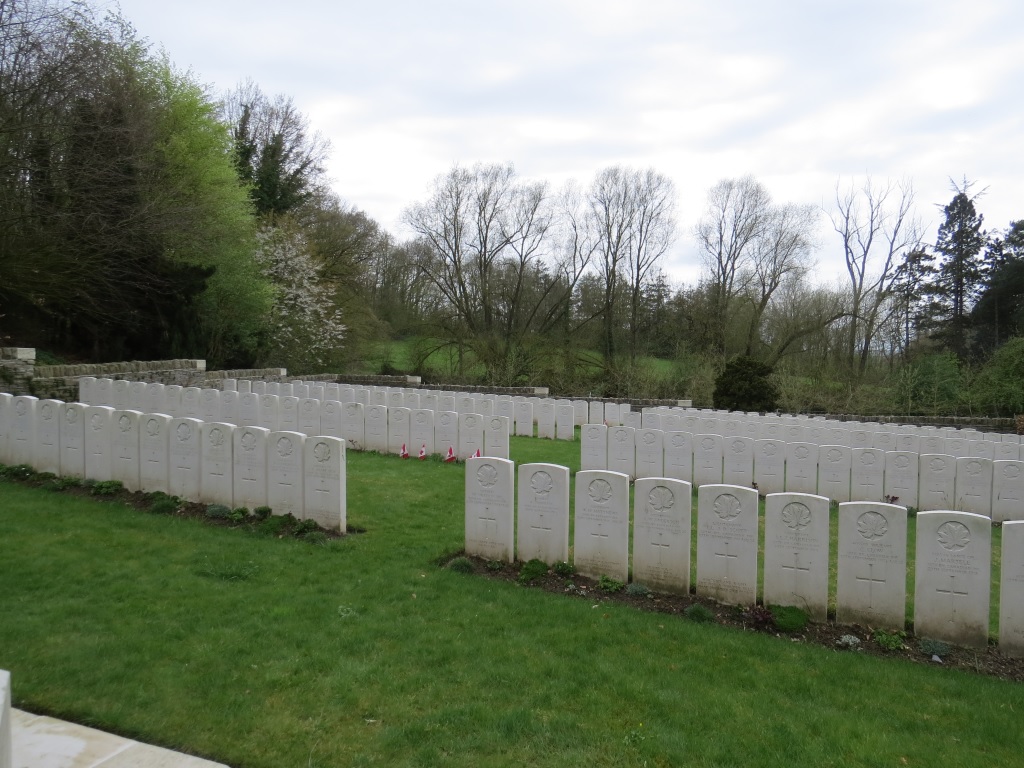
Bourlon Wood Cemetery made by the Canadian Corps Burial Officer in October 1918 following the Battle of Canal du Nord (27 Sept – 1 Oct 1918).

Bourlon Village
Bourlon a village approximately 6 kilometres west of Cambrai. It lies between the main Cambrai to Bapaume road (N30) and the Cambrai to Arras road (D939). From Arras the preferred route is to take the D939, direction Cambrai.
Bourlon Wood
Take the right turn into the village of Bourlon after the black and white Canadian signs with a maple leaf. Follow the D16e1 or “Route de la Gare” into the village and then follow the Commission’s green and white cemetery direction signs for Bourlon Wood Cemetery.
These will lead you along Rue de l’Abbaye and Rue des Mouches to the bottom end of a track that leads directly to the Cemetery.
Entrance

Rainy Season
Vehicular access to the cemetery limited and recommended that visitors park at the bottom end of Rue des Mouches and walk up the track to the Cemetery in wet conditions. Also possible to access Bourlon Wood Cemetery from the top of the track which starts at the Bourlon Wood Memorial. The Memorial signposted from the centre of the village by the traditional Canadian black and white signs with a maple leaf.
On approaching the Memorial the road can be followed to the left where a track descends about 200 metres to the cemetery. However, track unsurfaced, unsuitable for road vehicles and difficult to use during wet periods. Recommended visitors wishing to visit Bourlon Wood Cemetery take the preferred route detailed above.
Cemetery Plan

History
On its South-East side, stretching nearly to Fontaine-Notre Dame, is Bourlon Wood, and the village and the wood were the scene of desperate fighting in the Battle of Cambrai 1917; the 40th Division, which with the Guards and the 62nd Division bore the brunt of this fighting, has placed a memorial altar in Bourlon Church.

At the end of the Battle the British troops withdrawn from Bourlon, and the wood and the village ultimately retaken by the 3rd Canadian and 4th Canadian Divisions on the 27th September 1918. The village later adopted by the Borough of Hove.
Burials
CSM Henry Alway DCM
Company Sergeant Major Henry Alway DCM of the 102nd Canadian Infantry Battalion fell on 27 September 1918.

Son of Henry Alway and Rose Alway of 27 South St., Wellington, Somerset, England, previous service with Imperial Forces.
Lt Charles Dayrell Shreve MC
Lieutenant Charles Dayrell Shreve MC, son of Thomas C. and Mary A. Shreve, of Digby, Nova Scotia.

Killed-in-action near St Ollie under enemy shell fire. While directing placing of guns and ammunition, killed instantly by an enemy shell which burst near him.
Major S B Van Kleeck
Major Stuart Bruce Van Kleeck, 2nd Canadian Mounted Rifles Battalion, killed-in-action 29 September 1918. Son of Peter and Margaret (nee Armstrong) Van Kleeck.

Spouse of Ruth Clark. Brother of Dr. Peter Van Kleeck of Armstrong, British Columbia, Jenny, Annie, Martha and Margaret. His nephew, Flight Lieutenant Bruce Van Kleeck, 69 (R.A.F.) Squadron lost his life on 11 October 1944.

Captain J F MacIntosh MC
Captain John Fullerton MacIntosh, 28th Battalion, son of Mr. and Mrs. R. F. Macintosh, of Saskatoon, Saskatchewan.

Native of Glasgow, Scotland.

Capt W Verner MC
Captain William Verner MC, son of Samuel and Hannah Vernon, of 92, Langford Avenue, Toronto. Originally a PPCLI reinforcement, wounded and returned to England.

Vernon obtained a commission while in England, and earned the MC at Passchendaele. Wounded a second time, and returned to England and appointed a Captain and adjutant of his corps.

Temporarily in command of the battalion as of 28 September 1918, Vernon killed-in-action the very next day.
Captain A Johnson

Ambrose survived by his wife and a seven-year-old daughter.
Captain Ambrose Johnson

Chinese Labour Corps
Three Chinese labourers buried in 1919, and later five graves from the battlefields brought into Plot II, Row F.
Labourer Wei I and also Sung Te Ch’uan died 6 March 1919, and finally Yang Chih Fu died 13 August 1919 .
UCS
Nearly 250 Great War casualties commemorated in this site. Of these, over ten unidentified.

The Unknown Canadian Soldier (UCS) of the 102nd Battalion either Private Leon Albert Holmes 1003600, or Pte Frederick Melcher 1003881.
The cemetery covers an area of 874 square metres and enclosed by a rubble wall on three sides.
Bourlon Wood Memorial
274 metres South-West of the cemetery a Battlefield Memorial erected by the Canadian Government to recall the forcing of the Canal du Nord by the Canadian Corps on the 27th September 1918 and the subsequent advance to Mons and the Rhine.


