CEFRG.ca

Category: Battles

Battles of the Great War

On the Western Front in Belgium and France, Canadian soldiers distinguished themselves in many Great War battles, including Second Battle of Ypres, Battle of Vimy Ridge, and Second Battle of Passchendaele. In Canada’s Last Hundred Days of the Great War, Canadian soldiers the sharp end of the spear breaking through the enemy’s formidable trench defences, the Hindenburg Line.

Battle of the Somme

Only one action where the Canadian Expeditionary Force’s involvement negligible, but Canada’s contribution still resonates today.  The Royal Newfoundland Regiment (RNR) and the Battle of Beaumont-Hamel, of particular interest to CEFRG.   The RNR suffered decimating casualties on the first day of the Battle of the Somme. While Canada celebrates it’s birthday on July 1st every year, for the Province of Newfoundland, it is still a day of mourning.

British Expeditionary Force (BEF)

Canadian soldiers participated in many Great War battles not commonly associated with the CEF.  There are two reason for this, first, many Canadians served with elements of the British Expeditionary Force (BEF) during the Great War.  Secondly, the Canadian Field Artillery (CFA) were often attached to the BEF, for they were Corps Troops not associated with the Divisional structure of the CEF.

Tools

Battle maps, trench map coordinate converters, aerial photos, and Google Earth image overlays essential collections and tools used to understand Great War battles.  An extensive collection of battle maps available at McMaster University, and the National Library of Scotland.  These maps  particularly impressive – stored in the .tiff file-format.  There is no loss in resolution when zooming-in on these extremely large images.

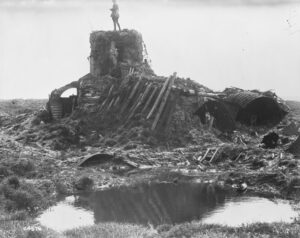
German O.P. at approximate position of 8th Bn. H.Q. on 22nd April 1915 (Second Battle of Ypres). April & May 1919. MIKAN No. 3397986

1915

  • BATTLE OF NEUVE CHAPELLE, 10 March
  • Action of St. Eloi, 14-15 March
  • THE BATTLE OF YPRES, 1915
    • GRAVENSTAFEL RIDGE (The Gas Attack), April 22
    • ST. JULIEN, 24 April-4 May
    • FREZENBERG RIDGE, 8-13 May
    • BELLEWAARDE RIDGE, 24-25 May
  • BATTLE OF AUBERS RIDGE, 9 May
  • BATTLE OF FESTUBERT, 17-25 May
  • Second Action of Givenchy, 1915, 15-16 June
  • THE BATTLE OF LOOS, 25 September-8 October
    • Action of Bois-Grenier, 25 September
  • Actions of the Hohenzollern Redoubt, 13-19 October
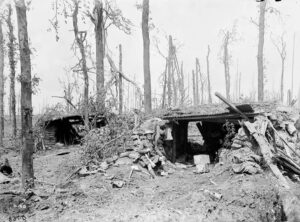
Battle of Mount Sorrel. Emplacement of two forward guns in Sanctuary Wood, captured by Germans and recaptured by Canadians, 22 June 1616. Sergeant William Alexander, Shot at Dawn, was promoted for his actions in this battle. MIKAN No. 352091
Battle of Mount Sorrel. Emplacement of two forward guns in Sanctuary Wood, captured by Germans and recaptured by Canadians, 22 June 1616. MIKAN No. 3520915

1916

  • Actions of St. Eloi Craters, 27 March-16 April
  • BATTLE OF MOUNT SORREL, 2-13 June
  • THE BATTLES OF THE SOMME, 1916
    • ALBERT, 1916 (Capture of Montauban, Mametz, Fricourt, Contalmaison and la Boisselle), 1-13 July
    • BAZENTIN RIDGE, 14-17 July
    • Attack at Fromelles, 19 July
    • Attacks on High Wood, 20-25 July
    • POZIERES RIDGE (Fighting for Mouquet Farm), 1-3 September
    • GUILLEMONT, 3-6 September
    • GINCHY, 9 September
    • FLERS-COURCELETTE, 15-22 September
    • THIEPVAL RIDGE, 26-29September
    • LE TRANSLOY RIDGES (Capture of Eaucourt l’Abbaye), 1-18 October
    • ANCRE HEIGHTS (Capture of Regina Trench), 1 October-11 November
    • THE ANCRE, 1916 (Capture of Beaumont Hamel), 13-18 November
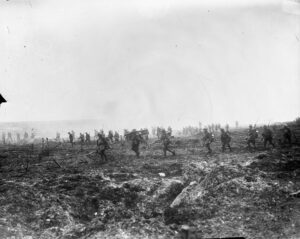
This original photo showing the advance on Vimy Ridge, was later retouched by official photographer W.I. Castle for exhibition purposes related to the Canadian War Records Office exhibitions of battle pictures (see Mikan # 3192389 for retouched version). MIKAN No. 3233066

1917

  • German Retreat to the Hindenburg Line, 24-29 March
  • THE BATTLE OF ARRAS, 1917
    • VIMY RIDGE, 9-14 April
    • FIRST SCARPE, 1917, 9-14 April
    • SECOND SCARPE, 1917, 23-24 April
    • Attack on la Coulotte, 23 April
    • ARLEUX, 28-29 April
    • THIRD. SCARPE, 1917 (Capture of Fresnoy) 3-4 May
  • Affairs south of the Souchez River, 3-25 June
  • Capture of Avion, 26-29 June
  • BATTLE OF HILL 70, 15-25 August
  • THE BATTLE OF MESSINES, 1917 (Capture of Wytschaete), 7-14 June
  • THE BATTLES OF YPRES, 1917
    • PILCKEM RIDGE, 31 July-2 August
    • LANGEMARCK, 1917, 16-18 August
    • MENIN ROAD RIDGE, 20-25 September
    • POLYGON WOOD, 26 September-3 October
    • BROODSEINDE, 4 October
    • POELCAPPELLE, 9 October
    • FIRST PASSCHENDAELE, 12 October
    • SECOND PASSCHENDAELE, 26 October-10 November
  • BATTLE OF CAMBRAI, 1917
    • The Tank Attack, 20-21 November
    • Capture of Bourlon Wood, 23-28 November
    • The German Counter-Attacks, 30 November-3 December
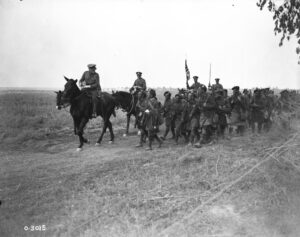
Sir Douglas Haig congratulating 85th Battalion. Battle of Amiens. August, 1918 3405991

1918

  • THE FIRST BATTLES OF THE SOMME, 1918
    • ST. QUENTIN, 21-23 March
    • Actions at the Somme Crossings, 24-25 March
    • FIRST BAPAUME, 24-25 March
    • ROSIERES, 26-27 March
    • FIRST ARRAS, 1918, 28 March
    • AVRE, 4 April
  • Capture of Hamel, 4 July
  • THE BATTLES OF THE LYS
    • ESTAIRES (First Defence of Givenchy, 1918), 9-11 April
    • MESSINES, 1918 (Loss of Hill 63), 10-11 April
    • HAZEBROUCK, 12-15 April
    • BAILLEUL (Defence of Neuve-Eglise), 13-15 April
    • FIRST KEMMEL RIDGE, 17-19 April
  • Action of La Becque, 28 June
  • THE BATTLE OF AMIENS, 8-11 August
  • Actions round Damery, 15-17 August
  • THE SECOND BATTLES OF THE SOMME, 1918
    • ALBERT, 1918, 21-23 August
    • SECOND BAPAUME, 31 August-3 September
  • THE SECOND BATTLES OF ARRAS, 1918
    • SCARPE, 1918 (Capture of Monchy-le-Preux), 26-30 August
    • DROCOURT-QUEANT CANAL, 2-3 September
  • THE BATTLES OF THE HINDENBURG LINE
    • HAVRINCOURT, 12 September
    • EPEHY, 18 September
    • CANAL DU NORD (Capture of Bourlon Wood) 27 September- 1 October
    • ST. QUENTIN CANAL, 29 September-2 October
    • BEAUREVOIR LINE, 3-5 October
    • CAMBRAI, 1918 (Capture of Cambrian), 8-9 October
  • BATTLE OF YPRES, 1918, 28September-2 October
  • Pursuit to the Sells, 9-12 October
  • BATTLE OF COURTRAI, 1419 October
  • BATTLE OF THE SELLE, 17-25October
  • BATTLE OF VALENCIENES (Capture of Mont Houy), 1-2 November
  • BATTLE OF THE SAMBRE, 4 November
  • Passage of the Grande Honnelle, 5-7 November
  • Capture of Mons, 11 November
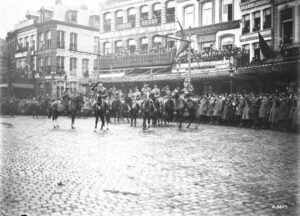
General Sir Arthur Currie, General Loomis and Officers in Grand Place, Mons, November 11th, 1918, taking the salute of the March past. MIKAN No. 3522365
  • Battle of the Scarpe in the Great War

    Battle of the Scarpe in the Great War

    Nomenclature

    Battle of the Scarpe a battle honour incorporating the tactical incident Capture of Monchy-le-Preux, formally entitled the Battle of the Scarpe, 1918, and itself part of The Second Battles of Arras, 1918.

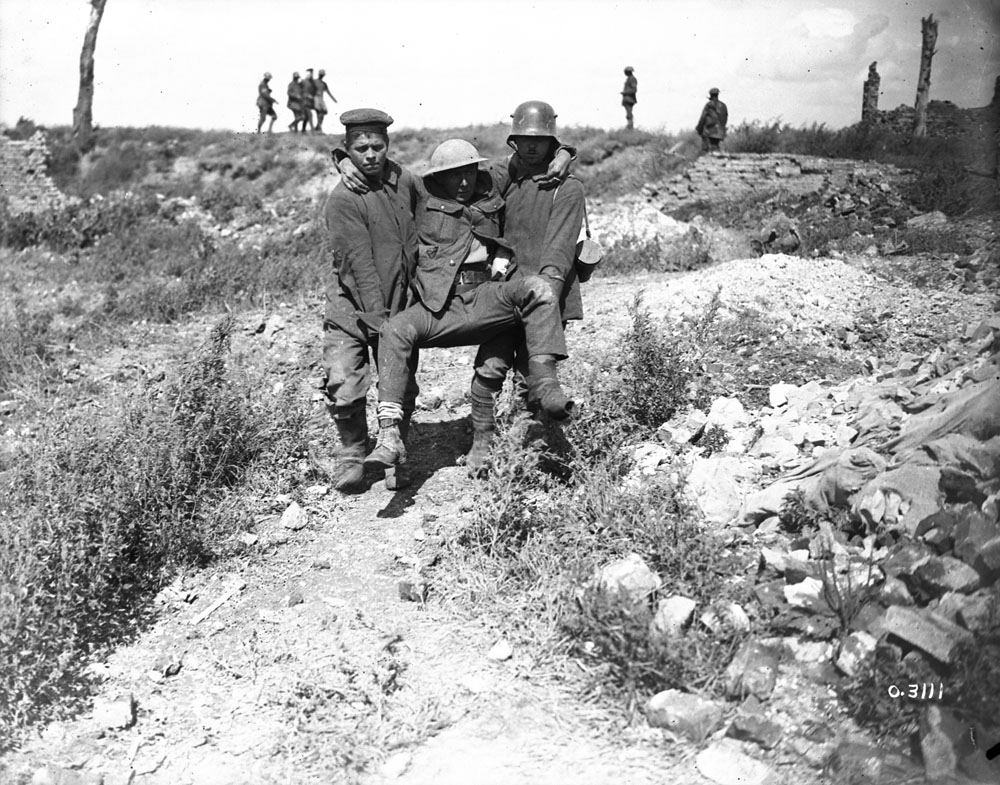
    German prisoners bringing in their wounded
    Battle of the Scarpe, 26 August 1918. German prisoners bringing in their wounded. MIKAN No. 3403184

    Background

    Following the brilliant success of the Canadian Corps at Amiens on 8 August 1918, the Corps moved back north to rejoin First (British) Army near Arras. The Battle of Amiens the start of Canada’s Last Hundred Days.

    Shock Troops

    As elite Shock Troops, the Canadian Corps consistently at the Tip of the Sword during this decisive period. Only soldiers of the German Alpenkorps, considered to be the best by the Allies, able to temporarily halt the advance at Hallu on 12 August 1918.

    General Konrad von Dellmensingen, the Commander of the German Alpine Corps (Alpenkorps), with his staff officers in the field, November 1916. Note scissor binoculars on the right. © IWM Q 23861
    General Konrad von Dellmensingen, the Commander of the German Alpine Corps (Alpenkorps), with his staff officers in the field, November 1916. Note scissor binoculars on the right. © IWM Q 23861

    Hindenburg Line

    Later, in mid-August, plans laid for First Army to attack east toward the German-held Drocourt-Quéant Line, an extension of the Hindenburg Line. The 2nd (Major-General Sir H.E. Burstall) and 3rd (Major-General L.J. Lipsett) Canadian Divisions began the advance on 26 August attacking on a four-mile frontage between the village of Neuville-Vitasse and the River Scarpe. The Canadians quickly captured the villages of Monchy-le-Preux and Guémappe.

    Canadians waiting to go forward. Battle of the Scarpe. 26 August 1918
    Canadians waiting to go forward. Battle of the Scarpe. 26 August 1918. MIKAN No. 3522250

    Byng Boys

    The 51st British Division under Sir Julian Byng formed part of the Canadian Corps and provided flank protection north of the Cambrai Road. According to Currie’s plan, simultaneous attacks launched by the British Division on the left, the 3rd Canadian Division between the Scarpe and the Cambrai Road, and finally the 2nd Division on the right.

    MIKAN No. 3404870
    General Sir Julian Byng talking to General Sir Arthur Currie. February, 1918. MIKAN No. 3404870

    Byng of Vimy, formerly the commander of the Canadian Corps, the reason men still referred to themselves as Byng Boys. General Sir Julian Byng, more than happy to help his close friend, former subordinate, and protégée.

    Some of the Byng Boys returning from action after defeating the Bavarians at Vimy Ridge. May, 1917 Battle of the Scarpe
    Some of the Byng Boys returning from action after defeating the Bavarians at Vimy Ridge. May, 1917

    Battle of the Scarpe H-hour: August 26, 3:00 a.m.

    No less than 14 field artillery brigades and nine heavy artillery brigades opened the barrage. In addition to the artillery of the 2nd and 3rd Canadian Divisions already engaged in the offensive, these units included the artillery of the 15th, 16th and 39th British Divisions and three army brigades. 

    60 pounder in action along side Arras-Cambrai road.
    60 pounder in action along side Arras-Cambrai road. 26 August 1918. MIKAN No. 3522243

    The attack made good progress. The 3rd Division captured Monchy, the first objective, with a skilfully executed encircling manoeuvre, praised long after the tactical feat.

    Monchy-le-Preux

    Arras Front. - Monchy le Preux. German dugout beneath the cross. April & May 1919 Battle of the Scarpe
    Arras Front. – Monchy le Preux. German dugout beneath the cross. April & May 1919. MIKAN No. 3397984

    Guémappe

    On the right, the 2nd Division captured the villages of Guemappe and Wancourt during the afternoon. By nightfall, the Canadian line extended about 914 metres east of Monchy.

    Regimental aid post of the Royal Army Medical Corps near Guemappe, 29 April 1917.
    Regimental aid post of the Royal Army Medical Corps near Guemappe, 29 April 1917.© IWM Q 5277

    Battle of the Scarpe 27th August

    Orders for the 27th to break through the Fresnes-Rouvroy Line and thereby advance by eight kilometres. It took two more days of bitter fighting before this defence system near Boiry-Notre-Dame penetrated, and when the Battle of the Scarpe ended on August 30, resolute German garrisons still stubbornly clinging to it.

    Arras Front - Boiry Notre Dame Church and School ruins. April & May 1919 Battle of the Scarpe
    Arras Front – Boiry Notre Dame Church and School ruins. April & May 1919. MIKAN No. 3404069

    Nothing more dangerous than a retreating enemy, as the Canadian casualties proved.

    Canadian Dressing Station within half mile of the line.Activity at a Dressing Station, wounded and stretcher-bearers and two motorized ambulances. Battle of the Scarpe
    Canadian Dressing Station within half mile of the line.Activity at a Dressing Station, wounded and stretcher-bearers and two motorized ambulances. MIKAN No. 3395884

    Two phases of the Arras operation cost the Canadians nearly 11,000 men. During the Battle of the Scarpe Georges Vanier, the future Governor General of Canada, lost his leg while commanding the 22nd Battalion.

    MIKAN No. 3192070
    Le major Georges P. Vanier du 22e Bataillon. Il est devenu le dix-neuvième gouverneur général du Canada, poste qu’il a occupé de 1959 à 1967. MIKAN No. 3192070

    Amongst the thousands of soldiers wounded in this battle a Montreal car washer of Japanese origin, Ischimatsu Shintani, an infantryman with the 24th Battalion who suffered serious head injuries.

    Victoria Cross

    During the first stage of the battle, Lt Charles Smith Rutherford of the 5th Canadian Mounted Rifles earned the Victoria Cross. While commanding an assault party, Rutherford suddenly found himself ahead of his men and near a fully-armed enemy party outside a pillbox. Alone, he persuaded the Germans they were surrounded and, believing that this was actually true, they surrendered.

    "Lt.-Col. Moshier, Capt. Grant and Capt. Turnbull, 11th Field Ambulance, outside captured German dug-out. August, 1918. Lt. Col. Moshier is seated at left. The sign over the captured dugout indicates this was also a German medical station. Lt. Col. Heber H. Moshier, Commanding Officer of the 11th Field Ambulance, was killed in action in late August, soon after this photo. Capt. D.G. Turnbull acted as a pallbearer at his funeral on the 30th of August, 1918."
    “Lt.-Col. Moshier, Capt. Grant and Capt. Turnbull, 11th Field Ambulance, outside captured German dug-out. August, 1918. Lt. Col. Moshier is seated at left. The sign over the captured dugout indicates this was also a German medical station. Lt. Col. Heber H. Moshier, Commanding Officer of the 11th Field Ambulance, was killed in action in late August, soon after this photo. Capt. D.G. Turnbull acted as a pallbearer at his funeral on the 30th of August, 1918.”

    Forty-five Germans, including two officers and three machine-gunners surrendered to Robertson. After they surrendered, Rutherford noticed another pillbox holding up the assault of his troops. He attacked and captured another 35 Germans.

    Lt. C.S. Rutherford, V.C. Battle of the Scarpe
    Lt. C.S. Rutherford, V.C. MIKAN No. 3220703

    Rutherford survived the war and served as the Sergeant of Arms in the Ontario Legislature from 1934 to 1940, and he would be the first Sgt Of Arms to eject a member from the legislature. Also the last recipient of the Victoria Cross from the Great War to die, when he passed away on 11 June 1989 at the age of 97. 

    Battle of the Scarpe Aftermath

    The Germans subsequently withdrew into the prepared positions of the Drocourt-Quéant Line and the Canadians continued their advance with plans to attack the Drocourt-Quéant Line on 30 August 1918.

    German officer talking in French to Canadian Officer Battle of the Scarpe
    Battle of the Scarpe. German officer talking in French to Canadian Officer. MIKAN No. 3403190

    Battle of the Drocourt-Quéant Line

    The victory at the D-Q Line, though unexpected, another mark for the Canadian Corps very successful Hundred Days. Sir Arthur Currie believed the fighting during the Arras battles to be the most difficult the Corps had ever faced; however, the pace would not be slowed.

    Canadian losses for the D-Q Line fighting 5,622 killed or wounded on 2 September alone.

    Please Subscribe

    Please subscribe to CEFRG to be notified by email when there are new posts. Subscription is free, and your email kept confidential.

    Or Contact Us

    ← Back

    Thank you for your response. ✨