CEFRG.ca

Category: Battles

Battles of the Great War

On the Western Front in Belgium and France, Canadian soldiers distinguished themselves in many Great War battles, including Second Battle of Ypres, Battle of Vimy Ridge, and Second Battle of Passchendaele. In Canada’s Last Hundred Days of the Great War, Canadian soldiers the sharp end of the spear breaking through the enemy’s formidable trench defences, the Hindenburg Line.

Battle of the Somme

Only one action where the Canadian Expeditionary Force’s involvement negligible, but Canada’s contribution still resonates today.  The Royal Newfoundland Regiment (RNR) and the Battle of Beaumont-Hamel, of particular interest to CEFRG.   The RNR suffered decimating casualties on the first day of the Battle of the Somme. While Canada celebrates it’s birthday on July 1st every year, for the Province of Newfoundland, it is still a day of mourning.

British Expeditionary Force (BEF)

Canadian soldiers participated in many Great War battles not commonly associated with the CEF.  There are two reason for this, first, many Canadians served with elements of the British Expeditionary Force (BEF) during the Great War.  Secondly, the Canadian Field Artillery (CFA) were often attached to the BEF, for they were Corps Troops not associated with the Divisional structure of the CEF.

Tools

Battle maps, trench map coordinate converters, aerial photos, and Google Earth image overlays essential collections and tools used to understand Great War battles.  An extensive collection of battle maps available at McMaster University, and the National Library of Scotland.  These maps  particularly impressive – stored in the .tiff file-format.  There is no loss in resolution when zooming-in on these extremely large images.

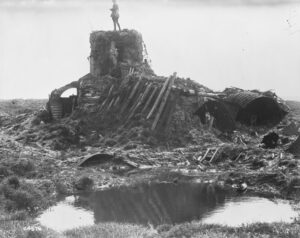
German O.P. at approximate position of 8th Bn. H.Q. on 22nd April 1915 (Second Battle of Ypres). April & May 1919. MIKAN No. 3397986

1915

  • BATTLE OF NEUVE CHAPELLE, 10 March
  • Action of St. Eloi, 14-15 March
  • THE BATTLE OF YPRES, 1915
    • GRAVENSTAFEL RIDGE (The Gas Attack), April 22
    • ST. JULIEN, 24 April-4 May
    • FREZENBERG RIDGE, 8-13 May
    • BELLEWAARDE RIDGE, 24-25 May
  • BATTLE OF AUBERS RIDGE, 9 May
  • BATTLE OF FESTUBERT, 17-25 May
  • Second Action of Givenchy, 1915, 15-16 June
  • THE BATTLE OF LOOS, 25 September-8 October
    • Action of Bois-Grenier, 25 September
  • Actions of the Hohenzollern Redoubt, 13-19 October
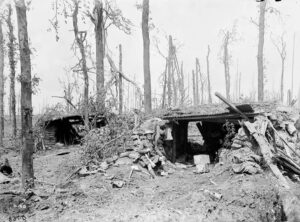
Battle of Mount Sorrel. Emplacement of two forward guns in Sanctuary Wood, captured by Germans and recaptured by Canadians, 22 June 1616. Sergeant William Alexander, Shot at Dawn, was promoted for his actions in this battle. MIKAN No. 352091
Battle of Mount Sorrel. Emplacement of two forward guns in Sanctuary Wood, captured by Germans and recaptured by Canadians, 22 June 1616. MIKAN No. 3520915

1916

  • Actions of St. Eloi Craters, 27 March-16 April
  • BATTLE OF MOUNT SORREL, 2-13 June
  • THE BATTLES OF THE SOMME, 1916
    • ALBERT, 1916 (Capture of Montauban, Mametz, Fricourt, Contalmaison and la Boisselle), 1-13 July
    • BAZENTIN RIDGE, 14-17 July
    • Attack at Fromelles, 19 July
    • Attacks on High Wood, 20-25 July
    • POZIERES RIDGE (Fighting for Mouquet Farm), 1-3 September
    • GUILLEMONT, 3-6 September
    • GINCHY, 9 September
    • FLERS-COURCELETTE, 15-22 September
    • THIEPVAL RIDGE, 26-29September
    • LE TRANSLOY RIDGES (Capture of Eaucourt l’Abbaye), 1-18 October
    • ANCRE HEIGHTS (Capture of Regina Trench), 1 October-11 November
    • THE ANCRE, 1916 (Capture of Beaumont Hamel), 13-18 November
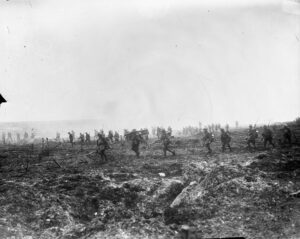
This original photo showing the advance on Vimy Ridge, was later retouched by official photographer W.I. Castle for exhibition purposes related to the Canadian War Records Office exhibitions of battle pictures (see Mikan # 3192389 for retouched version). MIKAN No. 3233066

1917

  • German Retreat to the Hindenburg Line, 24-29 March
  • THE BATTLE OF ARRAS, 1917
    • VIMY RIDGE, 9-14 April
    • FIRST SCARPE, 1917, 9-14 April
    • SECOND SCARPE, 1917, 23-24 April
    • Attack on la Coulotte, 23 April
    • ARLEUX, 28-29 April
    • THIRD. SCARPE, 1917 (Capture of Fresnoy) 3-4 May
  • Affairs south of the Souchez River, 3-25 June
  • Capture of Avion, 26-29 June
  • BATTLE OF HILL 70, 15-25 August
  • THE BATTLE OF MESSINES, 1917 (Capture of Wytschaete), 7-14 June
  • THE BATTLES OF YPRES, 1917
    • PILCKEM RIDGE, 31 July-2 August
    • LANGEMARCK, 1917, 16-18 August
    • MENIN ROAD RIDGE, 20-25 September
    • POLYGON WOOD, 26 September-3 October
    • BROODSEINDE, 4 October
    • POELCAPPELLE, 9 October
    • FIRST PASSCHENDAELE, 12 October
    • SECOND PASSCHENDAELE, 26 October-10 November
  • BATTLE OF CAMBRAI, 1917
    • The Tank Attack, 20-21 November
    • Capture of Bourlon Wood, 23-28 November
    • The German Counter-Attacks, 30 November-3 December
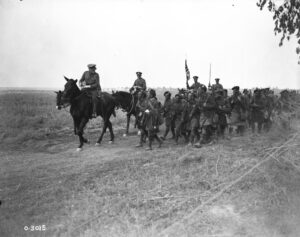
Sir Douglas Haig congratulating 85th Battalion. Battle of Amiens. August, 1918 3405991

1918

  • THE FIRST BATTLES OF THE SOMME, 1918
    • ST. QUENTIN, 21-23 March
    • Actions at the Somme Crossings, 24-25 March
    • FIRST BAPAUME, 24-25 March
    • ROSIERES, 26-27 March
    • FIRST ARRAS, 1918, 28 March
    • AVRE, 4 April
  • Capture of Hamel, 4 July
  • THE BATTLES OF THE LYS
    • ESTAIRES (First Defence of Givenchy, 1918), 9-11 April
    • MESSINES, 1918 (Loss of Hill 63), 10-11 April
    • HAZEBROUCK, 12-15 April
    • BAILLEUL (Defence of Neuve-Eglise), 13-15 April
    • FIRST KEMMEL RIDGE, 17-19 April
  • Action of La Becque, 28 June
  • THE BATTLE OF AMIENS, 8-11 August
  • Actions round Damery, 15-17 August
  • THE SECOND BATTLES OF THE SOMME, 1918
    • ALBERT, 1918, 21-23 August
    • SECOND BAPAUME, 31 August-3 September
  • THE SECOND BATTLES OF ARRAS, 1918
    • SCARPE, 1918 (Capture of Monchy-le-Preux), 26-30 August
    • DROCOURT-QUEANT CANAL, 2-3 September
  • THE BATTLES OF THE HINDENBURG LINE
    • HAVRINCOURT, 12 September
    • EPEHY, 18 September
    • CANAL DU NORD (Capture of Bourlon Wood) 27 September- 1 October
    • ST. QUENTIN CANAL, 29 September-2 October
    • BEAUREVOIR LINE, 3-5 October
    • CAMBRAI, 1918 (Capture of Cambrian), 8-9 October
  • BATTLE OF YPRES, 1918, 28September-2 October
  • Pursuit to the Sells, 9-12 October
  • BATTLE OF COURTRAI, 1419 October
  • BATTLE OF THE SELLE, 17-25October
  • BATTLE OF VALENCIENES (Capture of Mont Houy), 1-2 November
  • BATTLE OF THE SAMBRE, 4 November
  • Passage of the Grande Honnelle, 5-7 November
  • Capture of Mons, 11 November
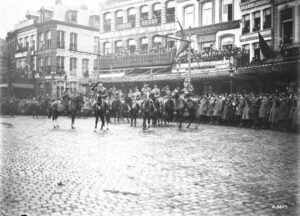
General Sir Arthur Currie, General Loomis and Officers in Grand Place, Mons, November 11th, 1918, taking the salute of the March past. MIKAN No. 3522365
  • The Battle of Bailleul in the Great War

    The Battle of Bailleul in the Great War

    According to Captain Robert N Clements MC (he wrote ‘Merry Hell’ The Story of the 25th Battalion (Nova Scotia Regiment)), whenever elements of the AEF and CEF came in contact on leave in England or elsewhere, the danger of open conflict never far away. The mutual animosity had developed after what then Sgt. Robert Clements had dubbed ‘The Battle of Bailleul’, two years before the actual Battle of Bailleul during the Final German Spring Offensive of 1918.

    The Battle of Bailleul
    The Battle of Bailleul – 30 Rue de Lille, Bailleul

    Though Canadian and Australian soldiers involved in several riots in their home countries, England, and Ireland during early 1916, no corroborating evidence found in Canadian war diaries, service files, and Circumstances of Death records, …as this tale proceeds it will be quite easily understood why accounts of the doings at Bailleul were never mentioned in any of the published records.

    The Battle of Bailleul
    The Battle of Bailleul – The Town Hall where the Canadian Corps was formed. Bailleul MIKAN No. 3404096

    The Battle of Bailleul

    Soon after the withdrawal from the Dardanelles early in January 1916, rumours began to circulate concerning the movement of the Australian divisions to the western front in France and Belgium. The program as understood by the usually well-informed lower ranks provided for a handing over of existing lines to the incoming Anzacs. The Canadians would then sideslip further north, closer to the apex of the Ypres salient.

    The Battle of Bailleul
    Cyril_Henry_Barraud-POPERINGHE_(CWM_19710261-0024)

    Up to that time the Canadian general headquarters had been located at Bailleul. That was to be handed over to the Anzacs with the future Canadian headquarters nearer to Ypres at Poperinge.

    Never Published

    Quite a lot of planning and some progress toward that arrangement appeared to have been made. Volumes have been written covering the battles of the war in great detail. As this tale proceeds it will be quite easily understood why accounts of the doings at Bailleul never mentioned in any of the published records.

    MIKAN No. 3386223
    An International Rifle Match – Canadians, Australians, New Zealanders, South Africans and Imperials. June, 1916. Sharpshooters appear to be mostly armed with Short Model Lee-Enfield service rifles. A spotter’s scope is set up to view the results. MIKAN No. 3386223

    Canadians remained temporarily at Bailleul awaiting the arrival of the advance elements of Australians prepared to start taking over. In due time these advance parties turned up. During the first few hours, while both sides were busy over official details, everything seemed to go smoothly and some progress was made. As the evening got under way, business was adjourned for further attention the next day. Naturally, with so much of more individual importance to discuss, unofficial conferences opened up in the cafés and estaminets.

    The Riot

    No record exists of the exact time and place where one Australian was reported to have loudly proclaimed that he and his comrades had been brought to France to clean up what the Canadians had started and could not finish. The reported equally loudly voiced reply wanted to know why the Australians had not successfully finished the work at the Dardanelles before they came. After that the result was beyond any doubt. First it was fists and feet, then bottles and glasses. In a very short while any weapon readily available, including NCOs’ side arms, either used by the owners themselves or snatched from their scabbards by other combatants, were involved in the fracas.

    Canadian Military Police, Corps Headquarters, 22 June 1916 MIKAN No. 3521716

    The riot spread quickly throughout the whole centre of the town. Both sides were about equal in numbers and advantage swayed from one to the other as the fighting spread. First efforts by senior authorities to control and separate the warriors were not at all successful. Finally the nearest regiment of English cavalry was brought in. By using their horses and the flats of their swords they restored a semblance of order and an uneasy truce. Next morning all further efforts to make the originally planned exchange were halted. During the day, minor clashes continued. But, by that time military police and control elements had been reinforced and any fighting quickly subdued.

    Casualty Figures

    The casualty figures never made public. But, throughout the Canadian Corps first-hand accounts from individuals who had been directly involved were gradually pieced together. These seemed to strongly suggest there had been some men from both sides actually killed. Probably another hundred had been taken to hospitals with severe injuries. And, all the remainder carried assorted bruises and contusions as a result of the evening’s activities.

    3395764
    The Battle of Bailleul
    Casualties just arrived. No. 1 Casualty Clearing Station. July, 1916. No. 1 C.C.S. was located at Bailleul at this time.
    In July, 1916 2810 patients were admitted and 70 died.
    MIKAN No. 3395764

    Canadian HQ Bailleul

    The major decision made at the highest level was to recognize the certainty of further and even more serious outbreaks if the two groups were left in any direct contact with each other. For the time being the Canadian headquarters would be left at Bailleul and the side movement northward delayed. The Australians would be put in the line further south and an entire British division positioned between them and the Canadians. The lines of communication from front to rear ran parallel but as far apart as possible. As a further precaution, the Australian rear bases along the channel coast were established around Le Havre.

    Canadian Military Police, Corps Headquarters, 22 June 1916. On the left, Sgt.-Maj. Lehfeldt of the Canadian Mounted Military Police (HQ 1st Infantry Brigade) MIKAN No. 3405484

    Those of the Canadians were left further north at Etaples. Thereafter, there were only a few very rare occasions when Canadians and Australians were located side by side in the forward areas. When that did happen they were both kept so busy fighting the Germans that they could not spare the time or energy to fight with each other. Otherwise, the bad feeling which started at Bailleul continued for the rest of the war. Whenever elements from the two sides came in contact on leave in England or elsewhere, the danger of open conflict was never far away.

    NCOs and side arms

    One other result was cancellation of the regulation for senior NCOs to carry side arms as part of their walking-out dress. The injuries during the Bailleul trouble made it very clear how dangerous these weapons could become in such violent circumstances.

    Sgt.-Maj. Lehfeldt of the Canadian Mounted Military Police (HQ 1st Infantry Brigade). MIKAN NO. 3218291

    It is certain that very few if any of the men directly involved are alive today. Many of them killed in the Ypres salient a few months later at St Eloi and Sanctuary Wood or during the Somme battles in September and October. Those who replaced them inherited the feelings from the original groups and kept them alive throughout the following years of active service on the western front.

    Canadian, Australian and British Officers at the graveside of a comrade killed while attacking a Gotha at night. 10 July 10 1918. Raymond Collishaw, CB, DSO & Bar, OBE, DSC, DFC. MIKAN No. 3403373
    Canadian, Australian and British Officers at the graveside of a comrade killed while attacking a Gotha at night. 10 July 1918. Raymond Collishaw, CB, DSO & Bar, OBE, DSC, DFC, second from right. MIKAN No. 3403373

    Subscribe

    CONTACT CEFRG

    ← Back

    Thank you for your response. ✨