Major William Orpen (later Sir William Orpen 1878-1931) born in County Dublin. Trained as an artist at the Slade School. Orpen elected ARA in 1910. When War commenced in 1914, Orpen raised funds for the War Effort by auctioning blank canvases on which the purchaser’s portrait would be painted. In 1915, commissioned into the Army Service Corps and carried out routine administration work at Kensington Barracks.

Opren served as an official War Artist on the Western Front from 1917 and knighted for his services in 1918. After the Armistice, he served as Official Artist at the Versailles Peace Conference. Orpen appointed RA in 1919 and died in 1931, aged 53.

foreground, with four members of the group sitting down, and another four standing behind. The last member of the group stands to the right, his foot up on a chair, resting his arm on his knee; he is poised reading a paper.
Some Members of the Allied Press Camp, with their Press Officers. From left to right – Standing: M Henri Ruffin (Agence Havas); Capt R E de Trafford; Signor G C Bedolo (Giornale d’Italia); M Paul Olivier (Le Matin); Capt E H Hale. Seated: Capt W Inge; Lieut-Col Veling (Le Temps); M R de Maratray (Le Petit Journal); also M André Tudesq (Le Journal).
Western Front
William Orpen commissioned as an official War Artist and served on the Western Front from 1917-1918.

German Prisoners by the Roadside

Self-Portrait in Battledress
Self-Portrait in Battledress in an area under bombardment. A sketch of the artist in tin hat and sheepskin gilet standing up to his ankles in mud; his face with strangely corpse-like features.

He stands holding a sketch pad in one hand and pencil in the other while shells explode like fireworks in the sky above his head. A line of German prisoners of war led by a British soldier can be seen in the distance.
Courcelette

Dead Germans in a Trench
On his arrival in France, Orpen’s first destination the Somme. The campaign had ended five months earlier but the area left an indelible impression on him, inducing feelings of fascination and revulsion.

Orpen visited again in August 1917, and though now full of wildlife, the artist found the abandoned battlefield unsettling. Rotting German corpses and the debris of battle remained strewn throughout.
Amiens
Mr. Dudley Forsyth, designer of Church Windows, Captain R. Maude, A.P.M. of Amiens and Major Orpen.

Captain R Maude (Assistant Provost Marshal of Amiens, centre) supervises Mr Dudley Forsyth (a designer of church windows, seated left, wearing cap), and Major William Orpen (seated right) as they sit at an easel to make sketches on a street in Amiens. A sign on a shop front behind them points towards Poulainville, Allonville, Villers-Bocage, Doullens and Vignacourt. The first and last are sketching, Amiens, 25 August, 1918.
Two Gentlemen of the Chinese Labour Corps
Two Gentlemen of the Chinese Labour Corps by Sir William Orpen (Mildura Art Ctr. M6. The Elliot Collection).

Oil on Canvas : 35.5×29.5 inchs (92×76.5cms) Signed : Lower Right ‘Orpen’
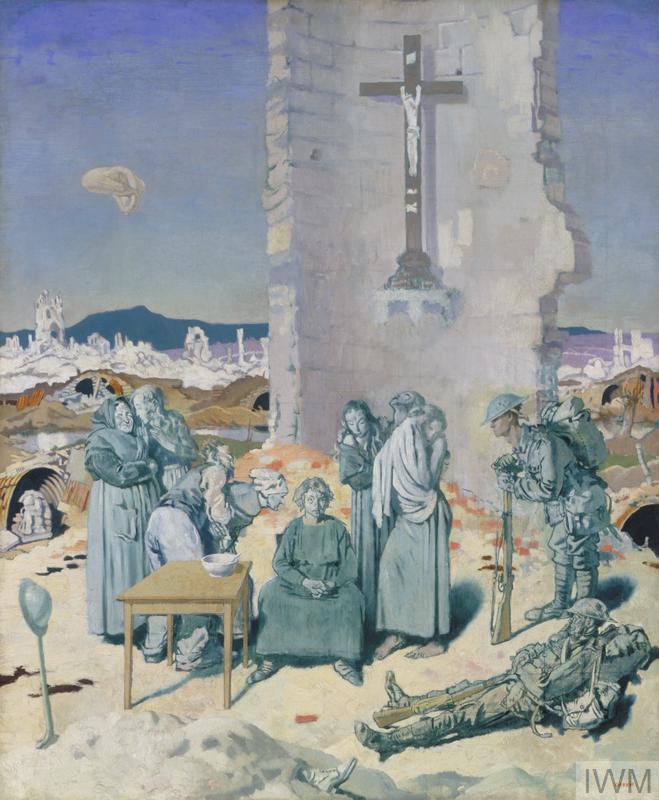
The Mad Woman of Douai (1918)
Orpen’s narrative to this painting found in his memoir, An Onlooker In France.

“In one spot in the mud at the side of the road lay two British Tommies who had evidently just been killed. They had been laid out ready for something to take them away … Death all round, and they themselves might be blown into eternity at any moment … Another day I went to Douai, and there I saw the mad woman. Her son told us she had been quite well until two days before the Boche left, then they had done such things to her that she had lost her reason. There she sat, silent and motionless, except for one thumb which constantly twitched. But if one of us in uniform passed close to her, she would give a convulsive shudder. It was sad, this woman with her beautiful, curly-headed son.”
William Orpen, An Onlooker In France
The Girls College, Péronne

Adam and Eve at Péronne
The same soldier (in same pose) appears in The Mad Woman of Douai (1918).

Yvonne Aubicq
This portrait caused considerable problems with the British military authorities as Orpen gave the piece the provocative title ‘A Spy’. But rather than being a spy or a refugee, the subject was in fact Yvonne Aubicq, a young French girl who was Orpen’s lover.

Mata Hari
Lieutenant-Colonel A N Lee, the British censor of official artwork, requested an explanation and Orpen elaborated on his provocative title with a false story. He claimed that the sitter was a German spy executed by a French firing squad. This was a subject particularly sensitive as Mata Hari had recently been executed by the French and the German execution of the British nurse Edith Cavell, who had aided the escape of Allied soldiers, was commonly used in Allied propaganda. Orpen was recalled to London and had to retract his story. He was severely reprimanded and only through his War Office connections did he manage to retain his status as an official war artist in France. Despite this episode, Orpen and Lee became good friends.

A half length portrait of Yvonne Aubicq seated in front of a background draped in fabric, her hands resting in her lap. Yvonne later married Orpen’s chauffeur, Captain William Charles Frederic Grover-Williams.
Yvonne – The Crossing Guard
Is it possible? Could the mysterious Yvonne, the Crossing Guard, be Yvonne Aubicq?

Flyers
William Orpen painted several flyers of the Great War. He spent part of September 1917 visiting airfields and during October 1917 he was based with No. 56 Squadron near Cassel.
Cassel a town in the Ypres Salient, Belgium where soldiers could come away from the fighting. Here, Orpen observed, they could ‘eat, drink, play the piano and sing, forgetting their misery and discomfort for the moment… One saw gaiety, misery, fear, thoughtfulness and unthoughtfulness all mixed up like a kaleidoscope.’

Major J B McCudden, VC, DSO, MC, MM

Major-General H.M. Trenchard, CB, DSO
Hugh Trenchard was the first Chief of the Air Staff, presiding over the foundation of the RAF in 1918, when the Royal Naval Air Service and the Royal Flying Corps were united as the new Royal Air Force.

Reginald Theodore Carlos Hoidge MC & Bar
Reginald Theodore Carlos Hoidge MC & Bar (28 July 1894 – 1 March 1963) a Canadian Great War flying ace, officially credited with 28 victories.

Lieutenant Arthur P F Rhys-Davids, DSO, MC
Portrait of the young pilot Lieutenant Rhys-Davids, killed shortly afterwards in a dogfight.

Flight Sergeant William George Bennett
Bennett’s portrait done when he was back in England recuperating, with the sitting starting on 24 June 1917. He was wounded by machine gun fire from the ground during a contact patrol on 4 May 1917 and returned to England at the R6 Auxilliary Hospital in Perth on 18 May 1917.

He then went on furlough on 16 June 1917 and officially returned 25 June 1917, the day after the first sitting for the portrait. It’s unclear whether he went back to France after that, but he was declared unfit for service as a pilot on 27 September 1918, so if he did then it was back as an Air Mechanic again, which he was before becoming a pilot on 20 October 1916.
Peace
A full-length depiction of a haggard and worn Kaiser Wilhelm II. He is naked and sits hunched, with folded arms and crossed legs, on the ground.

To the Unknown British Soldier in France
This was to be the third of Orpen’s three commissioned paintings of the Peace Conference. Orpen claimed he had completed thirty portraits before taking the radical decision to paint over the politicians and military leaders and reduce the scale of the chandelier. The painting caused some controversy when it was first exhibited at the Royal Academy in 1923. Orpen had painted two semi-nude soldiers guarding the tomb and two cherubs above – ‘after all the negotiations and discussions, the Armistice and Peace, the only tangible result is the ragged unemployed soldier and the Dead’. The Museum chose not to purchase the work, arguing that the content was not the subject they had commissioned. Orpen eventually painted over the figures and cherubs, too, and donated the painting to the Museum in memory of Earl Haig, ‘one of the best friends I ever had’.

In a letter to his mistress Mrs St George, written in 1921, Orpen sketched out the design of the original painting and identified a number of the twenty sitters. These included Sir John Cowans, (left, back row); Sir David Beatty, Sir Edmund Allenby, Sir Henry Rawlinson, Sergeant Grenadier Guards, (left, front row); Marshall Foch and Sir Douglas Haig (standing, archway); Sir Arthur Currie, Marshal Petain, Sir Frederick Sturdee (right, standing); Sir John French, M Georges Clemenceau (right 2nd row); Lieut A P F Rhys Davids, Mr D Lloyd George, Lord Plumer (front row). A number of these original portraits are still just visible.
Blown Up

Haig ‘The Butcher’
Douglas Haig, born in Edinburgh in 1861, one of the most controversial figures in modern British military history. Upon the outbreak of the war, Haig commanded I Corps in the initially small British Expeditionary Force sent to France in August 1914 under the overall command of Sir John French. As the BEF grew in size, Haig assumed command of First Army and then succeeded French as Commander-in-Chief of the BEF in December 1915. Haig presided over a series of major battles including the Battles of the Somme, Arras, Third Ypres, Cambrai, the German Spring offensives of 1918 and the British advances of the ‘Hundred Days’ in 1918.

He commanded the largest field army that Britain has ever sent to war. A force that increased in size from five Regular divisions at the outbreak of war to around sixty Regular, Territorial and New Army divisions by mid-1916. Haig led this field army to eventual victory. The manner in which he employed this force on the Western Front is still a subject of huge historical debate. Haig died in 1928 aged 66.
Versailles
The Paris Peace Conference in 1919 allowed the victorious Allied nations to resolve the end of the war, to apportion blame and financial responsibility and also to demand reparations from Germany. In addition, addressed wider issues such as forming the League of Nations and the creation of new nation states. Complex negotiations tried to match public desire for reparations to Germany’s willingness and ability to pay. In monetary terms, this the most important British painting commission of the war (£3000 compared to the £300 that ‘Gassed’ had cost) and to record the roles of the politicians, diplomats and military.
The Signing

The setting the dazzling Hall of Mirrors at Versailles, built by Louis XIV, at vast expense as a demonstration of his political power. Above their heads reads the legend ‘Le Roy Gouverne par lui même’ [The King governs alone]. A pointed reference to the conference’s endless squabbling, as Germany claimed not to be able to meet the penalties imposed and the allies were unable to agree a compromise. In Orpen’s vision, it is the extravagance of the architecture that sets the scene, reducing the politicians to a footnote. Their supposedly ordered world is distorted and broken by the mirrors behind them. In them the artist’s reflection twice and also, more significantly, the absence of any other audience. Nobody is watching. This shallow politics, mere posturing and an indication that the political forces and personal vanities that shaped the palace still present.

