Group of Seven
In 1915, after the outbreak of the Great War, Private Alexander Young Jackson 457316 enlisted in the 60th Battalion, CEF and sent to Europe. Wounded in the Battle of Sanctuary Wood in June of 1916. While recovering in the hospital in Étaples in northern France, he met Lord Beaverbrook. Soon he was appointed an artist with the Canadian War Records and immediately required to paint a portrait, despite his lack of experience with such themes. His subsequent works more in keeping with his preference for landscapes. From 1917 to 1919, Lieutenant A Y Jackson worked for the Canadian War Memorials as a war artist.

In late 1918, future Group of Seven member, Arthur Lismer, drew Jackson in uniform in Halifax, Nova Scotia.
The Group of Seven
The Group of Seven, also known as the Algonquin School, a school of landscape painters. Founded in 1920 as an organization of self-proclaimed modern artists and disbanded in 1933. Their works noted for bright colours, tactile paint handling, and simple yet dynamic forms. In addition to Tom Thomson, David Milne and Emily Carr, the Group of Seven remain the most important Canadian artists of the early 20th century.
60th Battalion
Organized in May 1915 under the command of Lieutenant-Colonel F A Gascoigne. Mobilized at Montreal, and also recruited in Montreal. Draft of 250 sent to 23rd Canadian Reserve Battalion in August 1915.

Embarked from Montreal 6 November 1915 aboard SCANDINAVIAN and later disembarked in England 16 November 1915, with a strength of 40 officers, 1024 other ranks.

Sailed from Montreal 6 November 1915, per SS SCANDINAVIA. After a couple of months in England, Private A Y Jackson and the 60th Battalion arrived in France 20 February 1916. Later reinforced by 23rd Canadian Reserve Battalion.
Battle of Sanctuary Wood

Jackson admitted to No. 1 Canadian General Hospital (GSW left shoulder and hip), Etaples on 4 June 1916. Evacuated to England and admitted to Lakenham Military Hospital, Norwich on 9 June 1916. Later admitted to the Convalescent Hospital at Woodcote on 18 July 1916, and finally discharged on 19 August 1916.

Canadian War Records Office
While recovering from his injuries, Jackson came to the attention of Lord Beaverbrook (William Maxwell Aitken), a Canadian business tycoon, British politician, and writer, who had him transferred to the Canadian War Records branch as an artist.

Return to France
On 13 August 1917, now an Honorary Lieutenant. Jackson returned to the battlefields to paint on 27 November 1917, Seconded for Duty with the CWRO. He likely arrived in the Ypres Salient following the departure of the Canadian Corps for the Vimy Sector after the Second Battle of Passchendaele. Lieutenant A Y Jackson quite familiar with Maple Copse during his short tour with the 60th Battalion in Belgium.
A Copse Evening, 1918
The most significant of all A. Y. Jackson’s war paintings, A Copse, Evening hugely indebted to the example of the English war artist Paul Nash, whom the Canadian artist greatly admired.

A line of soldiers (at right) treks through a muddy, shelled, and barren landscape, while searchlights in the distance scan the evening sky. The title of this A.Y. Jackson painting suggests that the area had once been heavily wooded, a powerful comment on the war’s devastation of the natural landscape.

Angres
The village of Angres a commune in the Pas-de-Calais department in the Hauts-de-France region of France, a region Lieutenant A Y Jackson had not previously visited. Jackson first visited the area around Vimy Ridge in October 1917. In this painting, his dreamy Impressionist style does not convey the brutal reality of the devastated battlefield.

Trenches near Angres


Camp near Saint-Eloy (sic)


Camoflage huts, Villers-au-Bois
Jackson’s European influences and training show in this 1917 painting of Villers-au-Bois near Arras, France. With their lively, curving shapes the trees resemble the cypresses in Jackson’s 1912 painting, Hills of Assisi, Italy.


Sketch for Canada Camp, Camblain l’Abbe


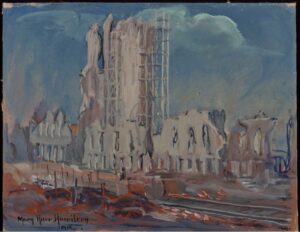
Cathedral at Ypres
The cathedral and Cloth Hall at Ypres have seen much more destruction since Lieutenant A Y Jackson last saw the town in May of 1916.


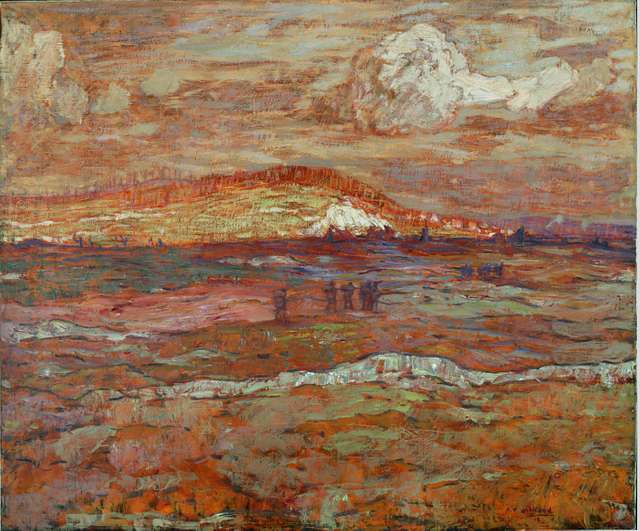
Hill 70 in the Distance


CSM Robert Hanna VC
Hanna decorated for his courageous actions with the Victoria Cross by His Majesty King George V, at a ceremony held at Buckingham Palace on 5 December 1917. The painting suggests Lieutenant A Y Jackson may have returned to France after this date, and not on 27 November 1917 as per his service record.


Gas attack, Lievin
In a 1953 article in Canadian Art, A. Y. Jackson wrote: “I went with Augustus John one night to see a gas attack we made on the German lines. It was like a wonderful display of fireworks, with our clouds of gas and the German flares and rockets of all colours.”

Painted by A. Y. Jackson in 1918. This painting shows a 1918 Allied nighttime gas attack on German lines in France. Future Group of Seven artist A. Y. Jackson later said the attack was “like a wonderful display of fireworks.”

Green crassier
On the evening of the 22 August 1917, Lt-Gen Arthur Currie met with Major General David Watson (4th Division) and Brigadier General Edward Hilliam (10th Brigade). Hilliam put forward the proposal that his Brigade would capture a position known as the Green Crassier (because of the vegetation growing on the slag). Taking this objective would complete the encirclement of Lens.

The crassier still exists and it is still green. It forms part of the Parc de la Glissoir in Avion.

House of Ypres
Drawn by A. Y. Jackson in 1917. Official Canadian war artist and future Group of Seven member A. Y. Jackson made “several sketches around Ypres,” Belgium, in November 1917, including this one. Jackson’s sketch of shattered houses is juxtaposed with his notes indicating, for example, “mud” and “brick all dull yellows.” Together, they give a sense of immediacy and provide insight into his understanding of the war and its victims.

Painted by A. Y. Jackson in 1917, he depicts poignantly the destruction of Ypres, Belgium. Rather than painting the famous Cloth Hall, Jackson chose the empty shells of houses – once the homes of ordinary Belgians – as his subject. Arthur Lismer, another future Group of Seven member, commented on Jackson’s work: “He saw . . . not the struggle of men in action, but rather the sad and wistful aftermath.”

Bombed out houses in Ypres dominates this A.Y. Jackson painting, while riders on horses move across the background. Lieutenant A Y Jackson the only member of the Group of Seven to experience combat.

John Chipman Kerr VC
VC Investiture of Kerr on 5 February 1917 by King George V, Buckingham Palace.

March 1918, Lievin


Church at Lievin, Moonlight

German Concrete Shelter, Lievin

Lorette Ridge, 1918
In this painting, Jackson created an evocative war landscape. He painted the small area of wooden stakes and barbed-wire entanglements visible on the study’s right.

These vertical features animate the bleak horizontal landscape. In the background, the stakes metamorphose into a distant line of soldiers.

Ablain Saint-Nazaire


Lorette Ridge Study, 1918
By painting on a wood panel, Jackson replicated the method he used for his outdoor painting before the war. He has altered his viewpoint slightly, so that the church of Ablain-Saint-Nazaire, visible in the original sketch, has disappeared.

Gun Pits, Lievin


Mont-des-Cats
Lieutenant A Y Jackson familiar with Mont-de-Cats during his first tour with the 60th Battalion.

The Canadian divisions had their own sniper training school located at Mont des Cats.

Lt Robert Shankland VC
VC Investiture of Shankland on 7 October 1918 by King George V, Sandringham, Norfolk.

Riaumont
Painted by A. Y. Jackson in 1918. This depiction of the destroyed French village of Riaumont when in March 1918, Jackson attached to the 3rd Brigade, Canadian Field Artillery, near Riaumont.

He “made little more than pencil notes, finding it hard to manage a sketch box while shells were dropping here and there.” Jackson later used his notes to produce this painting.

Screen road unfinished


Study for Vimy Ridge from Souchez Valley
On 12 October 1917, a day after he completed the sketch, Jackson painted this preliminary study for a painting.

Working from the sketch, he rearranged the landscape elements so that the trench is on the right, the trees are taller and cross diagonally, and the clouds are white and rounded. He added some cottages and a line of soldiers on horseback below the trees.

The Kemmel-Vierstraat road


The Pimple, Evening
Soldiers advance in line towards the pimple, a position north of Vimy Ridge. Initially outside of the Canadian Corps’ objectives for 9 April 1917, the pimple was later added to ensure that the Germans could not counterattack and recapture the ridge.

Canadian troops attacked in a snow storm on 12 April, driving the elite German defenders from dug-in positions.


Vimy Ridge from Souchez Valley


Vimy Ridge from Souchez Valley (2)


Vimy Ridge from Souchez Valley Sketch


Poperinghe

Vlamertinghe

Ypres


Return to Canada
Lieutenant A Y Jackson ceases to be Seconded for Duty with the CWRO on 27 September 1918 and returned to Canada. Still on duty, Lieutenant A Y Jackson assigned to the Siberian Expeditionary Force. However, on 2 May 1919, SoS from the CEF in Montreal. No record of Jackson having served in the Siberian Expedition.
The Edge of Maple Wood
When Lieutenant A Y Jackson left the military he settled in Sweetsburg, Quebec and began producing works such as The Edge of Maple Wood. He struggled in Quebec for several years, and considered a move to the United States. In 1925 he taught at the Ontario College of Art (OCA), in Toronto, the only time in 30 years he missed travelling home to Quebec for Spring, where his heart and best paintings based.

War Artists
As he noted in his autobiography, A. Y. Jackson had clear ideas on the role of artists in wartime: “It is logical that artists should be part of the organization of total war, whether to provide inspiration, information, or comment on the glory or the stupidity of war.” He continued: “What to paint was a problem for the war artist. There was nothing to serve as a guide. War had gone underground, and there was little to see. The old heroics, the death and glory stuff, were gone for ever; there was no more ‘Thin Red Line’ or ‘Scotland For Ever.’ … The impressionist technique I had adopted in painting was now ineffective, for visual impressions were not enough”
In 1933, Jackson founded the Canadian Group of Painters, which included former Group of Seven members Lawren Harris, A.J. Casson, Arthur Lismer, and Franklin Carmichael. He spent his final years as artist-in-residence at the McMichael Gallery (now the McMichael Canadian Art Collection) in Kleinburg, Ontario, where he is buried. He died on 5 April 1974, at the age of 91.

More
- Home of CEFRG
- Blog
- CEFRG on FaceBook
- CEFRG on YouTube
- War Diary of the 18th Battalion (Blog)
- 116th Battalion CEF – The Great War
- Les Soldats du Québec Morts en Service
- The Aerodrome
- Remembering the Fallen
- In Memory by Pierre Vandervelden
- About CEFRG
Subscribe
