Frederick Grant Banting born 14 November 1981, the youngest of five children. His parents William Thompson Banting and Margaret Grant of Alliston, Simcoe County, Ontario. Captain Frederick Grant Banting later became known as the co-discoverer of insulin, and not so well known as an accomplished painter and friend of Lieutenant A Y Jackson (the Group of Seven).

Co-discoverer of Insulin

The art of Frederick Grant Banting
A Y Jackson and Banting made early and frequent trips to the province of Quebec. Jackson introduced Banting to the Laurentians in winter around La Malbaie and Baie-Saint-Paul.

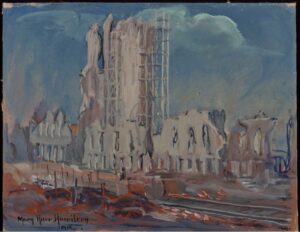
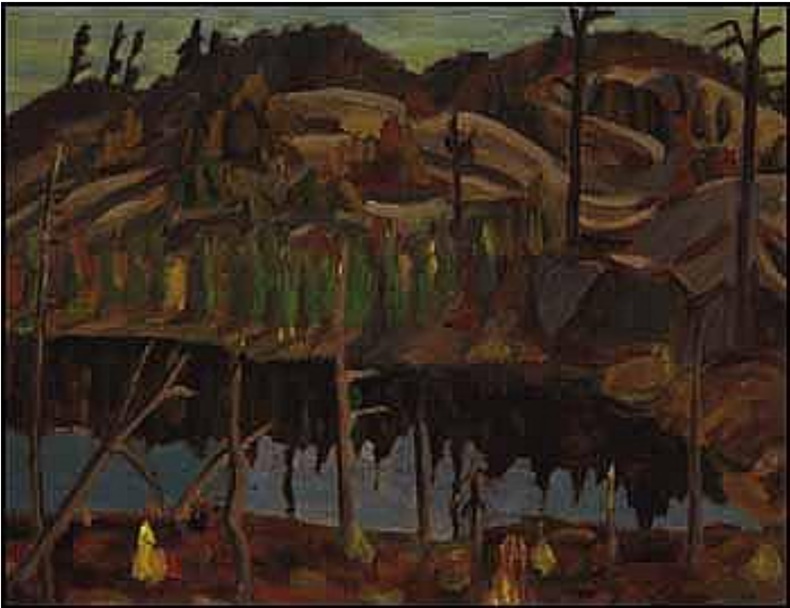
This image the closest Banting would come to depicting a scene from the Great War. The battered trees resemble depictions of Sanctuary Wood, though Banting never stationed in the Ypres Salient. Banting would be very close to the canal at Cambrai, however, as depicted by Mary Riter Hamilton.

Military Service of Frederick Grant Banting
Banting served as a Private from 14 March 1915 to 14 October 1915 with the CAMC 2nd Field Ambulance Training Depot at Niagara-on-the-Lake.

During this time, Banting rose to Sergeant, then Staff Sergeant, and granted a leave of absence for six months on 14 October 1915 for the purposes of attending Toronto University for his 4th year. Subsequently, granted a further extension to complete his 5th year in medicine.

The discovery of insulin one of the most important medical achievements of the twentieth century, netting Frederick Banting and James MacLeod the Nobel Prize in Medicine in 1923, and bringing worldwide acclaim to co-discoverers Charles Best and James Collip.
Dr Frederick Grant Banting
Now a Lieutenant in the CAMC, Banting attested 10 December 1916 at Toronto Camp, C/O Major Julian Boyd, AMC. Passed his CAMC medical exam on 17 January 1917 at Toronto Base Hospital, certified by medical officer Captain Ruggles George. Banting stood 5′ 11″ tall, 175 pounds.
England
ToS from Canada and posted to the CAMC Depot on 26 March 1917. Posted to Granville Canadian Special Hospital, Ramsgate on 2 May 1917. Banting would later return as a patient to this hospital in 1918, but the hospital moved to Buxton by then.

Granville Special Hospital, Ramsgate and Buxton opened 20 November 1915 in 1915 in the Granville Hotel, Ramsgate. Commanded by Lieutenant-Colonel W. L. Watt.
The hotel had been taken over by the War Office for use as a hospital for Canadians requiring prolonged and special treatment. Closed in August 1917 because of bombing and bombardment of Ramsgate. Opened in Buxton 4 November 1917.
No. 7 Canadian Sanitary Section
Attached to No. 7 Canadian Sanitary Section on 28 September 1917. No. 7 CSS organized in February 1916 as No. 4, Canadian Sanitary Section. Redesignated as No. 5 Canadian Sanitary Section 2 July 1916. Attached to Canadian Training Division, Bramshott. Redesignated as No. 7 Canadian Sanitary Section 24 February 1917.

Banting ceases to be attached to No. 7 Canadian Sanitary Section on 15 October 1917. To be Temp Captain, CAMC, 9 December 1917.

Captain Frederick Grant Banting remained at Granville Canadian Special Hospital until June of 1918, where on the 23rd he proceeded overseas for service with No. 3 Canadian General Hospital, Lt-Col John McCrae’s unit.
No. 13 Canadian Field Ambulance
Shortly after arriving at No. 3, Captain Banting posted to No. 13 Canadian Field Ambulance on 13 July 1918. No. 13 CFA organized at Victoria in March 1916 under the command of Lieutenant-Colonel J. L. Biggs. Left Montreal 1 July 1916 aboard METAGAMA and arrived in England 9 July 1916 with a strength of 9 officers, 182 other ranks. Arrived in France 13 August 1916 with the 4th Canadian Division.

On Sunday, 14 July 1918, Capt. F. G. Banting arrived for duty with the 4th Canadian Division, replaced on the establishment of No. 3 CGH by Capt. J. C. Clark. Note No. 13 Canadian Field Ambulance served with the 4th Canadian Division and now stationed at Ecoivres.

On 19 July 1918, Captains W C Walsh and F G Banting at L’ABBAYETTE ADS. O/C and Captain Barclay visited ANZIN and secured horse lines and quarters for the Horse Transport.
Battle of Amiens
On Roye road and the ADS opened up with Captain Paine and Captain Banting with 2 clerks at No. 9 CFA, the ASYLUM, south of Amiens.

Streams of wounded came in all night. The Horse Transport moved to Gentelles Wood the following day, and the ADS to the east side of Caix early on the 10th.

On the 19th, Captain Frederick Grant Banting returned from temporary duty with No. 5 CFA. On the 26th, Banting detailed to the 44th Canadian Infantry Battalion for temporary duty in relief of Captain C W Atkinson.

Lance-Corporal John Russell Clark
Lance-Corporal John Russell Clark, service number 463045, born 27 October 1895 at Glasgow, Scotland. He came to Canada in 1913, aged 18. He listed service with the 88th Victoria Fusiliers and listed store clerk as his occupation when he enlisted on 21 July 1915 at Vernon, British Columbia, with the CEF. Promoted to Lance Corporal in November 1915, deployed in France in June 1916 with the 29th Canadian Infantry Battalion and transferred to No. 13 Canadian Field Ambulance in December 1916.

John Russell Clark returned to Canada in June 1919. He married Eva Auchinachie and became a citizen of the United States of America, living in Seattle, Washington, and Juneau, Alaska. He died in 1974.
Captain Frederick Grant Banting Wounded
Banting wounded 28 September 1918 along with 4 Other Ranks of No. 13 CFA near Inchy.

Private Peter Green 524950 and Pte G D Fisher succumbed to their wounds later on the 28th (VIS-EN-ARTOIS BRITISH CEMETERY, HAUCOURT).

Captain Frederick Grant Banting evacuated to No. 1 CCS.
No. 1 Canadian Casualty Clearing Station
No. 1 CCCS organized at Liverpool, N.S. and Valcartier in August 1914 as No. 2 Clearing Hospital. Commanded by Major F. S. L. Ford. Left Quebec 30 September 1914 aboard MEGANTIC and arrived in England 14 October 1914 with a strength of 11 officers, 75 other ranks. At Duchess of Connaught’s Canadian Red Cross Hospital, Taplow, until arrived in France 2 February 1915. Redesignated as No. 1 Canadian Casualty Clearing Station 6 March 1915.

GSW right forearm, middle 1/3 ulnar border of forearm. Operation to remove shrapnel. Arrived at 2nd Western General Hospital, Manchester on 2 October 1918. Secondary haemorrhage occurred twice. Granville Canadian Special Hospital on 21 October 1918. Wounded healed, except for 20 percent disability in 5th digit. Transferred to Matlock on 27 November 1918 until 4 December 1918.

Captain Frederick Grant Banting granted leave from 4 December to 25 December 1918, and posted to Canadian General Hospital, Buxton on 27 December 1918.

Military Cross
Banting awarded the Military Cross, London Gazette No. 31183, 15 February 1919.

SoS on posting to CEF, Canada on 22 February 1919 per SS BELGIC.

Banting knighted in 1934. He married twice (Marion Wilson Robertson in 1926, and Henrietta Elizabeth Ball in 1939) and had a son with his first wife.
Death of Frederick Grant Banting
Vowing to retire from medical research at age 50 and paint full time, Banting 49 when tragically killed in an air crash while serving with the Canadian National Defence Associate Committee on Aviation Medical Research on 20 February 1941.

Banting had died during the day after the crash, February 21, 1941, of his injuries and exposure.

A small memorial park has been set up in Musgrave Harbour where the few remnants of original wreckage lie, while a restored Hudson has been placed nearby.

Contact CEFRG


