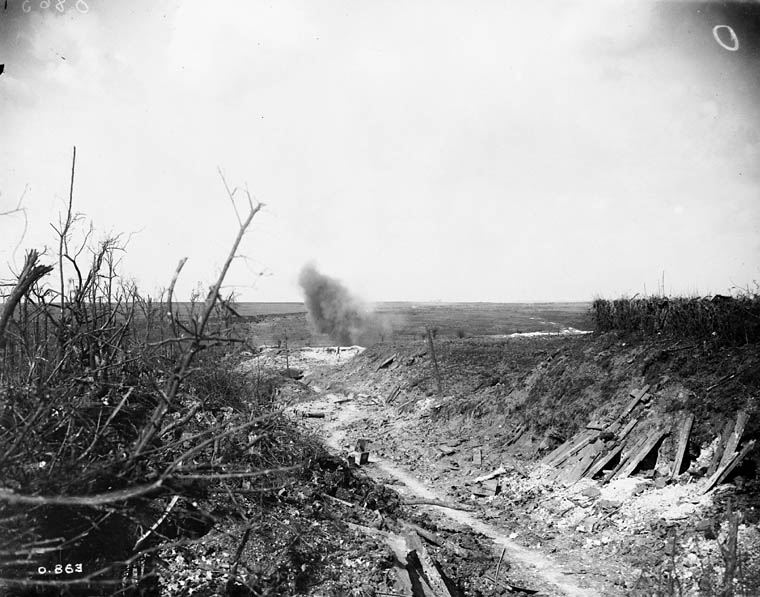
WLU: The George Metcalf Archival Collection at the Canadian War Museum has a thick file of original materials related to the 22nd Battalion’s role in The Capture of Courcelette including messages written by its commander, Lieutenant-Colonel T .L. Tremblay, and after action reports, many hand-written, by future Dominion Archivist Lieutenant-Colonel Gustav Lanctot. Nothing is known about the provenance of this file. It was in storage at the museum when, in 1971, serious efforts began to assemble disparate documentary materials into a proper archives collection. The file presents a splendid opportunity for someone to complete an in-depth account of the 22nd’s role in the battle.
The following narrative is included in the file. Neither its author nor the date that it was written is known. It is presented here to provide a taste of what is in the file and an idea of the ferocity of the fighting that the 22nd experienced at Courcelette.
Story of the 22nd Battalion
September 15th, 1916
When the first great attack of September 15th launched at 6.20 a.m., the 5th Canadian Infantry Brigade in Divisional Reserve. The 22nd Battalion located in trenches lying approximately between La Boiselle and Contalmaison. There, for the greater part of the day, only interested spectators. Over their heads the shells from the heavy batteries hurtled screaming through the air. All about them rows and rows of field guns and light howitzers firing furiously, with a deafening, brazen crash of sound.

15h30, 15 September 1916
As the morning passed, reports and rumours came to them of the successful assaults by the 4th and 6th Brigades. But, they had little expectation of being themselves called upon to take an immediate part in the battle. Suddenly, at 3.30 in the afternoon, Lieut-Colonel Tremblay received his marching orders. His battalion, in conjunction with the 25th Battalion on his left, was, at six o’clock that same evening, to advance to the assault and capture of the fortified village of Courcelette.
Here indeed was a military problem and a task to test the most highly trained and disciplined troops. In the short space of two hours and a half battalion orders had to be issued. All the Officers and NCOs who would participate. Careful preparations had to be made. The battalion would have to reach the point of departure for the assault over very rough ground. More than two miles away.
Moving into Position
Yet this was done. All went like clockwork. The training of months and months, the detailed and patient labour of anticipation had prepared for this very contingency.

The battalion finally set in motion, and, moving against time, began its march forward up the valley south of Pozières. Two companies in single file abreast, about 350 yards apart, led the way. 150 yards behind them came another company also in single file. At a similar distance the fourth and last company in the same formation.

Martinpuich
In this manner they mounted the ridge which conceals Martinpuich from view. From the trenches on this ridge the morning attack launched. Here they entered the zone of heavy hostile artillery fire. The ground, although dry, was a perfect confusion of shell holes, and shattered trenches. At this point, Major Bauset and Captain Chaballe in command of the two leading companies respectively. Swung their men up on the right in extended order, one man to every three yards. In this way they covered a line of about 900 yards. The right flank guided by the light tramway running into the southwestern corner of Martinpuich. Their left directed towards the ruins of the Sugar Factory, which presently came into view.

This manoeuvre could not have been more perfectly executed on the peaceful plains of Salisbury or the sandy fields of Valcartier. And yet, all about them there was a continuous and deafening explosion of High Explosive Shells and shrapnel. Even here men fell killed or wounded. The other companies as they, in turn, reached the crest of the ridge. Followed suit and extended into open order, the battalion thus moving forward in three successive waves.

Advance under fire
Lieut-Col. Tremblay went forward with the first wave. Remarking on a tendency to move too much to the right in the direction of Martinpuich, himself ran along the whole line, redirecting the advance. For over a mile the battalion continued in this fashion, under a heavy and continuous shell fire. Men struck down and killed or blown up and buried. Three times Col. Tremblay himself partly buried by the earth from shells exploding near him. Major Gringras twice narrowly escaped death, knocked down, bruised and shocked by near-by explosions.
Candy Trench
None the less the line moved steadily forward. At times they doubled through the artillery barrage. Thus they passed over the ground so gallantly won that very morning. Scattered here and there were bodies of men of the 20th and 21st Battalions and bodies of their German foes. At last the “Candy Trench” reached, manned by men of the 4th Brigade, and the Sugar Factory passed on the left. There the right of the line thrown forward until it rested on the Gun Pit Road and the direction altered to a left incline. Thus advancing directly from the south against the southern edge of Courcelette.

Artillery barrage
Stage by stage, in front of the infantry, our artillery barrage laid down with remarkable precision. But the 22nd no longer studied the time. They swept ahead without a pause, practically within their own shell fire.

18h00, 15 September 1916
Just at the edge of the village they were held up for a few moments until the barrage lifted. Then, with shouts and wild cries they poured into Courcelette in an irresistible flood. On the right, heavy hostile machine gun fire met them and about 50 men fell before the guns could be silenced. Here and there hand to hand struggles took place, snipers had to be dislodged, and deep dugouts full of cowering Germans were bombed.

Dugouts
The greater part of the 2,000 Germans who formed the garrison of Courcelette had, however, little stomach for the fight. The men of the 22nd speak of them with disgust as “les vaches” [“cows”]. In the streets they knelt down imploring mercy with their hands raised. They crept out of dugouts and sought eagerly to surrender. As the 22nd pressed northward through the village with their left flank guided by the main street and their right along the eastern edge of Courcelette they could see the enemy in numbers running away over the crest beyond and throwing off their rifles and equipment as they fled.
Moving into Courcelette
It was not the task of the 22nd to take prisoners – that was for the “mopping up” parties who followed them, to do – nevertheless, by the end of the attack, when the entire village was in their hands and they had reached beyond and established a line to the north and east of the quarry, over 300 prisoners, not including the large numbers of wounded, were found to have been captured. There was also a German 4.1” gun which they could claim, with 1000 rounds of ammunition, several machine guns, and a large quantity of German hand grenades.
The story of the fighting in Courcelette is one largely of individual courage and initiative. Innumerable tales could be told, for there was not a man who did not have his own adventure. Quickly, ferociously, they spread through every ruined house and cellar and dugout; shooting, bayoneting, returning triumphant with some crestfallen prisoner.
Heroes
Sergeant Mitchell 61859, known in the regiment as a daredevil fighter, secured a number of German bombs and set off on his own. He bombed two dugouts crowded with the enemy, but as he was attacking a third, he was himself shot and killed (REGINA TRENCH CEMETERY, GRANDCOURT).
One devout soldier brought in a prisoner and said :- “J’aurais pu bien le tuer mais ce n’était pas nécessaire. Le bon curé M’a [sic] dit de ne pas en tuer si ce n’était pas nécessaire.” [“I could well have killed him but it was not necessary. The good priest told me not to kill someone if it were not necessary.”]
Lieutenant Greffard
Lieutenant Greffard, who had at one time been the regimental sergeant major, was stunned by a shell near the Sugar Factory as the battalion was advancing to the attack. He lay unconscious for about two hours. When he regained consciousness, he refused to remain at the Dressing Station, but followed the battalion into Courcelette and reported to Colonel Tremblay. Colonel Tremblay put him in charge of a party with which he planned an attack upon a battery position some distance beyond the village.
While in the forward trench Greffard was shot through the shoulder. His wound was dressed by the battalion doctor and he then returned to his command. Here he was once more wounded and obliged very reluctantly to leave the fight.

Lieutenant Rene Lefèbvre
Lieutenant Rene Lefèbvre shot through the chest during the attack. As he lay on the ground, he raised himself up and waved his men forward although the blood flowing from his mouth. He had behaved with great gallantry and recommended for the DSO, by the Colonel, who had not heard that he had died from his wound (COURCELETTE BRITISH CEMETERY).
Major Maurice Edward Bauset
Major Maurice Edward Bauset [Beauset] had gone forward with his men and established a line along the eastern edge of the village. There for several hours he was tireless in his duties, encouraging his men, assuring them a supply of bombs, ammunition and drinking water and personally active in repelling repeated bombing attacks. Unfortunately in one of the numerous determined counterattacks which the enemy afterwards made, he was shot in the breast and instantly killed (SUNKEN ROAD CEMETERY, CONTALMAISON).

Major A.E. Dubuc and Lieut. Belzile had not taken part in the attack. They were among those officers who had been ordered to remain behind. During the night, Major Dubuc was sent forward by the Brigade to examine the situation and, if necessary relieve Colonel Tremblay, who, it was reported – erroneously as it afterwards proved – had been wounded. Lieut. Belzile volunteered to accompany him. Together they passed through a furious barrage which the Germans had then placed about Courcelette, and eventually reached the village. All communications with Major Bauset [Beauset] on the right had broken down.
Major Dubuc sent six men to try and reach him. Of these, two were killed, three wounded and the other returned to report. Another four men were then sent, all of whom were killed or wounded. Eventually two men succeeded in reaching him. They returned to say that he was holding on with great difficulty and seriously in need of reinforcements. A small party was collected by Major Dubuc and placed under command of Lieut. Belzile, who succeeded in reaching the front line.
Lieut. Belzile
After Major Bauset [Beauset] killed, Lieut. Belzile took command and held on grimly until he himself severely wounded, his leg being shattered and afterwards amputated – he died 29 September 1916 (BOULOGNE EASTERN CEMETERY). One of the men pressed on beyond the others and entered a German trench to the east of Courcelette. There he discovered a machine gun which he shouldered and brought back to his own trench. Not satisfied with this he called out;-
“Y a-t-il quelqu‘un avec le ‘pluck’ de venir avec moi? II y a une autre bien plus beau par lá,” [“Is there somebody with the ‘pluck’ to come with me? There is another more beautiful gun there.”] and, without waiting for a reply, back he went to fetch the other, but this time he was shot and killed.
Captain [D]ansereau was badly wounded in the leg but refused to leave his men. He lay in the trench loading spare rifles and passing them on to the men who were firing.
Sergeant Contant
Sergeant Contant, when all the officers in his company had been killed, took command and carried on with great skill and devotion until he himself was killed. There were numerous cases of this kind, NCOs and even men assuming command of detached posts and acting with distinguished courage.
Casualties
Of the 22 gallant officers who went into the action, 6 were killed and 11 wounded – so that only 5 came through unscathed. Of the wounded, two remained at duty during the three days and nights which followed – days of constant shelling and frequent counter attacks.
Major Renaud (SUNKEN ROAD CEMETERY, CONTALMAISON).
Lieutenant’s Abel P Beadry, Lavoie MM, and Louis Joseph Binet (SUNKEN ROAD CEMETERY, CONTALMAISON).

LCpl’s Dulong (COURCELETTE BRITISH CEMETERY), Edouard Leger DCM (VIMY MEMORIAL).

Corporal William Contant (VIMY MEMORIAL).

Thirty one Other Ranks, including Simoneau MM. Only six not named on Vimy:
Bealieu, Bouvrette, Desilet, Gallant and Auguste St Pierre buried at COURCELETTE BRITISH CEMETERY, and also Cadieux buried at POZIERES BRITISH CEMETERY, OVILLERS-LA BOISSELLE.

Counterattacks
Altogether while they held the line, the 22nd repelled 13 determined attacks, each time inflicting heavy losses upon the enemy.
It is impossible to mention the gallantry of all for each man did his duty, but the actions of Captain Chaballe, of Lieutenant B. Languedoc who was wounded, of Major Renaud and Lieut. Lavoie who were killed by the same shell, of Lieuts. Dupuy and Le Compte [Lecompte] and of Lieut. Binet who was also killed and of Captain Fontaine and Lieut. Baillargeé particularly remarkable.
Reinforcements were received from the 24th and 26th Battalions and Colonel Tremblay has expressed his admiration for the manner in which he was assisted by such men as Captain “Herby” Kingston of the 24th, afterwards wounded for the 2nd time, and Captain Ritchie of the same regiment. Also Major McKenzie and Lieut. Ward of the 26th Battalion.
Lieut. Bagnall, the artillery liaison officer, was magnificent throughout and rendered the most valuable service. Captain Robert McCamus Fair of the 5th Brigade Trench Mortar Battery killed while operating his Stokes Guns (VIMY MEMORIAL). He had also assisted very materially in the successful defence of the position.
Lt. Col. Thomas-Louis Tremblay
But there is no one who is more deserving of praise than Lieut-Col. Tremblay himself. His men have unbounded admiration for him and speak of him with an enthusiastic affection. He was in the forefront of the battle, constantly exposed to shell fire and the enemy’s snipers.

He personally placed forward posts and frequently visited the whole of the line, encouraging his men and directing the defence. He established his headquarters in the very heart of Courcelette itself, and during the three days and two nights when the battalion continued hold the village, he was tireless in his efforts; never even paused to sleep and was the soul and spirit of the defence.
Treatment of Prisoners
Among the prisoners captured there were two colonels, one a regimental commander and one a battalion commander. The regimental commander a German baron – a large man of most dignified and arrogant appearance. He frowned down upon little Colonel Tremblay and, with a fine show of indifference, pulled out a silver cigarette case, and made to smoke a gold tipped cigarette.

“It wouldn’t have been so bad,” said Colonel Tremblay, “if he had offered me one, but he didn’t.”
He was put with about 250 of his men, under a guard of 4 of the sturdy French-Canadians who were to march them back to the Corps Cage. In order to protect them from their own artillery, Colonel Tremblay gave one of their NCOs a Red Cross flag from the German Dressing Station and he told him wave it. This he did with a right good will, running up and down the line waving the flag frantically. However, the German gunners paid no attention to it and began to shell the party very heavily.

Attempted Escape
Several of the prisoners were killed or wounded. In the confusion the big baron thought he saw an opportunity. He called out an order to the men who then began to scatter, and he himself attempted to escape. This was a glorious opportunity for the little guards. Dropping on one knee, they began shooting. Several of the prisoners dropped, several others bayoneted, and the remainder came very meekly back into line. As for the baron – Pte. Shagoury, a battalion runner, shot him through the leg and led him limping and groaning back to the Colonel. Thereupon Colonel Tremblay looked upon him with a stern eye.

“Tell him,” he said to a German interpreter, “that he must be shot, ‘dos au mur.’” [back to the wall.]

Thereupon the proud baron fell to trembling, lost all his fine assurance, protested that he was only attempting to escape the artillery fire, and humbly begged to be spared. Satisfied with his triumph, Colonel Tremblay gave him a warning and sent him away a very different man in appearance to the proud captive of a few moments before.
End of Text
Were Canadians Savages?
Perhaps Canadian troops more savage than soldiers of any other army. Sir Arthur Currie took pride in the fact his troops prided themselves on killing the enemy. Wherever and whenever they could. The reality though, they could not have been the only savages on the Western Front. Could they have been slightly more savage than the rest?

They were not prone to killing Prisoners of War. In fact, when Sir Arthur Currie took command of the Canadian Corps he gave strict orders not to be disobeyed. Prisoners to be treated humanely…Currie took command of the Canadian Corps in July 1917, nearly a year after the Battle of Flers-Courcelette.

