Soldiers Graves Scandal
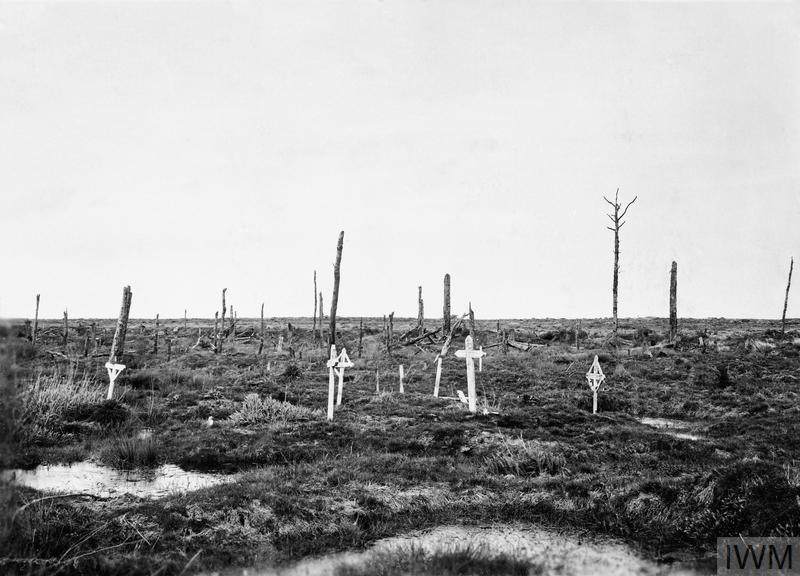
The Soldiers’ Graves Scandal had gathered momentum in the Fall of 1921 as the Directorate of Grave Registration and Enquiries (DGRE) and the Imperial War Graves Commission (IWGC) announced the end of the Burial Recovery Program on the Western Front. Understandably, the public furious. Early in 1922, another two scandals rocked the I.W.G.C. – the Captain William Thomas Meikle Scandal, and the Captain F E Bluett-Duff Scandal.
Captain William Thomas Meikle of the Australian Graves Service commented publicly on the Soldiers Graves Scandal in the Daily Herald, Adelaide, on 3 January 1921. According to Meickle ‘the majority of those reported missing are practically identifiable owing to the places and circumstances’ in which they were found, but that ‘the strict rule hitherto’ had been that a memorial should not bear a name ‘unless identification is positive’.

Mary Riter Hamilton collection. OP-0332 MIKAN No 2873530
The article continued: ‘It is suggested by Captain Meikle that it is better to take the chance of an occasional mistake than to leave many thousands of bodies unnamed and unknown’. Meikle apparently believed that it did not truly matter if a family travelled from Australia to the Western Front to weep at a graveside which did not actually contain the body of their loved one, as long as they believed it did.
A year later, Captain William Thomas Meikle would be dismissed for scandalous conduct while employed with the I.W.G.C.
Cast of Characters
D.A.I.W.
Deputy Assistant Inspector of Works. Not involved in this scandal, The Deputy Director Inspector of Works – Sir Frank Higginson CB CMG ARIBA.
I.W.G.C.
Imperial War Graves Commission. The I.W.G.C. had been established by Royal Charter on 21 May 1917. The Prince of Wales (later Edward VIII) appointed President, while Sir Fabian Ware became the Vice-Chairman.
H E J Grover – D.A.I.W.
Appointed as Deputy Assistant Inspector of Works on 12 May 1919. Transferred to Chief Clerk of Works on 1 May 1924. Left the Commission on 13 March 1931. War service as a Second Lieutenant in the Royal Engineers.
R S Lynch – Horticultural Officer
Appointed as a Horticultural Officer on 18 January 1919, and proceeded to France. Left the Commission on 30 September 1928. War service as a Lieutenant in an unspecified regiment.
Major W K K Kinnear (MBE)- Registration Officer
Appointed as a Registration Officer on 1 April 1921, and worked in France. Promoted to Chief Registration Officer on 18 June 1929, and to Area Inspector on 1 September 1930. Became a Chief Records Officer on 28 May 1948, and Chief Administrative Officer of the UK District on 11 June 1950. No end of employment dates recorded, but last entry is dated 1 January 1951.
T P Balfour – Chief Clerk of Works
Appointed as a Pioneer Class II (Patrolman) on 29 April 1919, and worked in France. Promoted to Clerk of Works in March 1920, and Chief Clerk of Works in April 1921. Left the Commission on 31 March 1931. War service as a Sergeant in the Royal Highlanders (Black Watch).
W T Meikle – No. 5 Area Superintendent
Appointed as an Area Superintendent on 12 April 1921, after joining the Commission in France. Left (resigned) employment on 20 April 1922. War service as a Captain with 6th Australian Infantry Battalion, Australian Imperial Force.
George Herbert Bailey – Gardener
Appointed as a Gardener on 24 August 1921, and worked in France. Later promoted to Gardener Caretaker. Retired on 31 March 1958.
Captain Arthur Hill -Botanical Advisor
Appointed as Botanical Advisor to the IWGC in 1917. Hill Assistant Director of the Royal Botanical Gardens at Kew at the time, and engaged by the Commission to offer advice on landscaping and planting. He pioneered the horticultural work of the Commission, in particular the ‘English country churchyard’ appearance of the war cemeteries and memorials. An overview of the horticultural treatment of war graves, “Our Soldier’s Grave” written by Hill and published in 1919. He died on 3 November 1941.
Frederick Arthur Ford – Gardener’s Labourer
Appointed as a Gardener’s Labourer on 6 April 1921, and proceeded to France. Promoted to Gardener on 7 August 1922, and to Gardener Caretaker on 1 October 1927. Remained in this role until retirement on 31 March 1960.
John Christian – Watchman
Appointed as a Pioneer Class II (Patrolman) on 23 February 1921, and proceeded to work in France. Reposted as a Watchman on 4 April 1921. Left the Commission on 12 March 1923. War service as a Bombardier in the Royal Garrison Artillery.
Mrs Crooks – House guest
Mrs Crooks may have been the wife of George Crooks appointed as a Pioneer Class II (Patrolman) on 8 November 1920, after joining the Commission in France. Reposted as a Watchman on 4 April 1921. Left the Commission on 5 June 1922. War service as a Corporal in the Military Mounted Police.
Major W F Austin – Secretary to Deputy Controller
Appointed as an Assistant Officer in Charge of Billeting & Rationing on 20 December 1919, and worked in France. Transferred to Officer in Charge of Supplies & Stores in April 1920, and promoted to Secretary to Deputy Controller in April 1921. Later transferred to Clerk of Works. Left the Commission on 5 March 1926. War service as a Major in the Cheshire Regiment.
Colonel R Haworth (OBE) – Chief Accountant
Appointed as Chief Accountant on 6 April 1920, and proceeded to France. Transferred Accountant & Auditor on 1 October 1927, and was later posted to Belgium. Promoted to Deputy Chief Administrative Officer on 1 February 1938, and to Chief Accountant on 15 November 1944. Left the Commission on 31 October 1945. Was awarded the OBE in 1932.
Colonel H T Goodland (DSO) – Deputy Controller
Appointed as Deputy Controller for France on 18 August 1919. Goodland had commanded battalions, including the 5th Bn. of the Royal Berkshires, handled battlefield clearance post-war, and instrumental in establishing the IWGC’s operations before settling in Canada.

Goodland left the Commission on 31 July 1928.
Major General Sir Fabian Ware (KCVO, KBE, CB, CMG) – Vice-Chairman I.W.G.C.
Appointed as Vice Chairman of the Imperial War Graves Commission by a resolution passed in the first Committee meeting held on 20 November 1917. Left the Commission on 17 June 1948.

Sir Fabian Ware responsible for the establishment of the IWGC and its development as the official organisation for commemorating Commonwealth forces. He also served as Director of Graves Registration and Enquiries in both world wars.
Captain F E Bluett-Duff – Assistant Land & Legal Advisor
Appointed on 13 September 1921 as an Assistant Land & Legal Advisor, and left the Commission in May 1922. War service as a Captain in the Royal Flying Corps.
Major Arthur Lockyer Ingpen – Secretary General I.W.G.C.
Appointed as Land & Legal Advisor for France on 25 March 1919. Promoted to Secretary General of the Anglo-Belgian Mixed Committee on 23 June 1919. In 1919, by then a Major, he was appointed the IWGC’s Land & Legal Adviser in France & Belgium, a post he held until retirement in 1932. Left the Commission on 30 September 1932. Served during the Great War in the Royal Naval Volunteer Reserve. For his work in the I.W.G.C. (in 1960 to become the Commonwealth W.G.C.) he was awarded an OBE in 1919 and later made a Member of the Royal Victorian Order (MVO) and for his work in France and Belgium he was made an Officer of the French Legion of Honour and of the Order of King Leopold.
Meikle Scandal
Grover, Lynch, Kinnear & Balfour write to Colonel H T Goodland DSO on 14 March 1922, detailing their exasperation over the conduct and behaviour of the No. 5 Area Superintendent, Captain William Thomas Meikle.
Letter to Colonel H T Goodland DSO
CONFIDENTIAL
No. 5 Area
Imperial War Graves Commission,
St Omer, France
Deputy Controller,
IWGC,
St Omer, France
Matters have occurred in this Area during the past six months which we, as the responsible departmental officials of the Area, consider ought to reach you by means other than the indirect methods of hearsay; matters which we have considered vital to the efficient working of this Area.

Two Women’s Auxiliary Army Corps (WAAC) signallers with spades used for digging ground to grow potatoes, near St. Omer, 13 February 1918.
Mr Lynch
With this in our minds we asked Mr Lynch to present the matter verbally to you on his recent visit to Head office, not in any spirit of vindictiveness, but purely with the thought that you should know.
The facts are as follows:-
- In July 1921 the Area Superintendent was incapacitated for duty for a matter of 3 weeks in consequence of a motor cycle accident sustained on Saturday, July 2nd, which was indirectly due to the fact that he was under the influence of drink.
The D.A.I.W. was compelled to carry out his duties for that period, and naturally his own duties did not receive so much attention as they otherwise would. This accident was the culminating point of a regular series of erratic incidents.

Ruined buildings in Amiens, with a view of the cathedral © IWM Q 3298
On one occasion the Area Supt. had a fit of depression & drove off to Amiens in the middle of the night and returned to Albert the following morning.
- On Friday August 19th the Area Supt cashed the pay cheque in Albert and then went on to Amiens to obtain small change on the car with which the D.A.I.W. was visiting cemeteries at Picquigny & Crouy.
Upon the D.A.I.W.’S return to Amiens at 3.45 p.m. the Area Supt. was found in a cafe and could not be persuaded to leave. The D.A.I.W. remained until 6 p.m. and at last finding there was no prospect of getting him away (thee D.A.I.W.) took the bag of cash & his keys away from him and returned to Albert with it, locking it in the safe on arrival.
Cash missing
The Area Supt was eventually brought back to camp during the night by the Australians and put to bed. Upon opening the safe on the following morning the cash was found to be 6,000 Francs short, and it is considered that but for the action of the D.A.I.W. in this matter there would have been considerable risk of the whole being lost.
- On Dec.30th at 9 a.m., Mr Hill was taken to Amiens by the Area Supt. as a safeguard for pay. They were away until 5.35 p.m. when both they and the car driver returned hopelessly intoxicated. The responsibility for this must rest with the Area supt.
- On Dec. 17th Hill and a general duties man were sent to the Post Office at 9.30 am with 19000 francs in cash to pay for postal pay mandates & after visiting estaminets, as reported in the D.A.I.W.’s letter of 7th inst. both returned to camp intoxicated.

1919-May 3395521 O-4585 PA-004503 Lunch at an Estaminet amid ruins, Mericourt. April & May 1919
Promotion
Even after these two incidents Hill was recommended for promotion to Supt. Clerk in the place of Mr Bailey who had also through out given loyal service.

Peronne, IWM:ART 2981) and heap of rubble in the foreground, and beyond this several bomb-damaged houses. Copyright: © IWM. Original Source: http://www.iwm.org.uk/collections/item/object/20809
Watchmen
- On another occasion the Area Supt. had both the Watchmen (Ford & Christian) in the staff mess at midnight, both were intoxicated & one of them was on duty. During the drinking Ford produced a revolver & threatened to shoot Christian.
- Such incidents as detailed in 3,4 & 5, tend to undermine camp discipline. So much was this so that the section header could get very little satisfaction when he reported any of his drivers to the A.S. for obvious reasons.
- On Feb.22nd. Mr Bailey, whom the Area Supt alleges could not get up to date with his work was sent to Perronne with Mr Lynch to take statements with reference to Skipper the A.S. stating that he was too busy to go. In the circumstances Mr Lynch could have taken these statements if the A.S. could not go; but on return to Albert it was found that the pressure of duties to which the A.S. referred was actually the painting of the Superintendent Clerk’s Office, the painter being the A.S.
- An uncomfortable feeling has been established by the system of rendering; adverse confidential reports to Head Office without giving the person concerned either a copy of the report or intimating to him that his word is unsatisfactory and thus giving him an opportunity to improve.
- The A.S. reported the recent loss of pay to you and added a list of instructions to Pears relating to same, giving you the impression that they had been in force previous to the loss reported. The A.S. asked Dir Balfour to consent to him in writing; to Head Office stating that he had been left in charge of the camp. Mr Balfour declined to do this.
- Departmental officials get little or no assistance or guidance. In the case of transport which we consider is the A.S.’s department no action before is taken upon our complaints to place the matter before the Transport Dept.
- Just prior to his departure on leave of absence the A.S. introduced Mrs Crooks into the camp and lived with her in the Camp Warden’s bungalow for one month. He permitted her to be present in his private office during official conversation with departmental officials and adopted an attitude in the Senior mess which made it intolerable for the junior officials.
- On the occasion of your visit with reference to the loss of pay the A.S. arranged for all members of his staff mess to be excluded during your lunch so that a woman who had no right there at all should be enabled to lunch with you and thus endeavour to regularise her position in our opinions and in yours.
- Since taking over this area we cannot remember the A.S. remaining in camp for a complete week, end more than once and he has certainly bean away for complete or extended week ends on at least 90% of the occasions.
- The Area Supt has adopted the habit of discussing officials with each of them in the other’s absence, which naturally fosters a very bad spirit.
Distasteful
These matters are distasteful to us and nothing but a sense of loyalty to yourself and the service upon which we are engaged would have induced us to take such action.
Signed
H.E. Grover,
D.A.I.W.
R. S. Lynch,
H.C.
W. Kinnear,
R.O.
T. Balfour.
C.C.W.
Albert
14-3-22
Letter to Sir Fabian Ware
The following week, Col H T Goodland conducted an interview with Captain William Thomas Meikle, and immediately wrote to Major-General Sir Fabian Ware.
CONFIDENTIAL
Head Office
Imperial War Graves Commission,
St Omer, France
Vice-Chairman,
IWGC,
London
Albert
I have to report that this morning I interviewed Captain William Thomas Meikle, Area, Superintendent at Albert and brought to his notice the charges made by his colleagues at Albert. He at first refuted the whole of the statements and wished to explain at length the reasons, but I told him that I was not taking any defence and could not enter into an argument and I pointed out that it was quite within his power if he so desired to demand an enquiry so that he could call his witnesses and refute these statements in any manner he pleased. He decided that he would not care to do so ana asked to be allowed to resign his position, which he did. I attach a copy of this.

Captain William Thomas Meikle admitted that while there was a certain amount of truth in the statements he could prove that the greater part of it was not as stated, and in connection with the position of Mrs. Crooks he admitted that he had made a, grievous error in allowing this lady to enter the camp under there circumstances without asking permission which would certainly have been withheld. Major Austin assumes temporary charge as the Area Superintendent at Albert immediately and Capt. Haworth goes with him to make a complete audit of his accounts before he is allowed to leave.

British officers examining the papers and belongings of German prisoners captured in the First Battles of the Somme.
Near Albert© IWM (Q 11024)
Resignation
Captain William Thomas Meikle suspended from this date and will not be allowed to do any more duty at Albert. I attach the original of the statements from Albert and a copy. You will, no doubt, advise me if you wish me to accept this resignation in writing or if you will do so yourself.
H.T. Goodland, D.S.O.
Colonel.
Deputy Controller,
Imperial War Graves Commission
20th March, 1922
Bluett-Duff Scandal
On 3 April 1922 Col H T Goodland writes to Sir Fabian Ware concerning the conduct of Captain Bleutt-Duff.
Letter to Sir Fabian Ware
CONFIDENTIAL
Head Office,
Imperial War Graves Commission,
France and Flanders.
Vice- Chairman,
Imperial War Graves Commission,
LONDON
(Controller & Financial Advisor)
CAPTAIN BLUETT-DUFF
I attach hereto a medical report on the above-named officer. It is with reluctance that I must ask you to remove him from France forthwith, and I suggest that his contract be terminated. In view of the present medical report, there is no doubt in my mind that his erratic behaviour for the last two months has been due entirely to excessive drinking, and I can
safely say that his assistance to we as regards attendance to legal matters has been practically nil. I do not consider that his state of health is such that there will be any marked improvement, except perhaps spasmodically, and, that being so, there is no dependence to be placed upon him.
Hotel de Commerce
I have had him removed from the Hotel de Commerce to our hospital at the Camp, where lie will have proper, treatment and nursing. The Doctor has reported to me that since last Thursday, when he took to his bed, he has had no solid food, simply stimulants – coffee and brandy. On Saturday he was a complete wreck, and rather than have smother Chanbers affair on my hands I took the action referred to. The doctor states to-day that now he is cut off alcohol he is suffering from insomnia, but this will yield to proper treatment and proper food and attention.
In reference to Captain Bluett-Duff’s work, I do not consider it at all satisfactory. This, of course, cannot be due to want of knowledge, but to lack of concentration caused by drink or worry, and I understand that unfortunately he is suffering from financial and domestic troubles of a serious nature.
Leases
I have to complain about the very unsatisfactory manner of the drawing up of the Leases he has had in hand – mistakes, etc., occurring in the final copies which had to be corrected at the office of the Notaire when I went to sign, and I cannot see now that Captain Duff had his work with any system as beyond one or two small interests, the whole of the practical part of the work that should have been carried out by him has been done by Monsieur Damatona. I am taking, up the matter of the Leases of the Formes des Bureaux and the Main Camp personally. Although the Lease of the Forme des Bureaux should have been in order and in proper shape for signing the Chief Accountant points out discrepancies to me which have to be carefully gone into.

Sick Leave
All this is very painful to me to have to say, but nothing is to be gained by retaining Captain Bluett-Duff, and I do not wish him to have anything more to do with any more Commission work. I suggest, therefore, that, as his health is in such a state, and it can be most accurately said that he is absolutely unfit for work, he be given notice of termination of contract, to be taken out in Sick Leave, if you agree.
I understand that there is another candidate for this post ready to step in at a moment’s notice, and if such is the case, and you are satisfied, please let him be appointed at once without any period of tuition such as occurred in Captain Duff’s case.
Acquisition of Land
Do not think there is any need for this tuition, especially as there is no question of acquisition of land, which I also understood was the only reason for tuition in Captain Bluett-Duff, and the new incumbent can start with an open mind, not having found his own opinions as to this running of his department, which does not tend to make co-ordination easy.

I wish him to take over his duties with the knowledge that he is to be an assistant to me, which was not the case with Captain Duff. I enclose also a further report from the Medical Officer dated to—day, which bears the opinion that Captain Duff is mentally unfit for the job. Hope to see Major Ingpen tomorrow night and mill discuss this with him.
For your information, I may say that I find he is in debt over Frs.2,000 to the Hotel de Commerce and over Fr.1,000 to the Chateau Club, and I am afraid his financial situation is not good as he is worrying over overdrafts, etc. It would appear that the Hotel people are holding his effects, but these matters I will discuss with Major Ingpen, and he will probably see some way out.
H.T. GOODLAND
Colonel
Deputy Controller
Imperial War Graves Commission
Letter to H T Goodland
Sir Fabian Ware hears of problems concerning the employment of Captain Bleutt-Duff and writes to the Deputy Controller in France of his concerns. Ware had hoped something could be done to spare the IWGC the expense of having to hire a replacement, but acknowledges Bleutt-Duff is a hopeless case.
Deputy Controller,
Imperial War Graves Commission,
France
CAPTAIN BLUETT-DUFF
Reference DC.No.115.
I have perused with regret the report, you have felt it your duty to make on the conduct of the above gentleman. I shall be glad if you will obtain his resignation and send it to this office as soon as possible.
Vacancy
In the meantime arrangements are being made to fill the vacancy and you will be informed immediately this has been done.
The circumstances you report as to Captain Bluett-Duff are all the more regretted having regard to the excellent references received when he joined the Commission.
Major-General,
Vice- Chairman.
I.W.G.C.
London.
10th April 1922.

Austin Scandal
Major Austin assumed temporary command of Area No. 5 following Meikle’s dismissal. Lt Col H T Goodland sought Austin’s dismissal two months later. The details of the reasons contained in a conversation with Sir Fabian Ware not included in this post.
Letter to Colonel H T Goodland
Sir Fabian Ware wrote to Colonel H T Goodland on 29 May 1922 regarding conversation concerning the dismissal of Major Austin.
CONFIDENTIAL
Colonel H.T. Goodland, D.S.Q.,
Deputy Controller,
I.W.G.C.s
France,
Day dear Goodland,
In view of the conversation you had with me on the subject of Major Austin, I think I ought to remind you that your powers do not extend to dismissing personnel on the cheque list.
…
While I have no doubt that you would not exercise the power of dismissal otherwise than quite properly in every case, you will easily understand that there are very often circumstances not within your knowledge which of necessity influence our views in London and you may be sure that your recommendations will always be given the most careful consideration.
Yours sincerely,
I.W.G.C.
London.
May 29th 1922.
Letter from Sir Fabian Ware
Much later, on 1 August 1922 Sir Fabian Ware wrote twice concerning Colonel H T Goodall’s request to dismiss Major Austin.
My dear General,
I have received the enclosed letter from Goodland and have drafted the attached reply. It may well be that Goodland has a fair case for terminating Austin’s engagement, with the Commission but his letter certainly does not, explain it sufficiently and has made the impression my mind of a somewhat unconvincing document. “My reply is a little argumentative but it may produce from hire a statement on which it will be possible to act. If can approve the reply will you either sign it yourself. or initial a filing copy and send it back to me when I will sign it and despatch it.
With kindest regards.,
Yours very sincerely,
Major-General Sir Fabian Ware
Rose Cottage,
Amberley,
Stroud, Glos.
Letter to H T Goodland
CONFIDENTIAL
Colonel H.T. Goodland DSO
Imperial War Graves Commission
Longuenesse,
St. Omer,
France,
My dear Goodland,
I have perused your letter of the 29th ultimo No.DC.148. Regret that I am not altogether satisfied with the reasons you
have put forward for dismissing Austin. I must remind you that in the present state of the labour market it is most undesirable that an ex-serviceman should be discharged from his employment unless:
- The duties on which he is employed have been completed and his services are for that reason no longer required.
- That the ran himself is inefficient or is conducting himself in a way that is detrimental to the public service or that his dismissal is called for on disciplinary grounds.
Secretary to the Deputy Controller
Major Austin at present holds the appointment of Secretary to the Deputy Controller and before I can consider the question of dispensing with his services I must ask you to say:
- Whether the appointment of Secretary to the Deputy Controller is now unnecessary and that the appointment can be abolished?
- Whether Major Austin is performing the duties of Secretary to the Deputy Controller in an efficient manner?
- Whether Major Austin is conducting himself in a manner which is detrimental to the public service and for these reasons should be relieved of his appointment?
Your answer to each of these questions should be full and detailed so as to enable the Commission to form an opinion as to the reasonableness of the action contemplated.

Other employment
In the event of the answer to question I being in the affirmative you should be prepared to offer Major Austin other
employment under the Commission or to give your reasons why no such other employment is possible.
…
Yours sincerely,
I.W.G.C. LONDON.
1st August 1922.
The I.W.G.C. did not dismiss Major Austin, but he later transferred to Clerk of Works. Austin left the Commission on 5 March 1926.
Research
X Confidential – Financial Admin 1920-1923.pdf (CWGC Archives).
Contact CEFRG


Your comments help to improve the site, validate the purpose of CEFRG, as well as being informative. Please comment – anything is much appreciated.