The Man with the Wreaths
Captain Henry Howard Chanter MC served with the 13th Battalion, Royal Highlanders of Canada during the Great War. Following his service with the Canadian War Graves Detachment 1919-1920, he founded The War Graves Wreath Company.

For a fee, Chanter would personally lay a wreath and take a photo of a Commonwealth grave for nearly twenty years, before interrupted by the Second World War. Chanter consistently won awards for his beautiful (natural) wreaths, but his skills as a photographer on the opposite end of the spectrum.
The Body Snatcher
Chanter secretly helped Anna Durie repatriate her son Arthur’s remains in 1925, following a failed attempt in 1921. He may have been involved in the failed attempt to repatriate Private Cecil Hopkins in 1919, and the successful repatriation of Major Charles Elliot Sutcliffe in 1925.

The IWGC fought for at least ten years to dispel the myth that the wealthy were able to legally repatriate their loved ones. Two successful illegal cases responsible for the controversy.

Though a British subject, born in Punjab, India, Chanter’s service with the 13th Battalion, CEF, made him a Canadian hero of the Great War.

Whether Canadian-born, or British-born, the men of the CEF considered themselves Byng Boys, since the popular British General Sir Julian Byng led the Canadians for most of the war.
Polarizing Figure – Captain H H Chanter MC
Captain Chanter mentioned more than a thousand times in IWGC correspondence. Though a few would attest to his professionalism and character, most would complain of his scurrilous conduct. The word most often associated with Captain Chanter in IWGC correspondence? Yes, scurrilous.
War Service of Captain Henry Howard Chanter MC
Chanter’s service file 188 pages long, about four times the average. Often denotes a soldier with a long medical file due to injuries, and actually not so much the case for Captain Henry Howard Chanter MC, though wounded no less than six times, and twice remained at duty.
He was an original of the 13th Battalion, signing up on 23 September 1914 at Valcartier. The Canadian government later recognized he was a soldier of some importance, and the summary of his service record impressive.
Captain Henry Howard Chanter MC
- Date and place of birth:- 4-11-78, Simla, Punjab.
- The marginally noted paid from 13-8-14 to 21-9-14 as a member of the 5th Regiment, Royal Highlanders of Cenada, Non-Permanent Active Militia, mobilized for Active Service.
- Enlisted, 13th Battalion, C.E.F., 22-9-14.
- Embarked for England, 3-10-14.
- Promoted Sergeant, 1-12-14.
- Proceeded to France with 13th Battalion, 9-2-15.
- Transferred to England, Sick, 1-4-15.
- Taken on strength 17th Battalion, 6-4-15.
- Transferred to 73rd Battalion, 17-4-16.
- Taken on strength 17th Battalion from 73rd Battalion, 11-5-16.
- Reverts to rank of Acting C.S.M. from Acting R.8.M., 22-6-16. (All relevant documents have been searched but no record found of appointment Acting R.S.M.).
- Promoted Temp. Lieutenant, posted to General List, and attached 17th Battalion, 23-6-16.
- Proceeded to 13th Battalion, France, 8-7-16.
- Wounded, 26-9-16, “G.S.W. Thigh”. Courcelette.
- Invalided to England, 9-10-16.
- Proceeded to 13th Battalion, France, 21-2-17.
- Wounded, remained at duty, 14-4-17.
- Wounded, 3-6-17, “G.S.W. Left Thigh”.
- Invalided to England, 19-6-17
- Proceeded to 13th Battalion, France, 3-6-28.
- Wounded, remained at duty, 17-8-18.
- Wounded, 2-9-18, “G.S.W. Legs”.
- Invalided to England, 5-9-18.
- Posted to 20th Reserve Battalion, 7-11-18.
- Appointed Assistant Embarkation Officer, Southampton, Ocean and Rail Transport Dept., 22-1-19.
- Promoted Temp. Captain, Quebec, Regiment, 22-1-19.
- Сеases to be attached Ocean and Rail Dept., 1-9-19.
- Attached to H.Q., O.M.F. of C. (Specially Employed), 14-12-19.
- Ceases to be attached H.Q. O.M.F. of 0., 6-1-20.
- Taken on strength War Graves Section, .M.F. of O., 7-1-20.
- Proceeded “On Command” to War Graves Detachment, Ypres,
23-1-20. - Struck off strength H.Q. O.M.F. of C. on transfer to Overseas Detachment, C.E.F. for duty in England, 29-2-20.
- Struck off strength, Overseas Detachment, C.E.F. on disbandment of Unit, 31-12-20.
- Taken on strength No.8 Overseas Detachment, General List, 1-1-21.
- Struck off strength on ceasing to be employed with No.8 Detachment, (Overseas), General List, N.P.A.M., 31-3-21.
- HONOURS and AWARDS. Military Cross (Auth. L.G. a/10-6-20).
LtCol W E L Coleman
The above service record compiled by LtCol W E L Coleman, Officer of Records, for the Adjutant-General.

Post-War Service of Captain Henry Howard Chanter MC
Medalled-soldiers of the CEF and BEF often selected to lead the War Graves Detachments in France and Belgium.
Captain H H Chanter MC, 13th Battalion, Royal Highlanders of Canada, ToS War Graves Detachment, Ypres on 7 January 1920. He returned for duty in England on 29 February 1920. SoS of the Overseas Detachment on 31 December 1920. Immediately, in 1921, he officially founded The War Graves Wreath Company, La Panne, Belgium.
The IWGC and Captain Chanter
They know a lot about him [Chanter] and the trouble regarding Nissen Huts at the time of demobilisation. - Sir Fabian Ware to Colonel Oswald, 8 May 1931.

An estaminet converted from a large dugout, Ypres.
Bawtree Ivan L Collection
Bawtree a member of the Imperial War Graves Detachment
Captain Henry Howard Chanter a member of the Canadian War Graves Detachment
Captain H H Chanter MC well-known to the IWGC. He frequently requested an interview with the Vice-Chairman, Sir Fabian Ware, but the head of the IWGC considered him too volatile and controversial, instructing his underlings to deal with the man. Col H T Goodland perturbed that Chanter still wearing his uniform in 1925.
Fast-forward to 1931
V.C.[Vice-Chairman Sir Fabian Ware] has an idea that he may be mixed up in this question of bodies. -Colonel Oswald, 8 May 1931.

Scurrilous
A letter from the LEGAL BRANCH to the Vice-Chairman on 23 May 1932 notes their consistent treatment of Captain Henry Howard Chanter MC.
The past troubles with regard to the scurrilous letters do not, of course, prove that Chanter does not carry out his orders, and as the Chief Administrative Officer appears to have raised no objection to the renewal of the permits, I assume that there has been no evidence against Chanter in this respect.

scurrilous
adjective
- making or spreading scandalous claims about someone with the intention of damaging their reputation; “a scurrilous attack on his integrity”
- He wrote a scurrilous piece about me in the local press.
The word scurrilous frequently associated with Captain Henry Howard Chanter in any internal IWGC correspondence.
1915
Repatriation
The non-repatriation of bodies proved the cause of nationwide controversy. In March 1915, French commander General Joseph Joffre banned exhumations of British soldiers in France. Field Marshal Sir John French, then commander-in-chief of the British Expeditionary Force, approved. However the body of William Glynne Charles Gladstone, a lieutenant in the Royal Welsh Fusiliers, repatriated home the following month. He happened to be the grandson of former Prime Minister W. E. Gladstone. This created a stir.

HAWARDEN (ST. DEINIOL) CHURCHYARD
In family enclosure, West end of old ground.
United Kingdom
Moreover a large-scale operation to exhume and transport bodies back to Britain a potential logistical nightmare and health hazard. Families seeking repatriation would face financial challenges. Estimated at least 27 British war dead repatriated prior to the ban in March 1915.
1919
Mrs Anna Durie
PEEL, ANNA BELLA (Durie), war mother and author; b. 13 Nov. 1856 in Thornhill, Upper Canada, second daughter of John Alexander Peel and Frances Burgess; m. 8 Oct. 1880 William Smith Durie* in Albany, N.Y., and they had a son and a daughter; d. 22 Dec. 1933 in Toronto.
According to family records, her father had been a newspaper editor who after the war became a successful merchant. Though never wealthy, able to buy a large home, possibly with money from his wife’s family, on the outskirts of the city and noted as a “man of culture and refinement.”
August 1919 – DGR&E
In August 1919, Durie made a request to the Directorate of Graves Registration and Enquiries (DGR&E) about the possibility of purchasing a zinc coffin at her own expense and having her son’s remains placed in the coffin. The request for a coffin later rejected by IWGC staff. Durie had also made several trips to France to view her son’s grave. She wanted to remove Captain Durie’s body from the creosote blanket it had been buried in and place it into a coffin “so that he would not lie in the cold earth.”

Corkscrew Cemetery was close to Fosse II.
Durie received upsetting news about her son’s grave in September 1919. An official notice advised her that Corkscrew Cemetery would be concentrated into the British Cemetery at Loos. Despite the notice, no action immediately taken. However, Durie worked to ensure that her son would be brought back to her family resting place at St. James Cemetery.

September 1919 – Concentration of Corkscrew Cemetery
Durie then received upsetting news about her son’s grave in September 1919. An official notice advised her that Corkscrew would eventually be concentrated into the British Cemetery at Loos. Despite the notice, no action immediately taken. However, Durie worked to ensure that her son would be brought back to her family resting place at St. James Cemetery in Toronto.
Durie Meets Captain Henry Howard Chanter MC
Durie noted meeting Captain Chanter at Corkscrew Cemetery in France in late 1919. According to Durie, Chanter contracted by families to place flowers at the graves of their loved ones in Corkscrew Cemetery. Linked to the IWGC, though Durie vague as to how.
In discussions with Chanter, he “let it slip that many other families had similar problems and suggested some had even exhumed the bodies of loved ones and returned them home.” It is likely here that the idea of stealing Captain Durie’s body became a primary objective for Anna Durie.
1920
Durie first approached elected officials in Canada, but although sympathetic to her cause, unable to help.

On 3 February 1920, Durie wrote a letter to the Headquarters of the Canadian War Graves Detachment (CWGD) in France detailing changes in the French Government’s embargo that prohibited the removal of bodies.
February 1920 – Canadian War Graves Detachment
Durie noted, and included, the Toronto newspaper advertisements by Robert Stone that explained bodies could be returned from certain districts in France. Evidently, Durie claimed that Mr. Stone had approached her about returning the body of her son. The letter requested that the body be exhumed and prepared to be moved. Arrangements made to transport the body by rail and ship at the expense of Mrs. Durie.

Exhumation Teams at Work – Remains found
The article caused a flurry within the CWGC. A letter from the CWGC to the War Graves Section explained that no known authority for the transportation of bodies from France to Canada existed. It also expressed concern that the Toronto advertisement could result in further enquiries from Canadians to have bodies returned from France to Canada. As a result, requested that an investigation should take place and, if necessary, that contradictory information should be published to prevent such requests from reaching the CWGC offices in France.

with skull carefull exposed. re-exhumation-at-lagnicourt-23-june-1920
IWGC Gardener George William Robinson
While employed with the IWGC, Robinson had seen the battlefield grave of HH Prince Maurice of Battenburg, which the Royal Family wished to have repatriated. Robinson described the scene as the most interesting grave he had come across (see: 1921).

IWGC Gardener G W Robinson described living among the Belgians in the former Ypres Salient.

Religion
During the time we have been living with the Belgians we have had every opportunity of noting their different customs, methods and last but not least diets. They are essentially Catholic and every house and estaminet has one or more crucifixes in the most prominent positions. Also they place religious figures and emblems in holes in the walls and build small shrines by the roadsides which they illuminate on saints days and religious festivals.

Church
They are very regular (the majority) in their attendance at kerk (church) and are afraid to death of theFather. On the appointment of a newFather the whole village isen fete with flags flying, triumphant arches and Chinese lanterns and mottoes andwelkoms' galore and just to complete the celebrations about 75% of the male population gets blind drunk.

New Homes
Every new house has to be consecrated by the priest before occupation. This operation or ceremony is performed usually before it is quite finished and a spray of broom or small branch fixed to the chimney as the outward and visible sign'. This is left to the tender mercies of wind and weather and looks decidedly comical apparently growing out of the chimney.

Beer
Their worst enemy could not but admit that they are thrifty and industrious, working from daylight until dark. On the other hand however they are inveterate boozers and consume prodigious quantities of their national beverage beer, which needless to say makes a tidy hole in the weekly wages.The common beer is vile stuff but the better grades are not bad and not intoxicating unless taken to excess. They also go in a good deal for light wines, Vin Rouge, Vin Blanc, Port, Malago and amongst theclass' Champagne being the most common. Spirits are strictly prohibited in the estaminets though they may be bought from the merchants.

Diet
They have three meals a day, a light breakfast and a hot dinner and supper with usually a cafe-drinken or cup of coffee at 10, and 2 or Two commodities rarely absent from the dinner table (middag-maal) are the soup and pork and potatoes. Puddings and sweets are unknown except by those who have lived in England. Supper usually consists or potatoes either chipped or fried whole and cold pork occasionally varied by beef, or an omelette or cheese.

They enjoy cheese best when plastered with mustard, and also go in for a soft kind which they spread on in lieu of butter (Camember). One of their most curious customs (to us) is of cooking a rabbit, or hare, with prunes and raisins and it is ` no sae bad' either. Soup is their strong point; they can provide a different sort every day of the week independent of seasons.

A Soldier’s Grave in France by Anna Peel Durie, 1920
Here lies a widowed mother's only son.
O gentle winds! temper the airs of heaven
That they blow softly where his young head rests
In friendly soil, rich-carpeted with bloom:
Scarlet and gentian blue and butter-gold,
Flecked with an English daisy here and there.
He was no dreamer, though he soundly sleeps;
Rather a man in whom the joy of life
Foamed sparkling to the brim; and when great France
Sent fort her her bitter, wailing cry for help,
(That France which holds him here enclasped in earth)
Eastward he turned his face and crossed the seas,
Laid youth and glorious manhood in the dust,
And so stepped into immortality.
Winston Churchill
Following vocal opposition from some MPs and other prominent figures, a debate held in Parliament on the “resentment aroused amongst relatives of fallen soldiers” by the Commission’s philosophy and methods.

Winston Churchill, the then-Secretary of State for War and thereby the Chair of the Commission, closed the debate with words of resounding approval. His support had not been guaranteed, and therefore came as a relief to Burdett-Coutts and Fabian Ware.
“…there is no reason at all why, in periods as remote from our own as we ourselves are from the Tudors, the graveyards in France of this Great War shall not remain an abiding and supreme memorial to the efforts and the glory of the British Army, and the sacrifices made in the great cause”.
–Winston Churchill in the House of Commons, 1920.
1921
Two letters hit the desk of Sir Fabian Ware on successive days in July 1921. Both Major A L Ingpen OBE and LtCol H T Goodland DSO, the Deputy Controller, upset with the actions of Captain H H Chanter MC.

HH Prince Maurice of Battenburg
During our first month out here we have done a fair amount of globe-trotting, working in a 15km radius, centering on Ypres. The most interesting grave I've come across so far is that of HH Prince Maurice of Battenburg who was a colonel in the KRRC, and was killed in 1914 and buried in Ypres' town extension cemetery. - IWGC Gardener George William Robinson, May 1920

The Royal Family unsuccessful in repatriating Queen Victoria’s grandson, Prince Maurice of Battenberg. Prince Maurice of Battenberg the only member of the Royal Family to lose his life on the battlefield, but despite the Royal families campaign, even they had to concede and the Queen’s grandson is buried in Ypres Town Cemetery alongside his fallen comrades.
Unsuccessful Case of Private Cecil Hopkins
The order forbidding the repatriation of remains from France to Canada not universally accepted. Multiple attempts made to retrieve the remains of lost loved ones in France. One such case involved H. Hopkins, who petitioned the IWGC in 1919 to allow his son’s remains (Private G. C. Hopkins) to be repatriated to Canada.

Private Grenville Carson Hopkins 2193335 Burial Return makes no mention of the theft.
Upon refusal by the IWGC, the elder Hopkins proceeded to steal his son’s body from his grave. Unfortunately for Hopkins, the IWGC traced the remains to a Belgian mortuary and reinterred Private Hopkins’ body in its original grave.
The body was reclaimed by the Secretary of Mixed Committee, and reburied in Schoonselhof Cemetery, Antwerp.
CEFRG Note: Private Grenville Carson Hopkins not placed in his original grave at Tyne Cot, but in Schoonselhof Cemetery, Plot IIa, 77. Not only a convenient location, and not so remote as Tyne Cot, providing better security.
This relates to the body of Private Hopkins, which I seized at Antwerp at the end of June, or beginning of July 1921. - LtCol Ingpen
July 1921
H T Goodland wrote to Vice Chairman Fabian Ware on 22 July 1921 expressing his concerns regarding the employment of Captain H H Chanter MC.
My dear General,

I enclose herewith a letter from the Editor of "Canada" with the cutting that appeared in the "Daily Express" and I will be glad if you will direct that an answer to this be given to "Canada", along the lines of the answer that appeared in some other paper, refuting the statement. I have replied to "Canada" that I am sending his letter on to you for reply and that he is on no account to publish anything until he hears from you.
This article in the "Express" is of course the work of Mr. Chanter, and probably is only a little bit of what he said in this interview. It simply shows how dangerous this man is. In reading between the lines one can see the vapouring's of a disgruntled man. I consider this man a great danger, and always have, as I have pointed out more than once.

Whether Sir George Perley can do anything to stop his activities, I do not know, but he should have been suppressed long ago, before he was demobilised and while still under some kind of Authority, although as far as I can see, he has been acting as a Free Lance for some years, from the fact that he is running a Bureau of his ore and has retained of course copies of all the Cemetery lists that his Office turned out. Gell suggests that he is probably in possession also of a good many of our Cemetery lists, as there are some missing ones in that Area.
This man still walks about in uniform, and it is nothing short of a scandal that he should still be allowed to do so.
I think it would be well to send strong refutations of this article to "Canada" and any other Canadian Papers.

22nd July 1921.
Yours sincerely,
The newspaper article referred to “It would appear to be inferred that less trouble is taken to identify the graves of Canadians, and presumably all Colonials, than is taken over those of soldiers from the United Kingdom.”
Major A L Ingpen went further: “Chanter is generally rather a nuisance by pretending to an official capacity that he, does not possess.”
Rejection of Captain Chanter
A PERSONAL AND CONFIDENTIAL letter address to R. D. Blumenfeld Esq., at the Daily Express, on 20 July 1921.
CaptainChandlerChanter is one of the officers who was not appointed when the final selection of Canadian officials on our staff was made by the Canadian Government. As a matter of fact a Canadian officer, appointed by the Canadian Government, is actually the Superintendent of the whole of this area for British, Canadian and all other graves.
The author of the letter makes a Freudian-slip referring to Captain William John Chandler, who was the first Area Superintendent of the Canadian War Graves Detachment in 1919. He was soon replaced by Major William Warren Piper, but the Canadian War Graves Detachment disbanded in August of 1919.
The Area Superintendent
Captain William John Chandler transferred to the Canadian War Graves Detachment on 18 May 1919, three days after 3rd Cdn Inf Works Coy had demobilized. After two months service with the CWGD, he returned to England on July 21, 1919 and was posted to ‘R’ Wing at Witley for return to Canada, on August 2nd.

Col H T Goodland Collection
His replacement, Major William Warren Piper, 21st Cdn Res Bn, England, late 31st Cdn Inf Bn arrived as Officer Commanding War Graves Detachment. Spent little if any time with the detachment overseas, SoS of the detachment 13 May 1919. Synovitus knee issues, he returned to Canada on 21 August 1919. SoS CEF on 30 December 1919.
At the time of writing, the an Area Superintendent was Major W S Browne. Appointed Area Superintendent on 1 April 1921, after joining the Commission in France. Browne was a Civil Engineer and had served 4 years, 10 months with the Royal Engineers. Left employment on 31 December 1928. His private address was in Weymouth. No record of service with the CEF.
The Canadian Area Superintendent
The correct Canadian referred to in the letter from July 1921 was Colonel John Horace Roy MC & Two Bars, appointed as an Area Superintendent for France on 1 April 1921. Roy left the Commission on 5 March 1923.

Col Roy died 1-1-61.
Major J H Roy had been wounded three times and recognized for his courage and leadership with the Military Cross and two subsequent Bars, a rare distinction reflecting three separate acts of gallantry. He served with Royal 22e Régiment (the “Van Doos”) and the 5th Brigade Machine Gun Coy.
Anna Durie’s Failed Attempt
In June 1921 Anna and her daughter Helen went to France. Despite attempts by local IWGC officials to restrain this “quite unreasonable” woman who “has practically lost her senses on this one subject,” Anna and her daughter, aided by two local men, exhumed Arthur’s blanket-wrapped corpse from Corkscrew British Cemetery, near Loos-en-Gohelle, on the night of 30 July.
Photograph at Corkscrew Cemetery
This image likely captured shortly before Mrs Durie’s first attempt.

- In the image above (left-to-right), EMBREE 414104 XX. D. 22. (E.22), DURIE (E.21), SHERRITT 693240 XX. D. 21. (E.20), JOHNSTON 721047 XX. D. 20 (E.19), SMEDLEY 859113 XX. D. 19. (E.18) (grave locations at LOOS BRITISH CEMETERY, CORKSCREW locations in bold). Not shown, STEELE 152687 XX. D. 18 (E.17).
- The image must be at Corkscrew, facing north, away from FOSSE No. II.
- The crosses would be placed above the remains at Loos.
Broken cart
However, when the body, now placed in a zinc-lined coffin, hoisted onto a waiting cart, the horse shied and snapped the shafts, the broken wood piercing the animal’s side. The remains in the new casket hurriedly returned to the grave.

“When I exhumed my son’s body I found him only about 4 feet below the surface of the ground and now the top of his coffin is not more than 3 feet below. With the assistance of one of the two Frenchmen who were with us, I and my daughter laid him in this oak coffin, which is lined with metal of some kind and the coffin bears a leaden plate with his name and the number of his battalion.” – From Anna Durie’s ‘confession’ in January 1925.
August 1921 – Major W S Brown
However, according to the IWGC, there was no alternative to the exhumation policy. After attempts to sway politicians in Canada failed, Anna Durie resolved to steal the body of her son. On 1 August 1921, a report received by Major W.S. Brown, the Area Superintendent, stating that Captain Durie’s grave had been disturbed.
Major Brown had previously interviewed Durie and described her as one of the “most unreasonable and one of the most difficult women I have ever had to deal with while engaged on this work.” Major Brown reported that Anna Durie’s intention after the failed attempt was unknown. However, on the night of her first attempt, the horse spooked, which caused the cart springs to snap, and the (new) coffin of Captain Durie placed back into the grave and the mound made up.
Letter to the Vice-Chairman from H T Goodland
This is the second time I have seen this notice of Chanter’s advertising himself as ‘late of the War Graves Commission”, and it is from the ” Times” of today . I do not think he should be allowed to put this reference to the Commission in seeing that he never belonged to it. – Deputy Controller, 14 December 1921
Chanter guilty of fudging the facts, for he had served with the Canadian War Graves Commission, and not the (Imperial) War Graves Commission, the IWGC.
Statement of IWGC gardener at Dadezeele British Cemetery
In 1921 the graves of two British soldiers at DADEZEELE British Cemetery, between Ypres and Menin, were found to have been disturbed during the night. It was apparent that they had been dug up and that the turf had been freshly re-laid. The War Graves Commission gardeners who made the discovery drew the attention of the foreman gardener to the graves and the matter was reported to higher officials but the graves were not opened to discover if the bodies had been removed.
1922
Rich vs Poor
Memorandum for the Minister (Mr Graham), 20 March 1922
Sir,

In connection with the attached correspondence; to yield to Mr. Hopkins' request would have the following serios consequences.

(a) It would be a breach of international understandings and most embarrassing not only to the IWGC and the British Government but to the Governments of other Dominions all of which are in accord with the respect to the policy.

(b) It would in the end be specially embarrassing for the Canadian Government because if permission is once granted to the rich to remove bodies at their own expense, there will eventually be a demand by the poor to remove bodies at the expense of the Government. If this movement were once to start the end could not be easily foreseen.

Colonel H C Osborne
Secretary, IWGC, Canada
Notice Board
A ‘Captain Chanter’ has a very conspicuous notice board up at his Office opposite the Hotel Splendid, east of the Menin Gate – “Graves Enquiry Bureau.”
-Col Lord Arthur Browne, Principal Assistant Secretary, 26 April 1922
1924
July 1924 – Lull
After Durie’s unsuccessful attempt, a significant lull in internal IWGC correspondence surrounding Durie. However, by July 1924, she had reappeared in France. Although the IWGC arranged for additional surveillance of Corkscrew Cemetery, Durie did not attempt another theft.
Wreath Complaint
The IWGC wrote to a woman regarding a complaint on 22 October 1924. The Deputy Controller suggested wreaths were hardly necessary.
Madam,
Your recent letter regarding Captain Chanter.
The Commission have no reason to think that Captain Chanter does not carry out his undertakings, but I venture to point out for your consideration that the graves are very carefully looked after by this Commission with flowers for the graves, etc., so that wreaths are hardly necessary. Moreover wreaths become untidy when dead and have to be removed.
While artificial wreaths detract from the appearance of the cemetery, and interfere with the proper upkeep of the greave. If you nevertheless wish to lay a wreath I suggest you forward me from England addressed to myself with a ticket attached asking that it should be laid on such and such a grave in such and such a cemetery.
The British Empire Service League, Secretary, wrote to the IWGC on 4 April 1924.
Dear Captain Ridler
I trust you will forgive my troubling you, but I should be very much obliged if you could give me any information regarding a body called the War Grave Wreath Co., of 48, Porcliester Road, Baysvitater, W. 2. ( Proprietors: H. H. Chanter and F. Sealey).

This Company is apparently circularising the relatives of the ex-Service men overseas, undertaking to place wreaths on war graves and send a mounted copy of the grave and wreath at a charge of 35/-.
We are asked for information as to the bonafides of this Company and I think probably you may know something of them.
I am further asked if there is any officially approved organisation for photographing war graves and, or placing wreathes on them. As a matter of fact I understand the Imperial War Graves Commission does the former but I am not sure about the latter.
Note: In 1925, 35/- (35 shillings) equal to £1 15s 0d (one pound and fifteen shillings) in British sterling, which is equivalent to £1.75 in decimal currency (about $32CDN in 2026).
Concentration to Loos British Cemetery
On 18 December 1924, Lt J R Pitman creates the Concentration of Graves document for Corkscrew Cemetery. Note the comment:

"The coffin containing Capt. W. A.P. Durie was found on top of Sgt D.T. EMBREE's remains, making Embree's remains difficult to extract."
A coffin, not a creosote blanket as expected.
1925
January 1925 – Col H T Goodland
Anna Durie quickly informed of the recent relocation to Loos (the IWGC soon takes measures to encrypt their communications on the subject). Durie then sent two letters to the IWGC in which she outlined her significant knowledge of the re-location. Requested to bring her son’s body back to Canada, and entered “emphatic protest” unless the Commission would grant her request.
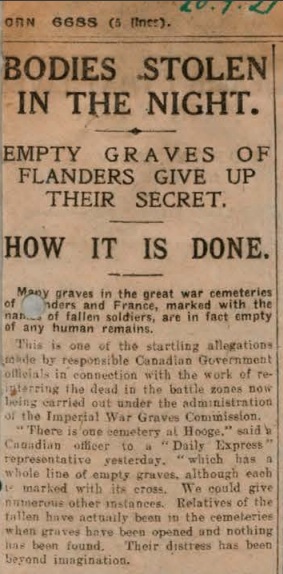
Bodies Stolen in the Night
During 1931, The Mirror ran a series of articles about clandestine operations in the cemeteries.

Contrary to what Captain Henry Howard Chanter MC writes, the body (Pvt G C Hopkins) in question stopped at the port of Antwerp by Major A L Ingpen, and now lies in Schoonselhof Cemetery, Antwerp.
Four years later, Captain H H Chanter MC “has devoted himself to the service of decorating the graves of British soldiers buried in France and Belgium.”
Letter to the Editor, 12 March 1925
Anna Durie wrote to the editor of The Mail and Empire on 20 February 1925. Her letter published on 12 March 1925.

On 26 February 1925, the subject raised in the House of Commons.

Encryption
The IWGC went to great lengths to prevent Anna Durie from intercepting their correspondence and began using a code in wires and telegrams. Perhaps purposely, no code given for Durie’s name.

Code
Undoubtedly this lady must have an agent in this country who is watching our movements. - Col H T Goodland to the Vice Chairman, 21 January 1925.
The IWGC began circulating a code in their internal corresponce.

SOLDIERS’ GRAVES, 27 May 1925
CARED FOR BY BRITISH OFFICER, Daily Mail, 27th May 1925.
For, nearly five years Captain H. H. Chanter, M.C., a wounded ex-officer of the Black Watch ( Royal Highlanders), has devoted himself to the service of decorating the graves of British soldiers buried in France and Belgium.
His headquarters are at La Panne Belgium, and with the assistance of his wife, who was a hospital sister, he, at the request of relatives, personally places wreaths on the graves of the fallen and sends home photographs of the graves as he leaves them.
Thousands of those at home who have not the means to go to France or Belgium. to pay this fond tribute to their fallen have written to Captain Chanter to thank him and to express their appreciation of his services.
A charge to cover the cost of the wreath and the labour involved made, and those who wish that some token should be placed on the graves of those who sleep in France should write to Captain Chanter at La Panne.
The British Association Ypres Salient
NOTICE.
Circulars are being sent out by two persons Mr. Bevis and Air. Seymour who call themselves 'The British Association Ypres Salient' and I consider it my duty to warn relatives regarding the activities of these men. Bogus Presidents have been given from time to time and the most fraudulent methods adopted and each time they are discovered fresh names are given' as references.
No doubt you have read in the papers about the desecration of these cemeteries and nothing is sacred to such people who pose as ex-service men who are unable to get employment in England: one article goes on to say so numerous have been the complaints, many of them heartrending in character, that the Imperial War Graves Commission has been compelled to take certain steps, which if the public will only co-operate, will go far to prevent the continuance of the scandal.
They have been refused permission by the Imperial War Graves Commission to take photographs in the cemeteries. One of the latest references, the Rev. A. Birkmire, "Toc H" has now had his name removed.
It is deplorable to think that such things can happen in such a noble work in which there is room for so many and it ought to be an honour to place these tributes.
H.H. Chanter
Captain.
Successful Case of Major Charles Sutcliffe
Though many instances of grave-robbing prevented through surveillance of cemeteries, or investigation afterwards, not all cases stopped. One lesser known example of a stolen body that of Major Charles Sutcliffe, killed behind enemy lines and buried in a private vault. His family’s request for repatriation denied.
Deception
However, in August 1925, his father, F.W. Sutcliffe, able to retrieve the body from the vault and bring it back to Canada. Though the French Préfet of the town allowed this, Sutcliffe had convinced the Préfet that the body actually that of an American from Minnesota in order to get permission. Since the United States did allow for repatriation, the French Préfet authorized the removal of Major Sutcliffe’s body to New York. However, after its arrival in New York, the body was shipped to Lindsay, Ontario.
The first place we went to was a mixed cemetery of British, French and American graves. The French graves are mostly kept up by local civilians and relatives, but the Americans are left alone pending exhumation and transportation to the USA. - IWGC Gardener, G W Robinson.
Successful Case of Captain Durie, July 1925
The Anna Durie case similar to the Sutcliffe case in that they both involved parents who requested repatriation of their sons’ bodies and in each case the bodies eventually buried in Canada. However, unlike the rather straightforward Sutcliffe case, the example of Anna Durie far more complicated. In the early hours of a July night in 1925, Anna Durie proceeded to British Loos Cemetery with two helpers and her daughter and removed Captain William Arthur Durie from his final resting place.

The case a result of a mixture of upper-class privilege, the military’s failure to enforce burial policy during the war, and the IWGC’s failure to enforce their own policies after the war. First, Anna Durie repeatedly defied military doctrine when it came to her son. For example, when Captain Durie injured in May 1916, Anna Durie proceeded to the front of France, a serious violation of military rules during the war.

While there, Mrs. Durie supplied her son with fresh fruit, strawberries, and flowers as he healed from a gunshot wound through his lung. Though Durie survived being wounded in 1916, he was killed in action on 29 December 1917 at Lens. His body was buried in Corkscrew Cemetery near Lens in France.

Colonel Goodland taken by surprise by the amount of knowledge she had regarding IWGC workings. On 21 January 1925, he wrote that:
[u]ndoubtedly this lady must have an agent in this country who is watching our movements. Who this can be I cannot imagine. No publicity whatever has been given to the projected removal of Corkscrew Cemetery, which fact must, of course, be known to more or less of the personnel of our Registration Department, and of course, it is quite possible that Mrs. Durie’s agent is in close touch with one of our people from this Department, but I have no means of confirming this. In response, the Commission reminded Mrs. Durie that it had no control over Corkscrew Cemetery’s re-location.
Note: The ‘agent’ of course, none other than Captain H H Chanter MC.
Loos British Cemetery
Upon learning of the finalised removal of her son’s body from Corkscrew to Loos, Anna Durie re-launched a quasi-public relations campaign against the Commission. A newspaper article appeared in the Evening Telegram in Toronto noting the IWGC violation of their pledge to leave cemeteries as they were.

The reference to Plot ?, Row E, Grave 21 at St. Pierre Cemetery appears to be deliberate subterfuge on the part of the IWGC to prevent Mrs Durie the ability to locate his grave.
Furthermore, the article noted Canadian officials’ objections to such moves. Indeed, some politicians did object to the removal of Corkscrew Cemetery. T.L. Church, MP for Toronto, noted the violation of the agreement to leave cemeteries with a certain number of bodies where they were.
- However, the response he received from the Honourable Mr. Macdonald in the House was that the Government of Canada was not aware of any such agreement.
- He also noted that it was generally understood that cemeteries with fewer than forty bodies needed to be consolidated.
February 1925 – Letter to Sir Fabian Ware
Despite the slight uproar caused by Durie, the bodies from Corkscrew Cemetery removed on 20 February 1925 and transported to British Loos Cemetery. Upon receiving notice of the move, Anna Durie wrote to Sir Fabian Ware in a tizzy, referring to the IWGC as “the most tyrannical and autocratic body of men that has existed since England lost the North American Colonies.” Within two weeks, Anna Durie was on her way back to France.

Sometime between Anna Durie’s landing in France and 26 July 1925, she met again with Captain Chanter, who arranged for the body of Captain Durie to be exhumed from British Loos Cemetery and transported back to Canada. However, according to Durie, he tightened his rules in order to avoid detection, insisting that they could not use a coffin when transporting the body, as the coffin the reason the 1921 attempt had failed.
July 1925 – Desecration
In the early hours of the morning on 26 July 1925, Anna Durie, with the aid of two men, exhumed the body of Captain Arthur Durie. Durie’s journal described the ordeal in great detail. As the two men she hired to steal the body commenced their work, she was overcome by her decision to desecrate her son’s grave. She noted begging the men to stop; that Captain Durie’s body was not being treated with dignity. Pieces of Captain Durie scooped out of the coffin and into a valise to be transported back to Canada (Lt J R Pitman will find small pieces of bone and some clothing when the grave opened later in September).

The IWGC discouraged photography of cemeteries and memorials under construction.
Anna Durie’s reaction to the desecration of Captain Arthur Durie’s grave reminiscent of her stated reasons for returning Captain Durie’s body to Canada. Anna Durie sought a Christian final resting place for her son. However, in order to provide that final resting place, she was forced to desecrate her own son’s grave. Her actions demonstrate the extreme measures that people would use to secure a final resting place for their loved one’s body.
Commission staff did not immediately realize that Captain Durie’s body had been stolen. Initially, the British Loos Cemetery gardener noticed that the grave had been disturbed. As a result, a test with an iron rod occurred on 28 July 1925. However, it determined that the coffin still in the grave. Not until Commission officials requested that the grave be opened to be inspected that they learned the body had been removed. By this time, Anna Durie already on her way back to Canada.
Registration Officer Lt J R Pitman
This grave was opened at 14.45 on 4.9.25. On being exposed the coffin was found to have been forced open. The timbers had been broken and displaced, and the zinc shell had been cut upwards from the foot. The coffin was empty with the exception of a few small pieces of bone and some portion's of the Officer's clothing. - Registration Officer Lt J R Pitman, Nos. 2 & 3 Areas.
September 1926 – Case dropped
Initially, the French authorities wanted to prosecute Anna Durie’s agents and to take Anna Durie into custody for questioning. However, proceedings delayed since France had to deal first with Britain and then with Canada to move forward with any case against Mrs. Durie. Ultimately, by September 1926, the IWGC officials of the firm opinion to drop the matter altogether, a sentiment shared by Canadian officials.
Grave Robbing
Examples such as the Durie case rare and extreme. However, they demonstrate multiple issues that the IWGC needed to contend with. There was not only the public’s need for a Christian burial for their loved ones, but also the legitimate fear of later desecration by unknown parties, both of which were exemplified by the Durie case. Though the Commission aimed to provide the best security possible for graves, its own officials recognized the chance of grave robbing and body ransoming, which had been as recently as forty years prior to the Great War.
Reburial of Captain Durie

Mail and Empire, and the Daily Star published the funeral of Captain Durie at St James Cemetery on 22 August 1925.

For three days Arthur’s body had laid “in state”, in the front room of the St George Street house, before being buried on 22 August 1925, in the family plot in St.James’ Cemetery.


Exploitation
Capt.Chanter and War Graves Wreath Coy.
I am able to give you information of such a nature that I trust will enable some action to be taken to stop the exploiting of relatives by the above-mentioned.
These people have recently placed no less than 75 wreaths in Etaples M.C. On Thursday last I met two women who were visiting the Cemetery. They both came from Leeds. One of them, (Mrs.Carter, 4,Southfield Place, Armley, Leeds) complained about a wreath and photograph for which she paid 21/-. She stated that the latter was so bad that she protested to the above-mentioned Company and they have written and promised to take another for her.

Mrs.Carter told me that she was asked to pay 35/- at first, but, as she is a widow and has to work very hard for her living, she said she could not possibly pay so much - but as previously stated, she paid 21/-.
Another case brought to my notice was that a relative ordered a wreath from each of these firms. The representatives arrived within two days of each other, and the last one took the wreath of the first one off the grave to take the photograph. Mrs. Carter was one of a party of about 12 relatives who were visiting graves in this Cemetery and they were all greatly incensed at what, they termed " being swindled".
Scandal
One thing is certain, these firms will not do any more business with relatives in the Leeds District, but it is those poor relatives who cannot come out, who will continue to be exploited unless some action is taken to prevent this scandal.

- Chief Horticultural Officer, Imperial War Graves Commission, 8 June 1925

On the same day Col H T Goodland wrote a long letter to LtCol Sir H Ellissen CBE, Controller & Financial Advisor to the IWGC.
The man is really a proper scamp.

On all sides I hear extraordinary tales of his dealings, and he is no better than a fugitive from Justice. As a matter of fact, he was before the Criminal Courts of Arras last year on the instigation of a Car Proprietor on a charge oil obtaining credit, etc. on false pretences, and it would be a relief if the man could be hounded out of the country.
1926
During Easter of 1926, Captain Chanter supervised the placing of over 10,000 wreaths, all blessed by Reverend W R D Mills, in Belgium.
Evening News 31 March 1926
The Evening News published a most flattering article on Captain Chanter, 31 Match 1926.


Chanter’s chief assistant was his wife.

Mystery Case of ‘Lieutenant Guthrie’
Statement by Exhumation Officer in charge of exhumations and re-internments in [] sector:
In 1926 the remains of a 'Lieutenant Guthrie', of the Canadian Mounted Rifles, exhumed from a German cemetery and taken to Corkscrew Cemetery at Loos for re-interment at the request of the relatives. The interment party included Madden, a gardener named P. Dempsey, a second named C. Entobed and others. The body placed in a new coffin and properly buried in the cemetery mentioned. Next day suspected that an attempt had been made to exhume the body and a special watch kept during the two following nights and days. This guard withdrawn on the third day.
Next morning the grave found to have been disturbed and instructions given for the grave to be opened to ascertain if the body still in the coffin. This done by a party consisting of the three men mentioned and others whose names could not be remembered.
Higher officials of the Imperial War Graves Commission present when the grave opened and the lid taken from the coffin. It was then found that the body had disappeared. The relatives of Lieutenant Guthrie, who had been in the district during the preceding four days, were searched for but were found to have left by motor car during the night and could not be traced. It was later reported that the body had been smuggled out of the country and taken to Winnipeg but we had no confirmation of this report.
Who was Lt Guthrie?
CWGC War Dead has no entry for a ‘Lieutenant’ Guthrie, nor any ‘Guthrie’ of the 1st CMR. Pvt Thomas Wilson Guthrie 2130486 the only Canadian soldier buried in Canada (RESTON CEMETERY), not so surprisingly in Manitoba. However, he died 4 October 1918 from Influenza in a Quebec city hospital.
If Guthrie’s body had been lost in France, then only one Guthrie qualifies, that of Pvt John Stewart Guthrie 437507, 7th Battalion, killed-in-action 26 September 1916. Indeed, his body lost, but he had been buried near Zollern Redoubt (57d.R.28.d.30.95) on the Somme. No indication he had been found and moved to Corkscrew Cemetery.
If his body had been lost in Belgium, then only one Guthrie qualifies, that of Pvt James Guthrie 426661, 28th Battalion, killed-in-action 6 June 1916. However, James never had any record of burial.
This leaves only a few other cases, which can be dismissed.
- Pvt Alexander Guthrie 757540, 3rd Battalion, killed-in-action 10 July 1917 and most certainly buried at LA TARGETTE BRITISH CEMETERY, NEUVILLE-ST. VAAST.
- Garvin Thompson Guthrie, 52nd Battalion most certainly buried at VIS-EN-ARTOIS BRITISH CEMETERY, HAUCOURT.
- And finally, Pvt Garvin Thompson Guthrie, AIX-NOULETTE COMMUNAL CEMETERY EXTENSION. His parents deceased as of 1922.
Loos British Cemetery
‘Lt Guthrie’ would have been concentrated to Loos British Cemetery from Corkscrew Cemetery.
- Three men of a Canadian Mounted Rifles Battalion are all Privates.
- None of the five Lieutenant’s from a CMR Battalion.
The identify of Lieutenant Guthrie remains a mystery.
Known Cases of Repatriation in 1926
An untitled IWGC document provides details of six cases known to the IWGC in 1926. No entry for a Lt Guthrie.
- BURGESS, James (successful)
- BARON, Gunner F F (unsuccesful)
- HOPKINS, Pte G C (unsuccessful)
- McLEOD, Adam, Major N (successful)
- SUTCLIFFE, Major Charles (successful)
- DURIE, Capt. W A (successful)
The cases of Hopkins, Sutcliffe and Durie already detailed.
James Burgess (successful)
Died 15. 2. 1919 in the British Hertford Hospital, Paris. Buried 21. 2. 1919 in LEVALLOIS PERRET Cemetery, Paris.

Body exhumed May 22nd 1919 and removed to England. Authority for the exhumation was granted by the Prefecture of Police ( service des
exhumations) on April 4th 1919, at the request of Mrs. Burgess.

Reburied Englefield Green. (This case resulted in re-issue of official circulars to local authorities not to permit exhumation of soldiers fallen in the War).
Gunner Frank Foster Baron (unsuccessful)
Died 16. 9. 18. Buried in WESTOUTRE Military Cemetery, Belgium. The brother of deceased, Herbert Baron of Hull, obtained from the British Consul at Antwerp a letter with information as to the normal procedure for removing a body to England, and with this, and the aid of civilian labour, exhumed the body and sealed it in a lead coffin. Mr. Baron represented to the Consul that he already had the necessary permit for removal.
Facts were - on 14.6.20, Mr.Baron went with a motor hearse from Antwerp, and civil labour, exhumed and placed body in coffin. Belgian gendarmes who happened to be passing prevented removal from Cemetery, and coffin replaced in grave.
This case resulted in proceedings by the Ministere de la Defense Nationale, against Baron and his civilian assistants. The defendants were convicted and Baron fined 26 francs and one-third of costs (penalty suspended under the First Offenders' Act). We advised Foreign Office not to protest against this conviction.
Major Adam Mcleod (successful)
Died 28. 8. 18. Buried in an isolated grave near FONTAINE-LES-CROISILLES (near Arras) France.

Report dated 24.8.1922 by the "Chef de Brigade", Gendarmerie, Pas- de-Calais, shows that the removal of the body was accomplished by Major-General Adam with the help of the Maire of Fontaine-les-Croisilles, who was ignorant of the regulations forbidding this. This took place 20.6.22.

The body was successfully brought to Glasgow and reburied in July 1922 in Glasgow Necropolis. (We took this up with the Scottish Board of Health, and the Board of Customs).
Lt Daniel Galer Hagarty
CEFRG suspects ‘Lt Guthrie’ may be Lt Daniel Galer Haggarty, PPCLI, killed-in-action 2 June 1916. SON OF LT. COL. E. W. HAGARTY AND MRS. CHARLOTTE E. HAGARTY, OF 662, EUCLID AVENUE, TORONTO, ONTARIO. ENLISTED FROM UNIVERSITY OF TORONTO, JUNE1915.
Colonel Haggarty mentioned as one of only three Canadians objecting to Canadian policy (Mrs Durie, and Mr Hopkins). Note that Mr Hopkins was a good friend of Prime Minister Meighen.
Lt Haggarty’s body interred by shellfire at 28.J.13.c.3.0. The location well forward in the German lines, may certainly qualify as having been buried in a German cemetery. Burial Report at Sanctuary Wood, concurs with the forward location. Burial Report (exhumed) and placed in Hooge Crater Cemetery, 28 May 1919, where he remains today. Recall ‘Lt Guthrie’ exhumed in 1926.
Bedford House Cemetery
Mr Hopkin’s had forwarded a clipping from a western newspaper referring to the body of a 1st CMR has been reverently buried in Bedford House Cemetery, England. This of course conveys the erroneous impression as Bedford House Cemetery is not in England but in Belgium.

This would explain the confusion over a ‘Lieutenant Guthrie’, 1st CMR having been repatriated. Again, there is no ‘Guthrie’ nor Lieutenant among the 12 Canadians buried at BEDFORD HOUSE CEMETERY.
1927
More Shilly-shallying
A. S. Runacres wrote and complained about Captain Henry Howard Chanter MC to the IWGC on 16 October 1927.
I am a joiner by trade, and have for the last few years looked forward to paying a visit to my son's grave (killed March 24, 1916), in the Town Cemetery Bethune, Grave 83, Plot 5, Row B. This I managed in the week end August Bank Holiday. I was very gratified at the excellent manner in which the graves are kept by the Imperial War Graves Commission's employees ( 3 Scotchmen in this case) and the cordial and helpful reception I had from the charge hand, Mr. Sterling, Rue Verguigneue, Bethune, P. de C. France.

During our conversation I mentioned the matter of sending 15/6 to Capt. Chanter for a wreath photo, and was surprised at the warning against doing so in the future, as I believed that the Company was connected with the Commission.

That the wreath is certainly placed upon the grave and a photo taken and sent to the relative but this wreath is immediately taken off and used on other graves, being replaced later by a paper one consisting of two leaves and 3 poppies, worth 6d.

He assured me that the authorities knew about the deception but were powerless to stop it, and he advised me in future to send any cash to the I.W.G.C. 82, Baker Street, W. where I should get value in wreath.
1928
Early in 1928, Mrs Durie, knowing very-well her son’s headstone remained in LOOS BRITISH CEMETERY, asked for the following inscription to be engraved.
“He took the only way and followed it unto the glorious end.”
Flabbergasted, the IWGC responded by writing to the French authorities to dissuade them from litigation regarding the Durie issue, and removed the headstone at Loos.
March 1928 – Loos
After March 1928, the case disappeared from IWGC records. Other than a formal request to strike Captain Durie’s name off the British Loos Cemetery registry, officials made no mention of the incident.
Anna Durie’s and her son’s story ends here in 1928, but Captain Chanter will remain a thorn in the side to the IWGC for another 12 years.
1929
Wreath Policy
During 1929, Chanter entered into a dispute with the British Legion and the IWGC. He felt slighted they were laying wreaths with a card noting they were placed by the British Legion.
Chanter’s Letter to Lord Stopford, 11 May 1929
My wreath and photograph defy competition, and the way the whole work is carried out is something to be justly proud of, and I am at a loss to understand the remark that my application is receiving " consideration." How long is my work to be held up pending- this authority so that I may informs relatives of the delay in attending to their requests? I have a duty to perform for relatives, and I think you will appreciate my position.
18.5.29. I have kept this letter back thinking I would receive the sanction by now.
Yours sincerely,
(Sgd.) H.H.Chanter.
P. S.
Capt. R. P. Wilcox promised to give me the photographic work and without a word " arrangements" are made with the I.W.G.C. after finding out all my prices and the way in which the photographs are presented to the relatives.
IWGC Reponses
From past experience, I think you will agree that the less we enter into correspondence with Captain Chanter the better, as it is certain to lead to voluminous responses.
Furthermore, I feel we must move with circumspection, for if Captain Chanter is placed on the List, we are placing a weapon in his hands which he will at once turn upon his competitors when hitherto he has failed to clear off the field by his Printed circulars of a depreciating mature.
– Chief Administrative Officer, 28 May 1929, St Omer
Persona non grata
The Principal Assistant Secretary wrote to the Vice-Chairman, Sir Fabian Ware on 11 June 1929.
I have had a somewhat violent letter from Chanter on the question of wreaths on central memorials and he has, written to the British Legion.
– Principal Assistant Secretary, 11 June 1929,.
I am not at present replying to Captain Chanter.
– Principal Assistant Secretary, 13 July 1929.
Captain Chanter concluded by saying he would very much like an interview with the Vice-Chairman, to which I did not reply.
– Director of Works, 13 September 1929.
Sir Fabian Ware asked the Assistant Secretary to inform Captain Chanter on 16 November 1928:
Dear Chanter,

Sir Fabian Ware has asked me to send you a line with regard to the wreaths, including yours, which are laid at the Menin Gate Memorial. He has had many complain from the public that the names of the firms supplying the wreaths are so prominently displayed. He does not rant to take any official action with regard to it, so asks me if I would send you a word as I think your wreaths are far more in number than anyone else's.

I am not sure exactly what you have on the cards, but evidently there is something which people do not like, so I think it would be a good thing if you could see your gray to make some change. I should like to hear from you about this.
1930

In conclusion I will not allow the slightest shadow of suspicion to be attached to my work I have been wounded six times, and have had the Honour of fighting with these men and now I have the Honour of placing tributes for thousands of grateful relatives. My work is hall marked and my success with flowers, which are used on the graves, is worthy of reference. - Chanter to Mr John English, OBE, 24 November 1930
The following prizes awarded to Captain Chanter for flowers from his garden at the Antwerp and Bruxelles Exhibition for the year 1930:
- Gold Medal given for the highest award by the Ministre de Agriculture Bruxelles.
- 1st Prize Silver Cup given by the Society Royale d’Horticulture et Agriculture de Bruxelles,
- 1st Prize Silver Cup given by the La Vie Rurale de Namur
- Gold Medal Bruxelles.
- Gold Medal Antwerp,
Captain Henry Howard Chanter MC never won any awards for photography.

Photography
He (Chanter) encloses photographs of the panels. This at once raises the whole merits and demerits of Capt Chanter’s work as a photographer. I am merely an amateur photographer, but I have taken photographs for a good many years, and may be allowed to know a little about the subject. If Capt. Chanter would take a few elementary lessons in photography, I am sure he could benefit greatly.
The remark in the relative’s letter would seem as a criticism of Captain Chanter’s photography, but not unfair.
I have already touched lightly on the work of the photographer himself, which it is unnecessary to ” rub in”.
– Robinson, Director of Works, 14 October 1930.

From CAPT. H.H. CHANTER M.C.
THE WAR GRAVES WREATH COY
LA PANNE, BELGIUM
Photograph by Captain Henry Howard Chanter MC
Legibility of Captain Chanter’s Photographic Work
The LEGAL BRANCH of the IWGC wrote to the Director of Works on 13 October 1930.
Would you kindly see and return the attached letter from Captain Chanter, enclosing three photographs of panels of the Vis-en-Artois Memorial.

This letter arose out of a complaint from a relative, Mr. Frank B. Shemming, to the effect that having placed an order with Captain Chanter in March 1929, he had not received notification that the wreath had been placed or any photograph up to the time of writing (19th September 1930). Captain Chanter was asked whether the order had been carried out and what was the explanation of the non-receipt of the photograph, and his present letter is the reply.

As this concerns the much debated question of legibility, I thought you might perhaps like to see the photographs in case they may be of any interest to you and in case you may have any observations to make, more particularly with regard to the question which Captain Chanter asks in his third paragraph.

Competition
Chanter proudly boasted his photographic work superior to that of his competition. Yet, during his many years with The War Graves Wreath Company, he failed to improve, and never recognized his skills as a photographer left much to be desired.

“With all due respect to Capt. Chandler, I would like to say that 2 or 3 of his photographs may be fairly described as thoroughly bad photographic work.” – IWGC Director of Works, 14 October 1930.

“Should you desire, we could in addition, providing the Panel is sufficiently accessible for the purpose, obtain a photograph showing the name of your relative.
The charge for this would be 2/6d .”
As the Director of Works at IWGC had known, photographing with the sun at an acute, rather than oblique angle, prevented washed-out images. Washed-out photos, characterized by low contrast, muted colors, and excessive brightness (overexposure). Without employing artificial methods, images of CWGC headstones are spectacular in full sunlight, and at an angle of 5-10 degrees.

British Legion
The Director of Records received a letter-of-complaint from Captain H H Chanter, and another request to have an interview with Sir Fabian Ware.
Captain Chanter said he understood the Commission issued authorities with the stipulation that those authorized were not to use the name of the Commission in any way. I said I thought this was the case , and he immediately produced a photograph of one of the pages of a circular issued by the British Legion. This photograph is attached Hereto and from which you will see that they state "By arrangement with the Imperial War Graves Commission, etc.,etc.,".

I repeated that I was not in a position to discuss the matter, but as he intimated he is taking the matter up with several eminent people, I think it is correct for me to lay the facts before you.

Captain Chanter said he does not want to be anything but friendly, but considers the British Legion will ruin the businesses of other firms, besides his own, and therefore he will have to take the only course open to him, i.e., to fight the matter, more especially as he cannot see that, the Legion, or anybody else, can possibly carry out their obligations on the terms stated in their circulars and letters.

Captain Chanter concluded by saying he would very much like an interview with the Vice-Chairman, to which I did not reply.
Complaints
Complaints having been received regarding the price and quality of wreaths laid in the British War Cemeteries in France and Belgium by some firms and organisations who solicit orders for this work, the Imperial War Graves Commission have decided, in the interests of relatives and others concerned, to issue permits to lay wreaths in the cemeteries to firms, organisations and individuals accepting certain conditions, and the attached list gives the names of those who have been so authorised by written permit to carry out this work.

List of Firms to whom Wreath Permits have been issued.


Placing of Wreaths
The IWGC posted a note in the Register Box of cemeteries asking relatives to place wreaths on the Stone of Remembrance, rather than on individual graves, in order to help the gardeners maintain the cemeteries. The gardeners advised the accordingly:
(1)The wishes of the Commission are not to be taken as an hard and fast Regulation.

(2) You must on no account attempt to enforce this request.

(3) You will unobtrusively look out for any Relative who proposes to lay a wreath, and then tactfully call his or her attention to the request pasted up in the Register Box, should a relative insist on placing a wreath on a Grave you must accept their decision without adverse comment.

(4) You will also bring this request to the notice of the representatives of the Wreath-laying Firms in exactly the same manner as you would to a single relative, should the representative refuse to comply, you will not make any comment to him, but you must at once report the fact to me and, if possible, give the name of the Firm in Question.
Chanter asked that his wreaths be allowed to remain for ten days, to which he did not receive an affirmative reply.
Education of Public Opinion
The Vice Chairman is particularly anxious that no hard and fast regulations should be laid down; he would infinitely prefer to bring about the desired result by a process of education of Public opinion. - PRINCIPAL ASSISTANT SECRETARY
Chanter’s thinking very much along the lines of the Vice-Chairman.
If this procedure is insisted on then I think you will find that the Public will ask for the cemeteries to be put under Civil control and put an end to this militarism. The very idea of a command in a Cemetery is wrong to my thinking. - H. H. Chanter
1931
On the 14th February a registered letter from Captain H.H. Chanter ( The War Graves Wreath Company) received. The envelope addressed to the Vice-President of the Imperial War Graves Commission, and the enclosure, a printed letter of two pages, addressed to Sir Fabian Ware.
This letter of a scurrilous and abusive nature; its venom being directed partly against the Vice- Chairman personally, partly against the policy of the Commission and partly against the technical efficiency of the staff; gross extravagance being the chief accusation.
His dealings with the Commission have been far from amicable, but he still remains on their list of permit holders as he has never been proved negligent or dishonest in his dealings with relatives.

He is apparently a man of violent temper and has been conducting for some time past an internecine war with certain of his competitors in the photographic and wreath laying business.
Chanter’s Quest
From a study of many letters which he has written to the Commission it is clear that he is anxious to remove his competitors from his path by fair means or foul, and nurses a grievance against the Commission for their refusal to help him to this end.
From a letter written to Captain H P R Foster, IWGC, London, 19 February 1931 regarding a letter received from Chanter on 5 February.
As Sir Fabian is abroad and not likely to return for some time and can do nothing until he returns, I do not think I should send the letter to him. It is certainly scurrilous, but I am not prepared to say it amounts to a libel, and in any case it is a personal matter for Sir Fabian, upon which no doubt he will have his own views and will not wish to be committed to any course now.

The attack on the Commission is of course foolish and ill-informed and can easily be met.
On 13 March 1931, the Vice-Chairman wrote, once again, about ignoring Captain Henry Howard Chanter MC.
A few weeks ago we had an impudent letter from Chanter containing wild statements on the lines of a letter you saw before you left. He states we are allowing a scandalous haste of money in headstones ” toppling” over – violent criticism of Hurst’s book and similar nonsense. I talked it over with Ping and felt strongly we should either ignore it or send a bare acknowledgement. Foster wanted to consult Phillips to which I agreed and a dram reply was made by Phillips but I did not agree with it. I therefore consulted air George and he said emphatically that we should ignore the letter and not even acknowledge it.
This I have done, and as we have had one or two perfectly reasonable letters from Chanter since on routine matters we have replied normally to these and I expect we sell hear nothing more.
You will remember that John English in the Mirror criticised these concerns that lay wreaths and afterwards said he was satisfied with Chanter’s work – thereby giving him a useful advertisement which, I think, is ghat he is trying to force us to do. – CWGC/1/1/3/16 (ADD 1/13/2)
Sunday Express Article, 3 May 1931


In response to an article in the Sunday Express suggesting clandestine operations of exhumations at the port of Zeebrugge, a man identified by authorities as Jean- Baptiste Roeyckens of Tervueren.
Monsieur le Procureur General.
La police judiciaire a pris egalement des renseignements au port de Zeebrugge au sujet du transport eventual des cadavres exhumes.
La personne suspecteé de s'occuper du transport clandestin des cadavres exhumés, est un nomme Roeyckens, Jean- Baptiste, géomètre, né à Tervueren, le 11 decembre 1890, époux de Véronique Gantois. J.B. repond au signelement donne, il a été recense a Poperinghe en 1920, a servie comme interprète dans l'armée anglaise, et a rempli pendant quelques temps les fonctions de commissaire de l'etat aux dommages de guerre.
Director of Public Prosecution
From a document summarizing actions taken regarding the exhumation of bodies from France and Belgium, 8 June 1931.
Meanwhile, on this side, the Commission's representatives on May 14th saw the Director of Public Prosecutions. He was of opinion that there were no grounds for proceedings against the newspaper for criminal libel.

On May 18th the Commission's representatives called on Mr. Norman Kendal, Assistant Commissioner, Scotland Yard, to ascertain his views as to the possibility of instituting a Police investigation.

He did not consider that the material was definite enough for that purpose.

The report indicates that the Police have not been able to trace the organization which was supposed to be carrying out these exhumations in Belgium.
Passport
On 9 May 1931, internal correspondence reveals a quest to deny Captain Chanter his passport.
Spoke to Mr. Martin, Chief Passport Officer, over the telephone this morning. I told him that Chanter had been writing libellous letters and that we wanted to get at him. Was there any likelihood of his passport being docked?

He mentioned that very strong grounds were necessary to justify refusing a passport.
‘Final’ Letter to Chanter from the IWGC
E. J. King wrote for the Secretary to Captain Henry Howard Chanter MC on 13 May 1931.
Your recent letters have now been placed before the. Vice-Chairman, who has just returned to the Office from absence owing to illness subsequent to his return from India and the East.

I am to say that the statements in your letters are so so reckless  and scurrilous that the Commission are not prepared to acknowledge any further from communication from you; any such will, therefore, be returned to you unopened and unread.
Waste Paper Basket
Note the Vice-Chairman had not been so final, on 23 March 1931. His own view is that every courteous letter from Captain Chanter should receive a courteous reply. But, that abusive or contentious letters should be consigned to the waste paper basket.
Belgian Police
On 9 June 1931, the Chief Legal Advisor informs Sir Fabian Ware it would not be possible to charge Captain Chanter in a British court, as there would be no means of enforcing it. But, perhaps a Belgian court could be considered.
Sir Fabian Ware contributed a SECRET document on 11 June 1931 in response, mentioning he already had personally contacted the Belgian Police.
Similar letters are being written by this ex-Canadian Officer (who is said to have been making a very satisfactory living for the last ten years by writing to relatives and getting them to agree to his laying wreaths on graves etc. for them) to several people including the Chancellor of the Exchequer who decided "not to reply" to the "scurrilous letters".

Captain Chanter does not get a good report from the Belgian Police from whom we have made confidential enquiries. I have taken legal advice as to how to deal with his letters which are absurdly inaccurate and personally abusive and consequently have been advised merely return them unopened.

Any genuine information he requires he can obtain from our staff in France. Its a difficult case to deal with - many such must come to you.

I think he must be more or less of a lunatic and meanwhile I have asked the Belgian authorities more about him. I advise the wastepaper basket.
TELEGRAM FROM CHANTER, 29 MAY 1931
MY STATEMENTS ABSOLUTELY TRUE AND YOU
KNOW IT STOP. YOUR WORK HALLMARKED BLUFF
STOP. CHALLENGE YOU AT ANY ENQUIRY STOP.
REPORTING AUTHORITIES STOP. – CAPTAIN CHANTER

Permit
Why does the IWGC continue to renew Captain Chanter’s permit? From a letter of 4 June 1931:
I Spoke to Mr. Lloyd of the Treasury Solicitor's Department on the telephone this morning. I asked him whether the withdrawal of Chanter's permit would be calculated to prejudice the Commission in any way supposing some action on the Commission's part became necessary later.

Mr. Lloyd was definitely of opinion that it would be unwise to withdraw the permit, because this would not accomplish the Commission's object of silencing Chanter, but merely irritate him into renewed activity.
House of Commons, 23 June 1931
- Captain P. T MacDonald asked the Secretary of State for War if he is now able to state the result of his inquiries regarding the violation of war graves in France and Belgium?
- Mr. Isaacs asked the Secretary of State for War if he has now completed his inquiry into the question of the violation of British war graves; and, if so, can he give the House any information on the subject?
- Mr. Mills asked the Secretary of State for War if he has now completed his investigations into the question of the violation of war graves on the Continent and the exhuming of bodies of British soldiers and taking them to England for re-burial?
Response from Mr Shaw, the Secretary of State for War
As a result of the special inquiry which has been and is still being carried out, no support has been discovered for the allegations that were made. Those allegations would involve the disinterment of bodies at night-time, the opening and restoring of carefully turfed graves, and the embarkation and smuggling of the bodies from the Belgian coast into this country.

Frankly, it seems incredible that a carefully tended grave could be opened up and restored again under cover of darkness so skilfully as to avoid detection. The investigation shows that it is almost inconceivable that the alleged proceedings could escape notice at any stage.

I think it safe to say that the story may be dismissed and its publication is all the more discreditable in view of the pain that it could not fail to revive in so many thousands of cases.
The House of Commons dismisses the allegations, finding them incredible. The Secretary not prepared in making the sensationalism any more public, and no official response, other than the response given in the House of Commons.
Interrogation of Captain Henry Howard Chanter MC
On 5 June 1931, Le Procureur du Roi, Claeys, writes to Monsieur le Procureur General, detailing his interrogation of Chanter.
- Chanter complained that Bevis & Seymour were providing the same service as he to the IWGC without authorization. He said they were found guilty of misdealing’s at Bard Cottage Cemetery during 1928-1929. Chanter also added they had removed his flowers at Paris-Plage in 1928.
- Capt. Chanter also said that in 1922 and 1923 the parents of an English soldier had offered him $1,000 to exhume their son’s remains, to which he refused. Three or four weeks after the second refusal, Chanter said the grave tampered with. Captain Chanter added the gardener at Paris-Plage aware of these events, and at other cemeteries. When asked, Chanter said he could no longer recall their names.
- Chanter showed the prosecutor a copy of a letter from 10 May 1928 stating his involvement with the English press publications done without his involvement.
The prosecutor concluded nothing to note regarding Chanter’s character, and would not open an investigation, as the events had not occurred in his district.
Il n'y a rien a remarquer en ce qui concerne la moralité de Chanter susdit. Je n'ai pas ouvert d'information relative aux faits denoncés par Chanter, ces faits ne s'étant pas passés dans mon arrondissement.
Le Procureur du Roi,
signé : CLAEYS.
Report Disappears
Dear Ingpen,

The second report of the Ministry of Justice has mysteriously disappeared. It has no doubt been put away carefully, but where, no one seems to know.

This is the supplementary report, you remember, dealing with the interrogation of Chanter.

IWGC, London, 17 August 1931
Notes on Statements Supplied by the Sunday Express
The IWGC files on Captain Durie and Private Hopkins specifically mentioned.
Statement by Exhumation Officer
This statement evidently meant to refer to the case of Captain W. A. P. Durie , the facts regarding which are all on the file CCM/19578. Reference made in this to three men. Madden is at present employed in a temporary capacity by the Commission as Registration Clerk and at one time a Field Assistant. Entobed is probably C. Gotobed ,a gardener (temporary) whose appointment terminated in April 1931.
Statement by Mrs Murphy
The question of the removal of a German body does not concern the Commission in any way, as they are not responsible for the care of German graves.
Statement by IWGC Gardener
File WG. 35097 shows that a Belgian body exhumed from this cemetery by the Belgian Service in 1924.
Statement by Captain Chanter
The case of Hopkins dealt with on file CCM/16470 and this case, also is a well-known one.
There is no entry in the Tyne Cot Cemetery Register regarding Private Hopkins.
Captain Chanter at no time employed by the I.W.G.C., but serving with the Canadian Graves Detachment, taken over by D.G.R.&E.
1932
WREATH AND PHOTOGRAPHIC PERMITS
CAPTAIN H H CHANTER
I have been in communication with Captain Chanter on the subject of his permit, and I enclose herewith his application for his existing permit to be renewed.

Chief Administrative Officer
Imperial War Graves Commission
Central Europoean District
2 March 1932
1933
On 7 July 1933, LtCol F Higginson, IWGC, Arras received a letter concerning a complaint about Chanter from a Mrs Marsh.
Before we take any action in this matter, the Vice-Chairman wishes me to consult you, as, on the one; hand, we are reluctant to stir up a hornet's nest, while, on the other, we have, in a case like this, a very obvious duty to a relative.
Another complaint on 23 July 1937, concerned advance payments requested by Chanter.
The Rev. Mr. G.P. McWilliam, Manse of Beath, Cowdenbeath, Fife, has shown me a; letter which his mother ( an aged lady) has received from a Captain C.H. Chanter, 'War Graves Wreath Co., La Panne, Belgium. The writer of the letter suggests that Mrs. McWilliam should send in advance payments sufficient to cover the cost of providing and laying three wreaths during the course of the next twelve months.
Apparently Mrs.McWilliam, unknown to her son, has been having wreaths laid on her son's grave near Arras for some time through the medium of this Capt Chanter. In the letter which Mrs.McWilliam has just received, Capt. Chanter indicates that his war wound has been troubling him and that explains why he wishes to have payments in advance.
Mrs.McWilliam, while not wishing to make any fuss over the matter, is anxious to know if this Capt. Chanter is known to you and if he is a reliable person.
1937
The IWGC wrote to Mrs D Makepeace on 20 July 1937.
Madam,
I am directed to return the letter from Captain Chanter enclosed with your letter received on the 20th instant, and to say that the Commission have no observations to offer. The War Graves Wreath Company is a private and unofficial agency not connected with the Commission.
1936
In 1936—the year a belligerent German leader marched German troops back into the Rhineland—Ware attended a conference at Cologne, Germany about the German War Graves Commission (Volksbund Deutsche Kriegsgräberfürsorge).

Ware delivered a speech suggesting that war cemeteries could promote “a blessed healing of wounds” but included a timely warning to his audience about the risk of another war.

1938
On 3 March 1918 the Secretary write to Mrs M C Watson of Co. Armaugh, Ireland.
Dear Madam,
In reply to your letter which was received on the 1st March, to the best of the Commission's belief Captain H. H. Chanter is still connected with the 'War Graves Wreath Company...and you will observe that Captain Chanter is included in this list.
1940
The Second World War forced Captain Henry Howard Chanter MC and his wife to return to England, leaving his company behind. Rev F Wesley Clifford called the IWGC to inquire about whether Chanter stilled employed by the IWGC. From a confidential internal IWGC letter…
Mr. Clifford said that his father-in-law had received two letters from Captain Chanter which, while they did not ask for assistance, left little doubt that Captain Chanter was in need of it, or wished to give the impression that he was.

Refugee

I had to say that although Captain Chanter had been carrying out this service for some years the Commission was not altogether happy about him and I felt bound to tell Mr. Clifford this. Mr. Clifford said he quite understood - indeed he had suspected that something of the kind might be the case - but he felt that his father-in-law would probably take the view that Captain Chanter had performed this peculiarly personal service satisfactorily for a great number of years and for that reason he would no doubt consider offering him some assistance now that he had come to England as a refugee.

I said I fully appreciated this but I thought that I ought to warn him that if he did think of offering him assistance he ought to 'watch his step fairly carefully.
Sir Fabian Ware
At age 70, Ware accepted the post of Director General of the Graves Registration and Enquiries at the War Office when British troops began fighting again in Europe in 1940. Backed by Winston Churchill, he recorded the deaths of civilians during World War II and continued his work as the commission’s vice chairman until his health failed in 1948.
1944
Handwritten letter from Mrs Brooman White, Second Lieutenant Brooman White’s mother. Asking whether Captain Chanter still in the business of placing flowers and wreaths on graves. Explaining that she used to ask Captain Chanter to place a wreath at Christmas and also on 15 May, the anniversary of her son’s death, 11 October 1944.
Reply on 20 October 1944 from Frank Tyrell (Clerk of Records) to Mrs Brooman White. Informing her that the Commission had no information as to whether Captain Chanter had resumed his business. Although known to have left Belgium when the country invaded in 1940. Reminding her that Captain Chanter and the War Graves Wreath Company authorised by the Commission but had no official connection with it, 31 October 1944.
1945
Captain Henry Howard Chanter MC died 23 November 1945 and buried at Hampstead Cemetery, London Borough of Camden, Greater London, England. His second wife Elsie passed away in 1965.

The CWGC plot contains 217 Commonwealth burials of the Great War war and a further 45 of the 1939-45 war here. In addition there is 1 Polish soldier and 1 Czech soldier burials and 1 non war military burial.

Not surprisingly, Captain Henry Howard Chanter MC buried with his wife in the civilian section of the cemetery, R. 2. 46b. Hampstead Cemetery consecrated by the Bishop of London and opened in November 1876. It is 26 acres and designed in the Egyptian style.

1949
Sir Fabian Ware died on April 28, 1949 at age 79 and buried in the churchyard of Holy Trinity in Gloucestershire. A memorial stone to him is enshrined in the hallowed halls of Westminster Abbey in London. His wife, Anna, asked to comment on her husband, simply answered: “His life was his work.”

CEFRG: Rather ironic a decent photograph of
Ware’s grave cannot be found online.
Today the commission, renamed the Commonwealth War Graves Commission (CWGC) in 1960, commemorates 1.7 million war dead in 153 countries—an unequaled enterprise in world history.

1970
Thanks to a change in procedure introduced without fanfare in 1970, the Canadian military’s policy of “burying where they fell” replaced by a new guiding principle: That the bodies of all Canadian military personnel who die abroad will be returned to Canada.
2002
Friendly Fire – Tarnak Farm Incident
Four members of 3 Princess Patricia’s Canadian Light Infantry died on the night of 17/18 April 2002 after an American F-16 dropped a 500-pound bomb. The pilot faced charges of involuntary manslaughter and assault. He had thought muzzle flashes from a live-fire exercise involving the battalion’s parachute company were directed at his two-plane flight. The other pilot was also charged.
- Sergeant Marc Léger, 29, of Lancaster, Ont. (LANCASTER (ST. JOSEPH’S) ROMAN CATHOLIC CEMETERY),
- Corporal Ainsworth Dyer, 24, of Montreal (TORONTO NECROPOLIS),
- Private Richard Green, 21, of Mill Cove, N.S. (ST. JAMES CEMETERY (HUBBARDS)),
- Pte. Nathan Smith, 27, of Porter’s Lake, N.S. (CREMATION),

Dyer had enrolled with the Militia’s 48th Highlanders of Canada as an Infantryman in February 1996 and transferred to the Regular Force in October 1997. After completing Battle School, Cpl Dyer posted to 3 PPCLI in the spring of 1998, where he served as a Rifleman and deployed with 3 PPCLI on Operation Palladium to Bosnia-Herzegovina in 2000.
Wounded
Eight wounded men of 3 PPCLI included:
- Sergeant Lorne Ford, Age: 33, Brampton, Ontario
- Corporal René Paquette, Age: 33, Winnipeg, Manitoba
- Corporal Brett Perry, Age: 26, Winnipeg, Manitoba
- Private Norman Link, Age: 24, Grande Prairie, Alberta
- Corporal Brian Decaire, Age: 25, Winnipeg, Manitoba
- Master Corporal Curtis Hollister, Age: 29, Cupar, Saskatchewan
- Master Corporal Stan Clark, Age: 35, Vancouver, British Columbia
- Corporal Shane Brennan, Age: 28, Collingwood, Ontario
I would like to say first and foremost that I sincerely regret the accident that occurred... My heart goes out to the families of the men killed and injured in what can only be described as a tragic accident in the 'fog of war'. The accident was truly unfortunate and I am sorry that it happened. - Major Harry Schmidt
Major Schmidt fined nearly $5,700 in pay and reprimanded.
In a report prepared for MP David Pratt, Ed Smith‘s committee concluded that the army should have followed wartime tradition and buried the soldiers killed near Kandahar in the closest military cemetery.
Controversy Continues
Smith, of Stittsville, Ont., cited the remains of six Canadian airmen buried in Myanmar (formerly Burma) in 1997, 52 years after their Dakota crashed. “The relatives wanted their remains returned to Canada. Regrettably, the government stood by what we understood as policy and insisted they should be ‘buried where they fell.’”

On 5 March 5 1997 the remains of the six Canadian airmen buried together in a teak casket in the Taukkyan War Cemetery on the outskirts of Yangon, Myanmar (formerly Rangoon, Burma). The funeral service was the final farewell to:
- Warrant Officer William Rogers of Halifax, N.S.,
- Pilot Officer William Kyle of Perth, Ont.,
- Flight Sergeant Charles McLaren of Campbellville, Ont.,
- Flying Officer David Cameron of Oshawa, Ont.,
- WO Stanley Cox of Beresford, Man.,
- Leading Aircraftman Cornelius Kopp of Duchess, Alta.

distinctive shape of the Rangoon Memorial, which lists almost 27,000 missing war dead.
Persons
Blomfield; Sir; Reginald Theodore (1856-1942); Appointed on 13 August 1919 as a Principal Architect, and left the Commission in March 1928. During his time with the Commission, Blomfield designed the Menin Gate Memorial to the Missing in Ypres, Belgium, and contributed to the design of over one hundred cemeteries. The Cross of Sacrifice, found in most CWGC cemeteries, was also created by Blomfield.
Browne, Lord Arthur (Col.) (KBE, CB); Appointed as Principal Assistant Secretary on 15 December 1919, and worked in London. Left the Commission on 30 September 1930, but then returned on a consultation capacity on 1 October 1930.
Browne, W. S.; Area Superintendent for the IWGC. Interviewed Anna Durie, whom he described as one of the most difficult individuals he had dealt with.
Chettle; Henry Francis (1882-1958); Lt Col; Director of Records and Deputy Controller
Col H T Goodland
Goodland; Herbert Thomas (1874-1956); Col.; soldier; Deputy Controller; Appointed as Deputy Controller for France on 18 August 1919. Left the Commission on 31 July 1928.
Major A L Ingpen
Ingpen, Arthur Lockyer (Major) (OBE, MVO); Appointed as Land & Legal Advisor for France on 25 March 1919. Promoted to Secretary General of the Anglo-Belgian Mixed Committee on 23 June 1919. Left the Commission on 30 September 1932. Served during the First World War in the Royal Naval Volunteer Reserve.
King, Edward Joseph (Capt.) (MC); Appointed as Personal Assistant to the Vice Chairman on 13 February 1930. Resigned on 28 February 1934, but reappointed as Principal of the Secretarial Branch on 1 October 1946. Left the Commission on 15 June 1948.
Lutyens, Sir Edwin Landseer (OM, FRIBA); Appointed as a Principal Architect on 1 August 1919, and left the Commission on 31 December 1930. During his time with the Commission, Lutyens was responsible for designing some of the most iconic war cemeteries and memorials, including the Thiepval Memorial to the Missing of the Somme, Etaples Cemetery, and the Arras Memorial. The Stone of Remembrance, featured in every cemetery with over one thousand graves, was also Lutyens’ design, intended to commemorate those of all faiths and of none. Lutyens remained as an Honorary Consulting Architect to the Commission until his death in January 1944.
Osborne, Henry Campbell (Col.) (CMG); Appointed as Secretary General of the Canadian Agency on 7 September 1920. Died in post on 19 April 1949. Colonel Osborne also served as Secretary of the Canadian Battle Monuments Commission.
Oswald; Christopher Percy (1875-1966); Appointed as Deputy Financial Advisor on 4 November 1919. Promoted to Controller and Assistant Secretary of Finance on 1 April 1937. Left the Commission on 30 September 1943. Served during the Great World War with British General Headquarters, France.
Sir George Perley
Perley, Sir George Halsey PC GCMG; businessman, philanthropist, politician, and diplomat; b. 12 Sept. 1857 in Lebanon, N.H., son of William Goodhue Perley, a lumberman, and Mabel Elvira Ticknor Stevens. Although not a member of the Canadian delegation to the Paris Peace Conference, as high commissioner Perley signed three of the six major treaties and 11 of the 25 supplementary treaties, agreements, and declarations to which Canada a party
Pitman, J R; Appointed as a Registration Officer on 1 April 1921, after joining the Commission in France. Left to take up a position with the Civil Service on 14 August 1933. War service as a Captain in an unspecified regiment.
G W Robinson
Robinson, George William; joined the Commission on 9 April 1920 from an address in Penrith. He was aged 21 at the time and single, had served in the Army for part of the war, and before that worked as a gardener. Sent to France as a Gardener’s Labourer, promoted to Gardener the following August, and to Sub- Foreman Gardener in 1921. He resigned on 18 February 1922.
Robinson; Sir; Heaton Forbes (1873-1946); Lieutenant-Colonel; civil engineer, soldier, Deputy Director of Works (1920-1925), Director of Works (1926-1938)
Roy, J H (Lt. Col.) (MC & Two Bars); Appointed as an Area Superintendent for France on 1 April 1921, and left the Commission on 5 March 1923. War service as a Lieutenant Colonel in an unspecified regiment. (Col. John Horace Roy, MC, served with the Royal 22e Régiment (the “Van Doos”).)
Sir Fabian Ware
Ware; Sir; Fabian Arthur Goulstone (1869-1949); newspaper editor and the founder of the Imperial War Graves Commission
Wilcox, R P; Appointed as a General Duties Man on 20 February 1924, and proceeded to France. Promoted to Messenger on 31 March 1924. Left the Commission on 31 March 1925. War service as a Private in the Canadian Infantry.
Research
- Tribute to the Fallen: The Evolution of Canadian Battlefield Burials during the First World War, Jeremy P. Garrett, The University of Western Ontario, Supervisor: Vance, Jonathan, The University of Western Ontario
- The Chiddicks Family Tree, by Paul Chiddicks
- Our absent hero : poems in loving memory of Captain William Arthur Peel Durie, Durie, Anna, 1856-1933., author.
CWGC ARCHIVES
Captain H H Chanter
- CWGC/8/1/4/1/2/61 CCM19578 Captain WILLIAM ARTHUR PEEL DURIE – TORONTO (ST. JAMES’) CEMETERY – Canadian Infantry
- File of correspondence and reports regarding Captain William Arthur Peel Durie. The documents detail Captain Durie’s initial burial in Corkscrew (Bully-Grenay) British Cemetery, France, later concentrated to Loos British Cemetery, France, and the unofficial exhumation and reburial in Toronto (St James’) Cemetery in Canada, carried out by his mother and sister in 1925.
- CWGC/1/1/7/B/54 ACON 167 Exhumations – France And Belgium – Sunday Express Article
- Main topics: newspaper article alleging bodies had been privately exhumed and repatriated; informant’s evidence; that exhumations took place and bodies were smuggled to UK.; investigations by Belgian authorities.
- Copies of statements obtained by author of newspaper story (including statement by Capt. H. Chanter); with letter; and notes on statements 21 and 27 May 1931
- Main topics: newspaper article alleging bodies had been privately exhumed and repatriated; informant’s evidence; that exhumations took place and bodies were smuggled to UK.; investigations by Belgian authorities.
- CWGC ADD 1/13/2 Sir Fabian Ware – Correspondence with Col. Oswald
- Letter re wreath-laying business of H. Chanter; 13 Mar. 1931.
- CWGC/1/1/16/5 WG 250/1/1/1 PT.1 France And Belgium – Placing Flowers On Graves – Capt. H.H. Chanter
- CWGC/1/1/16/6 WG 250/1/1/1 PT.2 Placing Wreaths On Graves – Capt. H. Chanter
- Summary of Commission’s relations with Chanter; 4 Mar. 1931.
Cases
- CWGC/ADD 7/2/2 Diary of a IWGC Gardener – G W Robinson 1920-1922
- Extracts from a diary written by Mr. G.W. Robinson during his time working as a gardener for the IWGC from April 1920 to December 1921. Also biographical account of Mr. Gardener’s life provided by his son, George Robinson.
- CWGC/8/1/4/1/1/53 AA31064 Lieutenant KENNETH FLEETWOOD GORDON PINHEY – THE HUTS CEMETERY – Royal Field Artillery
- Request form signed by Lady Pinhey authorising Captain H.H. Chanter to receive and forward the wooden cross of Lieutenant Pinhey on her behalf, dated 31 Jan 1924.
- CWGC/8/1/4/1/2/54 CCM16470 Private G. C. HOPKINS – SCHOONSELHOF CEMETERY – Princess Patricia’s Canadian Light Infantry (Eastern Ontario Regiment)
- CWGC/8/1/4/1/3/56 Second Lieutenant RONALD BROOMAN WHITE – VLAMERTINGHE MILITARY CEMETERY – Royal Inniskilling Fusiliers
- File containing a single enquiry regarding the placing of a wreath on the grave of Second Lieutenant Ronald Brooman White in Vlamertinghe Military Cemetery, Belgium.

Vlamertinghe Military Cemetery, 23 April 2015, cefrg.ca


Your comments help to improve the site, validate the purpose of CEFRG, as well as being informative. Please comment – anything is much appreciated.