Prince of Orleans and Braganza
Captain Antoine Braganza MC served as aide-de-camp for General Jack Seely during 1917/1918. Antônio born in Paris, the third and last son of Isabel, Princess Imperial of Brazil, and her husband Gaston of Orléans, count of Eu. His father a grandson of the last Bourbon king of France, Louis Philippe I, and his mother the eldest daughter and heir of Emperor Pedro II of Brazil.

Early Life of Antoine Gaston Philippe
Baptized on 27 August 1881, his full name Antônio Gastão Luiz Filipe Francisco de Assis Maria Miguel Rafael Gabriel Gonzaga. His family affectionately called him Totó.
After his grandfather deposed in a military coup in Brazil, he and his family sent into exile in Europe. As a child, chronically sick with bronchitis. Educated in Paris, and at the Theresian Military Academy in Wiener Neustadt, Austria. After graduation, he was a Hussar lieutenant in the Austro-Hungarian Army between 1908 and 1914.


Royal Canadian Dragoons
When the Great War, Antônio prevented from joining the French armed forces by a law that forbade members of the deposed French royal family from serving in the military. Instead, he was commissioned on 2 December 1916 as Lieutenant Antoine Gaston Philippe Braganza in the Royal Canadian Dragoons where he served attached to the Royal Flying Corps as a pilot and intelligence officer.
Appointed Temporary Captain and Seconded to Royal Canadian Dragoons and attached as Brigade Intelligence Officer, 20 June 1916.

Captain Antoine Braganza awarded the Military Cross on 16 August 1917.
Military Cross Action
In mid-April 1917, supposedly as Seely’s principal brigade intelligence officer, Prince Antônio volunteered to crawl out at night into no man’s land and spent nearly 20 hours in daylight lying there unobserved: ‘watching, counting, drawing’. By 11 pm he had crawled back to the British line with ‘an exact account of the numbers of the enemy, the number of sentries, where they were placed, the exact position of the trench mortar and the machine guns, the number of dugouts with the number of men occupying each, the exact position of the wire … all portrayed on a beautifully drawn little map. When he took the place we found that this map and his description were accurate in every detail.’
It is in doubt that this incident took place on the date described, or if it did, Prince Antônio was not Brigade Intelligence Officer, because On 22 February 1917 Prince Antônio had been appointed Aide-de-camp to the GOC Canadian Cavalry Brigade, Brig General JEB Seely.

Captain Antoine Braganza aide-de-camp to the commander of the Canadian Cavalry Brigade, Brigadier-General Seely, from 22 February 1917 until May 1918, and then was seconded for duty with the War Office in July.
Winston Churchill
Captain Antoine Braganza detached for duty with Parliamentary Secretary to the Minister of Munitions.

Jack Seely had been relieved of command of the Canadian Cavalry Brigade on 20 May 1918, (having been gassed some months earlier). Brigadier General Seely (who was a serving Member of Parliament) was appointed the Parliamentary Secretary to the Ministry of Munitions on 10 July. The Minister of Munitions at the time being non-other than Winston Churchill. It is without doubt that the Prince Antônio would have come into contact with Churchill during his time at the ministry.

The chateau was owned by a friend of the Prince Antônio – the Marquis de Bargemont. Attached to the brigade was war artist Sir Alfred Munnings, and also at the chateau was William Orpen.

Orpen painted Brigadier-General Seely in ‘a large upstairs bedroom’ while Munnings painted Prince Antônio outside ‘on a black horse in the sunlight’.
Alfred James Munnings
Alfred James Munnings (1878-1959) one of England’s most popular painters. He achieved renown as one of England’s finest painters of horses. A man of humble origins, he initially was an observer of upper class life while depicting scenes of rural activities. The Great War brought his career to an important turning point. His engagement by Lord Beaverbrook’s Canadian War Memorials Fund led to a series of prestigious post-war commissions.

Munnings accepted in the homes of Britain’s most illustrious families. He was admitted to the Royal Academy of Art, became its president, and was knighted. Nevertheless, he remained in touch with his roots and the common folk. Munnings, in the 20th Century, represented traditions in British painting that dated back to the 17th Century, notable relating to sporting pictures (frequently centred upon horses) and rural landscapes.
Sir William Orpen
War artist Sir William Orpen met Alfred Munnings in France and published an account of his fellow painter at work. At the time, Munnings preparing a portrait of Prince Antoine of Orléans and Braganza, aide-de-camp to General Seely, the commanding officer of the Canadian Cavalry Brigade.
“He used to make the poor Prince sit all day, circumnavigating the château as the sun went round. I remember going out one morning and seeing the Prince sitting upon his horse, as good as gold. Munnings was chewing a straw when I came up to them. ‘Here,’ said he. ‘You’re just the fellow I want. What colour is that reflected light under the horse’s belly?’ ‘Very warm yellow,’ said I. ‘There! I told you so,’ said he to the Prince. Apparently there had been some argument over the matter. Anyway, he mixed a full brush of warm yellow and laid it on. Just before lunch I came out again. There they were in another spot.
Portrait of Captain Prince Antônio of Orleans and Braganza

‘Hey!’ said Munnings, ‘come here. What colour is the reflection now?’ ‘Bright violet,’ said I. ‘There! What did I tell you?’ said he to the Prince; and he mixed a brush-load of bright violet, and laid it on. “As the sun was sinking I went out again, and there was the poor Prince, still in the saddle. Munnings had nearly as much paint on himself as on the canvas. He was very excited. I could see him gesticulating from a distance. When he saw me he called out: ‘Come here quickly before the light goes. What colour is the reflection on the horse’s belly now?’ ‘Bright green,’ said I. ‘It is,’ said he, ‘and the Prince won’t believe me.’ And he quickly made a heap of bright green and plastered it over the bright yellow and bright violet reflections of the morning and midday.
So ended the day’s work, and the bright green remained in full view till the next sitting.”
Warrior
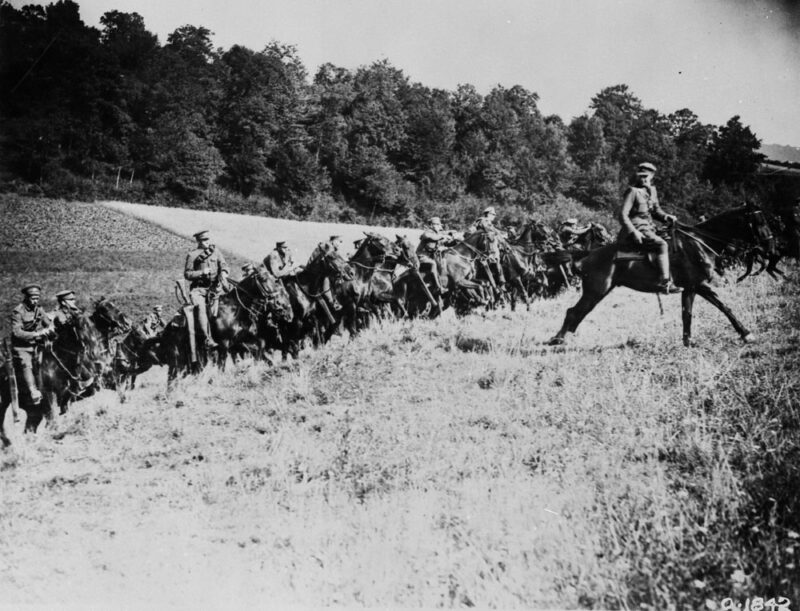
Warrior the horse of Captain Jack Seely during the Great War. Seely and Warrior served throughout the entire war, travelling to France with the British Expeditionary Force (BEF) in 1914 and returning home in the winter of 1918. They survived some of the fiercest fighting of the war, on the Somme and at Ypres. Seely and Warrior led men of the Canadian Cavalry Brigade in the last major cavalry charge of the war, at Moreuil Wood in March 1918.

Casualties were high – a quarter of the men and half the horses were killed. But Warrior escaped unscathed, only to be injured while travelling to his next post. Warrior was dubbed ‘the horse the Germans could not kill’. In 2014, 100 years after the war’s outbreak, Warrior was posthumously awarded an honorary Dickin Medal on behalf of all animals who served in the First World War. The Dickin Medal, sometimes referred to as the ‘animals’ VC‘, was instituted in 1943 to recognise acts of bravery and devotion to duty by animals during periods of war or conflict.

Battle for Moreuil Wood
During the famous Battle for Moreuil Wood on 30 March 1918, Seely realised he had to get a message to the British in Villers-Bretonneux to the left of the wood. He gave identical messages to Prince Antônio and Colonel Young of the Royal Canadian Dragoons. Young galloped off to the west of the village of Hangard while Prince Antônio was to try to reach Villers-Bretonneux direct. The prince had only gone 300 yards when his horse killed beneath him. Seely’s orderly, Corporal King, promptly gave the prince a fresh, fast horse and he elegantly swung himself into the saddle and galloped away. Prince Antônio reached Villers-Bretonneux to deliver his message; Maréchal Foch later awarded the prince the Chevalier of the Légion d’Honneur.

Death of Captain Antoine Philippe MC
Little known of what happened on 26 November 1918. A DH4 numbered F6078 flying from No 1 Aircraft Supply Depot at Marquise in France back to the Central Despatch Pool at Southgate in UK, when they crashed in fog, with fatal results, at Old Soughgate, Middlesex. The pilot was Lt John Harold Whitham, and the passenger was Prince Antônio.

Antônio died three days after he sustained injuries in an air crash at Edmonton, London, 26 November 1918, shortly after the end of the war. His remains placed in the Royal Chapel of Dreux, in France

Inquiry
“The court hearing having duly considered the evidence are of the opinion that the accident occurred through the pilot being unable to see the ground owing to an extremely thick ground mist – apparently through no engine failure but in order to see the ground and find his bearings. The machine was completely wrecked and should be written off as a charge against the public.”

Captain Antoine Braganza Awards
- Military Cross
- 1914-1915 Star
- British War Medal
- Knight Grand Cross of the Order of Carlos III (Spain)
- Knight Grand Cross of the Order of Christ (Portugal)
- Knight Grand Cross of the Order of Merit (Bulgaria)
- Knight Grand Cross of the Order of Pedro I (Brazil)
- Knight Grand Cross of the Order of the Rising Sun (Japan)
- Knight Grand Cross of the Order of the Rose (Brazil)
- Victory Medal
- Chevalier of the Légion d’Honneur
Contact CEFRG


