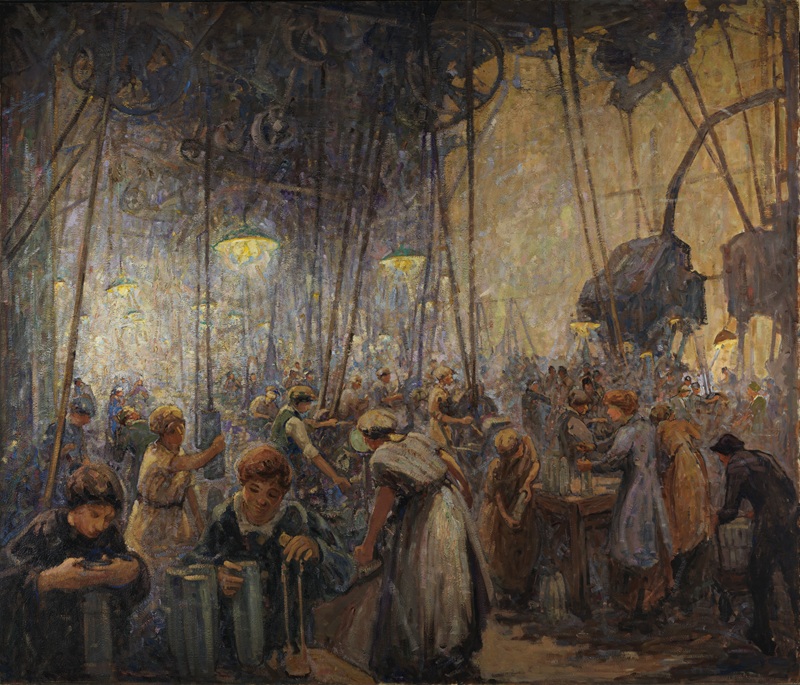
Four women artists commissioned by the Canadian War Memorials Fund to depict female munitions workers. Henrietta Mabel May, Dorothy Stevens, Frances Loring, and Florence Wyle. Founded in 1916, the stated goal of the Fund to provide “suitable Memorials in the form of Tablets, Oil-Paintings, etc. […], to the Canadian Heroes and Heroines in the War.” Expatriates Florence Carlyle and Caroline Armington participated in the program while overseas.
Mabel May
Mabel May invited to paint a home-front composition by Eric Brown, director of the National Gallery. And, an active participant, with Sir Edmund Walker, in the employment of Canadian artists for the Canadian War Memorials Fund. “As you may know,” he wrote, “the Canadian War Records is getting work done in Canada now, and several artists are working on some of the most interesting subjects connected with the war. I have wondered whether you have seen anything of women’s work in munition factories or aeroplane works that has struck you as a good subject for a picture!”

“I remember work of yours which should make such a subject easy and interesting to you, and I should be very glad if you would let me know what you think of the matter or if it was worth while [sic] coming up here about it, to come and discuss the matter any time convenient to you. The way to manage the matter would be to decide on your subject or subjects and their size, which should not be small, six feet or so, and then suggest a price that would cover your studies and the finished picture. I would then formally commission the picture and you would go ahead.”

Munition Workers
Painted by Mabel May in 1919. This painting captures what a female factory worker described as the avenues of clanking, grinding, clashing machines. Mabel May one of four women artists commissioned by the Canadian War Memorials Fund to depict female munitions workers. After visiting a factory in September 1918, May described her experiences as all desperately interesting. Montreal artist Mabel May used an impressionist technique to show women working in a munitions factory. The women in the painting were performing work of an untraditional nature.

The large and atmospheric canvas Women Making Shells by Henrietta Mabel May (1877–1971) depicts a noisy, machine-filled shell factory in Montreal. In 1918, the Canadian War Memorials Fund commissioned a painting of women’s munitions work from May. The organizers obtained permission for her to sketch in the Canadian Pacific Railway Angus shops and the Northern Electric plant.

As she was a prominent member of Montreal’s art scene, known for her industrial landscape and harbour scenes, the subject of women’s wartime labour suited her skills and interests.

Dorothy Stevens
Dorothy Stevens provided her own take on the munitions factory in a series of etchings.


She also depicted shipbuilding, forges and airplane factories in Toronto.

Born in Toronto, Stevens trained at the Slade School in London and the Académie Colarossi in Paris. Before returning home, she made her name as an etcher and painter.

Stevens approached Brown on her own initiative, suggesting a series of prints on home front activities. She was granted the commission in 1918.

The resulting images, such as Munitions – Heavy Shells (1918), show both men and women working with heavy equipment. Their poses and expressions reflect the physical nature of their labour.

Another print, Munitions Fuse Factory (1918), depicts many women working in the close quarters of a factory floor.

Sculptors Frances Loring and Florence Wyle
The sculptures of Frances Loring and Florence Wyle also emphasize the physical labour of the female war worker. The artists — nicknamed “the Girls” — born in the United States and met at the Art Institute of Chicago. They then moved to New York, and finally, to Toronto. They became the centre of an artistic circle that dominated the Canadian art world throughout the 1920s and 1930s.

Eric Brown
Already well-known, Loring and Wyle approached by Brown in 1918 to produce a series of small bronze statues commemorating “the various types of girl war workers.” Fifteen works were produced in all (six by Loring, nine by Wyle), nine of which had women as their subject. Depicted as types rather than individuals, their solid, muscular figures have been called heroic. They are frequently compared to classical Greek statues. The formal poses and serene expressions of the women in Wyle’s Noon Hour (1918–19) and Farm Girl (1918–19), for example, project a sense of stoic grandeur even in a relatively small format. Meanwhile, works such as Loring’s Girls with a Rail (1918–19) and The Shell Finisher (1918–19) emphasize the active physicality of work: fabrics ripple, muscles strain and bodies stretch.

Loring’s and Wyle’s sculptures well received by critics, audiences and other artists alike. In a letter to Wyle, Brown reported on a conversation she had with A.Y. Jackson: “He says you have done a series of bronzes which make him wish to knock down all the statues in Toronto and let you replace them with anything you wish.” May’s and Stevens’ images well received when exhibited in 1919.

Beaux-Arts
Trained in the Beaux-Arts tradition and influenced by modern trends. Frances Loring and Florence Wyle important in the development of sculpture in Canada. Producing many fine works that ranged from portraits to Great War memorials.

Loring preferred to work on a monumental scale. While Wyle typically created smaller pieces that display sensitivity and a fine touch.

For nearly 50 years, they shared a home and studio known as “The Church,” which served as a gathering place for the arts community in Toronto. Leaders in their field, Loring and Wyle were founding members of the Sculptors Society of Canada in 1928.

Florence Carlyle
During the war, Carlyle did hospital work and sold her finest paintings to aid the Red Cross. As well as serving in the Women’s Land Army. She was forced to retire for a rest in 1918 when her health gave out.
After the death of her parents and the sale of the family home in 1912, Carlyle travelled through Italy with her friend Juliet Hastings. The pair eventually settling down in Yew Tree Cottage in East Sussex, England. When war began in 1914, Carlyle volunteered for war work, and regularly contributed paintings to support the war effort.

In the spring of 1918 she was commissioned by the Canadian War Memorials Fund to paint a portrait of Lady Drummond, Assistant War Commissioner of the Red Cross. Carlyle continued to paint throughout the war years, sending some work back to Canada, but a shortage of art supplies and her gradually fading eye sight began to limit her production.

After the war Carlyle remained in England and concentrated more on her writing. With the financial help of Juliet’s father in 1921, Carlyle and Juliet went to Italy and France. She began to have regular bouts of illness, and died of stomach cancer on May 2nd, 1923 in Crowborough, England with Juliet and her sister Maude by her side. Her death widely reported in Canada.
Caroline H. Armington
Caroline H. Armington born on September 11, 1875, in Brampton, Ontario, and passed away on October 25, 1939, in New York City. She began her formal art training at the Académie Julian in Paris, where she met and later married fellow student Frank Milton Armington (1876-1940).

Renowned for her paintings, etchings, and watercolors, Armington depicted the enchanting streets of Paris, the charming canals of Bruges-La-Morte, and various landscapes, all created en plein air. Her artistic style was uniquely shaped by her travels and studies across Europe, while her paintings reflect the influence of French Impressionism, characterized by their airy and sunlit canvases. In contrast, Armington’s etchings and engravings showcase a different artistic approach, as she produced a variety of traditional-style etchings depicting scenes from France, Europe, and North America.

Société Nationale des Beaux-Arts
She exhibited her work multiple times in London and received invitations to the prestigious Paris Salon in 1911 and 1912, as well as the 1935 Salon d’Automne. Armington was also an active member of the American Federation of Arts, the Société Nationale des Beaux-Arts, and the Société de la Gravure Originale en Noir.

A substantial body of her art held in the Peel Art Gallery (Brampton), the Bibliothèque nationale de France, and the British Museum. Caroline’s contributions to Canadian art continue to be celebrated today, with her works regularly featured in exhibitions and academic studies.

During the Great War, the Armingtons served with the American Ambulance Service in Paris (Caroline as a nurse and Frank as an orderly). After the war, Lord Beaverbrook selected two of her solidly constructed prints, depicting the No.8 Canadian General Hospital in Saint-Cloud and the British Army and Navy Leave Club in Paris, for purchase by the Canadian War Memorials Fund.

In 1939, both Armington’s in poor health, and Caroline suffered a heart attack during an air-raid alarm. They decided to leave Europe, arriving in New York, where Caroline died three days later.
Curator Eric Brown of the National Gallery of Canada
In addition to the women of the Canadian War Memorials Fund, Brown also greatly influenced the evolution of Canadian art by befriending, encouraging, and championing other contemporaries such as Thomas John (Tom) Thomson, the members of the Group of Seven, and Emily Carr. Brown’s promotion of his favourites in exhibitions, lectures, and articles sometimes caused tension with the gallery trustees, while artists working in more traditional styles felt marginalized. In 1932 over 100 artists, led by Edmund Wyly Grier (who had been the best man at Brown’s wedding) and reflecting the conservative instincts of the Royal Canadian Academy of Arts, petitioned the government of Richard Bedford Bennett to dismiss Brown.

The effort to dismiss Brown prompted more than 300 other artists, including Alexander Young Jackson, to come to Brown’s defence. Thereafter, his authority unassailable. Friends from the arts world and beyond regularly gathered at their home at 657 Echo Drive, where Brown died after a brief illness, 6 April 1939. He was interred at Beechwood Cemetery, Section 30, Lot TG 118.

Contact CEFRG

